May 9, 2025

Some Thoughts on the Prince Carlo di Borbone Photo “Scandal” and Gennaro De Crescenzo’s “Due Parole Chiare su Borbone e Savoia”

After being repeatedly questioned by my non-monarchist associates about the "scandalous" photo circulating online of Prince Carlo di Borbone and Emanuele Filiberto di Savoia sitting together at the Pope's funeral in Rome, along with Gennaro De Crescenzo's reaction (see below), I can't shake the feeling that their inquiries lack sincerity. It feels more like an attempted gotcha moment when they condescendingly ask, "How do you feel about your 'founding father' abandoning monarchism?" or blithely remark, "Look, your movement isn't truly monarchist, even your Prince isn't fully committed to the cause.”

I don't know Gennaro De Crescenzo personally, so I won't presume to speak on his behalf. However, I have deep respect for him and the selfless dedication he has shown to the Neobourbon movement. His bona fides are, in my view, unsurpassed and beyond reproach. In fact, I credit him, along with the late Riccardo Pazzaglia and the other founding figures of the Movimento Neoborbonico, for introducing me to Neobourbonism back in the early '90s. Before discovering them, I was just a right-wing anarch attempting to traverse the ruins of Western modernity.

The confusion, I believe, stems from the conflation of his Movimento Neoborbonico, which is a cultural organization, with the broader Neobourbon Movement. The latter has become a catch-all name for the manifold Duosiciliano socio-political activists and groups, including we monarchists. When he states that the Movimento Neoborbonico is not monarchist, he is specifically referring to his own group. Apolitical in nature, the Movimento Neoborbonico also doesn’t align with Communist, Jacobin, or Republican ideologies, though its ranks include individuals from a wide array of political backgrounds.

As for the princes being seated together, this is really quite trivial. From what I understand, the Vatican assigns the seating arrangements, so they didn’t choose to sit next to each other. Even if they had, what’s the big deal? We should remember that they are cousins and have even invested each other into their respective dynastic orders. While I firmly support Prince Carlo’s claim to the throne of the Two Sicilies and oppose the Savoy's claim to Italy, I hold no ill feelings toward Prince Emanuele. To me, that photo simply shows two Christian princes honoring the memory of the late Holy Father.

Regarding any doubts about Prince Carlo's commitment to “the cause,” it's undeniable that he, along with his eldest sister, Princess Beatrice di Borbone, and the entire Royal House, are deeply devoted to Southern Italy. While they may not be perfect
, it's clear that their investments and charitable contributions to the region are substantial, and they genuinely care for our people.

We owe the Prince, De Crescenzo, and all our Neobourbon confratelli a debt of gratitude and fidelity for their steadfastness in the face of adversity. We will continue to follow their example and forge ahead. Forza e onore! Viva 'o Rre!

~ By Giovanni di Napoli, May 8th, Feast of the Apparition of the Archangel Michael


Addendum

Due Parole Chiare su Borbone e Savoia

di Gennaro De Crescenzo

Nel 1984, quando furono portati a Santa Chiara Francesco II e Maria Sofia, io c'ero e c'era anche (giovanissimo come me) il principe Carlo di Borbone. E c'eravamo tutti e due dieci anni dopo quando "rivoltammo" Napoli celebrando il ritorno (dopo un secolo e mezzo) dei Borbone a Napoli con una città imbandierata dai neoborbonici per tutta la nottata e tra giornali e televisioni di mezzo mondo. Abbiamo visto anche noi la foto di Carlo di Borbone e di Filiberto di Savoia a Roma per i funerali del Papa e neanche a noi, ovviamente, è piaciuta (soprattutto per la risata inopportuna del sabaudo).

Premesso che i posti erano chiaramente pre-assegnati (capita ormai al cinema da decenni, figuriamoci per un evento di questa importanza), premesso che anche il ramo "spagnolo" era accanto a Filiberto, i due principi si conoscono e si frequentano, inevitabilmente, a Montecarlo e in giro per l'Europa. Ovvio che a noi non sia simpatico l'erede sabaudo soprattutto perché non ha mai chiesto perdono per quello che i suoi antenati hanno fatto ai popoli delle Due Sicilie, non abbiamo capito i suoi progetti recenti con l'acquisto di varie società calcistiche campane e spesso dice una cosa per noi del tutto falsa ("Napoli è una città sabauda"). Il problema, però, è che sono passati oltre 150 anni e (è bene ricordarlo) il principe Borbone non è Francesco II e quello sabaudo non è Vittorio Emanuele II. Chi pensa che siano le stesse persone o è troppo in buona fede o dovrebbe farsi visitare da un ottimo specialista. Stesso schema se qualcuno ha pensato che l'erede borbonico, simbolo vivente della grandezza del nostro passato, avrebbe dovuto (o potuto) salire su un cavallo bianco e ricostruire il Regno dei suoi avi. In questo caso si richiederebbero specialisti e ricoveri a meno che qualcuno non pensi che questa cosa sia stata o sia possibile e in questo caso ci chiediamo (social e post con 4 like a parte) quali accordi diplomatici abbia già chiuso "qualcuno" con l'Italia, l'Europa o l'ONU.

A questo proposito siamo costretti a chiarire una cosa che non pensavamo di dover chiarire a diversi amici (i "nemici" non capiscono o fanno finta di non capire ed è inutile perderci tempo): il Movimento Neoborbonico non è mai stato né sarà mai un movimento monarchico e lo diciamo dal lontano 1993. Il nostro è un movimento culturale e il nome "neoborbonico" (assurdo davvero che si debba ripeterlo) deriva da un mio incontro con il grande e compianto amico Riccardo Pazzaglia al quale sottoposi vari nomi e prevalse quello più provocatorio per sfondare il muro omertoso, ottuso e colpevole dei media e, dopo 30 anni, dopo i risultati raggiunti e dopo che questa categoria "neoborbonica" è diventata ormai sinonimo di orgoglio e di amore per la storia del Sud, la provocazione è stata un successo epocale e senza quella parola noi tutti forse non staremmo qui. Il "neo", del resto, è chiaro e sta ad indicare proprio che dal passato noi puntiamo al futuro (e non ci sembrava così difficile da capire).

"Se per disprezzarci dite che siamo borbonici noi lo rivendichiamo con forza e sempre più fieri dopo studi e ricerche alla luce di quello che i Borbone hanno rappresentato per tutti noi dai famosi primati alla conquista/colonizzazione del 1860": questa la nostra scelta nel 1993 fatta salva una bella parte di persone che si dichiarano monarchiche e (in tempi nei quali in tanti si dichiarano addirittura giacobini o seguaci delle ideologie del Novecento) si tratta di persone degne di tutto il nostro sacro e quotidiano rispetto anche per i valori cristiani che con quegli ideali vengono trasmessi da secoli.

Molti di quelli che oggi si indignano per quella foto, però, a quei tempi non erano nati o non sapevano neanche chi fossero i Borbone e senza di noi forse oggi starebbero in 4 a parlare di queste cose o starebbero ancora gridando vivalitalia... Dove eravate mentre i neoborbonici e Carlo di Borbone subivano gli assalti con le pietre di anarchici e comunisti a Battipaglia o ad Avellino? Dove eravate quando due politicanti presentarono due interrogazioni parlamentari "preoccupati da un Borbone che gira per l'Italia ad abbracciare migliaia di persone entusiaste tra migliaia di bandiere"? Dove eravate mentre noi perdevamo anni e anni in giro per gli archivi a ricercare le verità storiche e per le scuole a divulgarle? Dove eravate mentre "convincevamo" le autorità a non sequestrare le nostre bandiere allo stadio dopo che per primi e con le collette le avevamo diffuse lì e altrove come non era mai capitato prima (ed è capitato anche per l'ultima partita a Napoli)?

In questi anni ricordo decine e decine di manifestazioni con la presenza di Carlo di Borbone (sempre assenti gli altri "rami", "presenti" solo da qualche anno e da quando dirsi "borbonici" è, grazie a noi, più facile e più "conveniente"). Ricordo, da parte del principe, centinaia di dichiarazioni a favore della verità storica e contro Savoia&Risorgimento e anche di borse di studio o di beneficenze negli ospedali e nelle parrocchie di Napoli e del Sud. Se tutti noi oggi parliamo di questi temi e siamo in tanti, in tantissimi (anche con altri movimenti), è anche grazie alla presenza e alle parole di Carlo di Borbone che (con tutta la stima per noi e per voi) ha sempre e giustamente avuto una risonanza internazionale che noi e voi non avremmo avuto. Per circa 30 anni è stato così e da circa 30 anni ci lega un affetto vero e anche personale verso il principe e i rappresentanti della Casa Reale ma è chiaro che se i progetti della Casa Reale Borbone Due Sicilie, del principe e delle principesse saranno in futuro diversi, noi andremo avanti lo stesso come abbiamo sempre fatto, da volontari "a perdere" h24 e da 32 anni. Continueremo ad andare avanti sulla nostra strada, con la serenità, la passione e l'impegno disinteressato e costante di sempre, tra Memoria, Orgoglio e, prima o poi, Riscatto.

Grazie a tutti. Un abbraccio a tutti.

Meridiunalata: "Aria" by Cav. Charles Sant’Elia

Reprinted from Cav. Charles Sant'Elia's Meridiunalata / Southernade, an evocative bilingual collection of poetry written in Neapolitan and translated to English between 1989 and 2010.*

Aria

Give me this fine and hot air,
Give me this dream
Of noonday,
Your darkest eyes islands.

Give me this cool thought,
Give this melancholy
All about,
Your wet and salty hair.

Arietta

Rammella chest’aria fina e cávera,
Rammillo chistu suonno
‘E miezujuorno,
Ísole l’uocchie tuoje scure scure.

Rammillo chistu penziero frisco,
Rammella chest’appecundría
A tuttepizze,
‘E capille tuoje nfuse e salate.

* Self-published in 2010, Meridiunalata / Southernade is a treasury of poems gleaned from Cav. Sant'Elia's previous collections (Nchiuso dint''o presente, 'A cuntrora, and 'O pino e l'éllera), which were circulated among friends in New York City and Naples. Special thanks to Cav. Sant'Elia for allowing us to reprint his poetry and translations.

L'industria a Napoli tra Ottocento e Novecento

In Napoli

May 8, 2025

Habemus Papam Leone XIV

Let us pray for our new Holy Father, Pope Leo XIV. May he be a holy and wise successor of the Apostle Peter and lead the Church back to tradition and orthodoxy. God bless him and his pontificate. Viva il Papa!

Calabrian Verses for the Occurrences of 1898 in Milan

Illustration of the Bava Beccaris Massacre
for Le Petit Journal, 22 May 1898
Submitted by Cav. Charles Sant'Elia

After the unification of Italy through the late 1800s, Italy underwent a tumultuous period marked by profound political, social, and economic changes, from North to South. A well-known event was the so-called “Stomach Protest” of 7 May 1898 in Milan, which represents one of the most tragic and significant episodes of the era. The combination of difficult economic times, shortages, and social tensions led to a series of popular revolts, which culminated in the brutal repression orchestrated by General Fiorenzo Bava-Beccaris, who formerly served in the Piedmontese army in the Crimean War and the Risorgimento. On 7 May 1898, many Milanese crowds of protestors were fired upon by the army. The news quickly went around Europe and the world, reaching the small town of San Fili, in the province of Cosenza, Calabria. The local priest Don Giovanni Gentile, known as Chiacchiara, was moved to write verse in his native Calabrian dialect and publicly denounce a murderous and unjust government. This took true courage in the wake of the brutal repression inflicted on the rebels and fighters in Calabria and the South who were killed by thousands, including women and children, after being dismissed as “brigands” and criminals, often under summary field executions under the Legge Pica, and which continued in an intolerant and punishing posture beyond 1900. This economic downturn, coupled with repressive violence and incarceration, fueled the great emigration from Italy.

Over the centuries, San Fili has experienced its share of upheavals, particularly during the unification of Italy. The townspeople witnessed contracts awarded to politically connected firms, employing workers from outside the area to initially construct a railroad to San Fili. Later, the Ferrovie dello Stato decided to shut down the railroad, effectively removing San Fili from the railway network altogether. This occurred during periods when numerous unemployed young people were emigrating to the United States, Canada, and Argentina, and more recently, to Germany. San Fili remained proudly monarchist through the 1940s and, in fact, voted against the Republic in the referendum of 1946. Many oldtimers remarked over the years how one was better off under the Bourbons. The well-known Cardinal Fabrizio Ruffo, who led the Sanfedisti army, raised largely from Calabrian volunteers, against the revolutionary French invading army in 1799, was born in San Lucido, which borders San Fili, Rende, and Paola. Despite San Fili’s monarchist and Catholic ways, it even had some “republicans” and profiteers who attempted to fire upon Cardinal Ruffo during fighting on 6 March 1799 in the Crati Valley, striking his cross. The few criminals were arrested and subdued by the Sanfedisti. During the upheavals, groups from Falconara who had been at odds with the Sanfilesi took the occasion to invade San Fili and violent battles ensued, with the people of neighboring Bucita joining in to defend San Fili. San Fili had its share of carbonari sectarians as well, such as Santo Cesario, who was executed with the famous Bandiera brothers in the Rovito valley in 1844 when they attempted an invasion of the Two Sicilies with other foreign volunteers hoping to foment an insurrection. Sadly, these young idealists would be horrified to see the intentional destruction of half of Italy, which led to millions “voting with their feet”.

San Fili, a baronial town replete with seven churches, including one going back to 1304 and one in the area where Joachim of Fiore preached, was once a center of silk (five mills) and copper production as well as agriculture and yet after the unification of Italy, it found itself relegated to poverty and a loss of its centuries old commerce. Many townsmen died in the First and Second World Wars, and chain migration decimated the population. Nonetheless, this small town produced tough and resilient people and many notable and accomplished people, including Vincenzo Miceli (1858-1928) professor of constitutional law and his brother Alfonso Miceli (1855-1940) president of the Court of Appeals of Naples, and Baron Marcello Miceli, Gentleman of His Holiness Paul VI, John Paul I, and John Paul II, cavaliere di grazia e devozione SMOM.

The poem Pane! written by Don Giovanni Gentile alias Chiacchiara was published in a collection in 1904.

Pane!

Don Giovanni Gentile, alias Chiacchiara


Mentre l’uomini povari e dijuni

Vaû ppe’ le vie gridannu: «Pane! Pane!…» 

Lu Guvernu ce manna battagliuni

E li tratta cchijù pieju de ‘nu cane.


Sparanu sti surdati a li truppuni

E faû ‘na chianca de le carne umane,

Ammazzanu le mamme e li guagliuni: 

Ma “Pane!” torna si grida dumane.


Cari Ministri latri e sprigugnati,

Dintra la crozza cchi cosa ci aviti?

Ccu paddre nun si saziû l’affamati…


Vui stati franchi, mangiati e viviti?

Ma si pue ni vidimu disperati,

Vi facimu la peddra a quantu siti.


Bread!

Don Giovanni Gentile, alias Chiacchiara


While poor and starving men

Go through the streets shouting: «Bread! Bread!…» 

The Government sends them battalions

And treats them worse than dogs.


These soldiers shoot at the crowds

And make a butchery of human flesh,

They kill mothers and children: 

But “Bread!” they continue to shout tomorrow.


Dear shameless thieving Ministers,

What have you got in your noggins?

You don’t satisfy the hungry with bullets…


You’re all set, you eat and drink?

But if then we find ourselves desperate,

We’ll get you all as many as you are.

May 7, 2025

Brief Excerpts from ”Meditations on Hunting” by José Ortega y Gasset

In our time—which is a rather stupid time—hunting is not considered a serious matter. It is thought that enough has been said on the subject by calling it a diversion, presupposing, of course, that diversion, as such, is not a serious matter. Yet serious examination should lead us to realize how distasteful existence in the universe must be for a creature—man, for example—who finds it essential to divert himself. To divert oneself is to separate oneself temporarily from what one usually is, to change for a while our usual personality for another which is more arbitrary, to attempt to escape for a moment from our real world to others which are not ours. [p.19]

* * *

The fact is that for almost all men the major part of life consists of obligatory occupations, chores which they would never do out of choice. Since this fate is so ancient and so constant, it would seem that man should have learned to adapt himself to it and consequently to find it charming. But he does not seem to have done so. Although the constancy of the annoyance has hardened us a little, these occupations imposed by necessity continue to be difficult. They weigh upon our existence, mangling it, crushing it. In English such tasks are called "jobs"; in the Romance languages the terms for them derive from the Latin word trepalitum, which originally meant a terrible torture. And what most torments us about work is that by filling up our time it seems to take it from us; in other words, life used for work does not seem to us to be really ours, which it should be, but on the contrary seems the annihilation of our real existence. We try to encourage ourselves with secondary reflections that attempt to ennoble work in our eyes and to construct for it a kind of hagiographic legend, [1] but deep down inside of us there is something irrepressible always functioning, which never abandons protest and which confirms the terrible curse of Genesis. [2] Hence the bad feeling we usually inject into the term "occupation." When someone tells us that he is "very occupied" he is usually giving us to understand that his real life is being held in suspension, as if foreign realities had invaded his world and left him without a home. This is true to such an extent that the man who works does so with the more or less vague hope of one day winning through work the liberation of his life, of being able in time to stop working and... to start really living. [pp.24-25]


* * *

Argue, fight as much as you like, over who should be the privileged ones, but do not pretend that squares are round and that hunting is not a privilege. What happens here is just what has happened with many other things. For two hundred years Western man has been fighting to eliminate privilege, which is stupid, because in certain orders privilege is inevitable and its existence does not depend on human will. It is to be hoped that the West will dedicate the next two centuries to fighting—there is no hope for a suspension of its innate pugnacity—to fighting, I say, for something less stupid, more attainable, and not at all extraordinary, such as a better selection of privileged persons.


In periods of an opposite nature, which were not revolutionary and in which, avoiding false utopias, people relied on things as they really were, not only was hunting a privilege respected by all, but those on the bottom demanded it of those on top, because they saw in hunt-ing, especially in its superior forms—the chase, falconry, and the battue [3]—a vigorous discipline and an opportunity to show courage, endurance, and skill, which are the attributes of the genuinely powerful person. Once a crown prince who had grown up in Rome went to occupy the Persian throne. Very soon he had to abdicate because the Persians could not accept a monarch who did not like hunting, a traditional and almost titular occupation of Persian gentlemen. The young man, apparently, had become interested in literature and was beyond hope. [pp.30-31]


Notes:

[1] The consecration of work, its positive interpretation, was one of the great new themes characteristic of the Renaissance, on which even the greatest antagonists—for example, Saint Ignatius of Loyola and Luther—are agreed. Work has been the "modern" virtue par excellence, the bourgeois virtue.

[2] "In the sweat of thy face shalt thou eat bread" (Genesis 3:19).—Trans.

[3] Practice of beating woods to drive the game from cover.Trans.


* Reprinted from Meditations on Hunting by José Ortega y Gasset, translated by Howard B. Wescott, Charles Scribner’s Sons, New York, 1985

New Book — The Virgins of the Rocks

A new title that may be of interest to our readers. Available at Amazon.com


The Virgins of the Rocks by Gabriele D'Annunzio (Translated by Agatha Hughes)

Publisher: Anson Street Press
Publication Date: March 29, 2025
Hardback: $30.95
Paperback: $8.09
Kindle: $0.99
Language: English
Pages: 126

Read description

Click here to see more books

Listing does not imply any endorsement

May 6, 2025

Photo of the Week: Silver Sculpture of the Madonna dell’Assunta, Reale Cappella del Tesoro di San Gennaro

Silver Sculpture of the Madonna dell’Assunta in the Reale Cappella del Tesoro di San Gennaro, Cathedral of the Assumption of Mary (Cattedrale di Santa Maria Assunta), commonly known as the Cathedral of St. Januarius (Cattedrale di San Gennaro), Napoli, Campania. Photo courtesy of Patrick O’Boyle

Dieci Tesori Calabresi

In Diamante

May 4, 2025

Sargent and Paris at the Metropolitan Museum of Art

Capri Girl on a Rooftop, 1878, oil on canvas

After a long week filled with unavoidable doomscrolling, annoying speculation about the upcoming Papal conclave, and everyday interactions with the insufferable denizens of Gotham, visiting the ongoing exhibit Sargent and Paris at the Metropolitan Museum of Art in New York City was exactly what I needed to lift my spirits. Exploring the enchanting early works of painter John Singer Sargent (1856–1925), the exhibition presents a rich array of pieces from his travels and the decade he spent in Paris, including his scandalous portrait of Virginie Amélie Avegno Gautreau, famously referred to as Madame X.

Rosina Ferrara (Capri Peasant - Study), 1879, oil on canvas
(L) Dan les Oliviers à Capri (Among the Olive Trees, Capri), 1878, oil
on canvas. (R) Young Man in Reverie, ca. 1876-78, oil on canvas

Neapolitan Children Bathing, 1879, oil on canvas
(L) Staircase in Capri, 1878, oil on canvas. (R) Fumée d'Ambre Gris
(Smoke of Ambergris)
1880, oil on canvas
The Daughters of Edward Darley Boit (Portraits d'enfants), 1882, oil on canvas
(L) Madame X (Virginie Amélie Avegno Gautreau), oil on canvas, 1883-84.
(R) Unfinished Replica (Study of Mme Gautreau), ca. 1884, oil on canvas
(L) "Portrait of Mme***" from Le Monde Illustré, July 5, 1884, woodcut, Charles Baude (French, 1853-1935), after John Singer Sargent. (R) Photograph of "Madame X," from Album of Photographic Reproductions of Paintings by John Singer Sargent, ca. 1884-85, Albumen silver print, unknown artist
Madame Gautreau Drinking a Toast, 1882-83, oil on panel
Virginie Amelie Avegno Gautreau, Study for "Madame X,"
1883-84, charcoal on paper
(L) La Carmencita (Carmen Dauset Moreno), ca. 1890,
oil on canvas. (R) The Sulphur Match, 1882, oil on canvas
Venetian Interior, ca.1880-82, oil on canvas
The Fencing Master Arséne Vigeant (1844-1916), 1885, oil on canvas
In no rush to leave, I took the opportunity to view the Caspar David Friedrich: The Soul of Nature exhibit one more time before it closes on May 11, 2025.

Wanderer Above the Sea of Fog, c.1818, oil on canvas; and The Chasseur
in the Forest
, 1814, oil on canvas, by Caspar David Friedrich
A Walk at Dusk, 1830-1835, oil on canvas, Caspar David Friedrich

May 2, 2025

Review — The Lions of Sicily on Hulu

In my recent review of M. Il figlio del secolo, I noted my regret at not watching The Lions of Sicily (I leoni di Sicilia) instead. However, despite my strong dislike for M, it turns out that it was the better option. I found The Lions of Sicily so disappointing that I couldn’t even get past the first episode.

Released on Disney+ on October 25, 2023, this historical drama is adapted from Stefania Auci's 2019 novel about the Florio family. Utterly bored with the show’s lack of depth and character development, I found the overly simplistic depiction of class conflict and the trials and tribulations of the merchant class and the nouveau riche in nineteenth-century Sicily uncompelling.

The performances fell flat, and the choice of using modern pop music for the soundtrack was ill-advised. Unfortunately, even the exquisite period costumes and stunning Sicilian backdrop couldn’t redeem the show. In hindsight, its association with Disney should have raised a red flag for me.

May 1, 2025

New Book — In Morte Degli Italiani

A new title that may be of interest to our readers. Available at www.idrovolanteedizioni.com


In Morte Degli Italiani by Gianandrea de Antonellis

Publisher: Idrovolante Edizioni
Publication Date: 12/11/2024
Paperback: € 16.15
Language: Italian
Pages: 250

Read description

Click here to see more books

Listing does not imply any endorsement

April 28, 2025

Review — M. Il figlio del secolo

Spoiler Alert!!!
"In its political praxis [fascism] uses liberal ways, democratic means, and even socialist practices." ~ Alfredo Rocco, The Political Doctrine of Fascism
Having recently reviewed Babylon Berlin and The Leopard, I decided to give it another go and binge-watch all eight episodes of director Joe Wright's adaptation of Antonio Scurati's 2018 novel, M. Il figlio del secolo (Mussolini: Son of the Century). While I can't comment on its faithfulness to the source material since I haven't read the book, the series struck me as excessively melodramatic, overly simplistic, and overtly propagandistic. Set during the rise of fascist dictator Benito Mussolini in 1920s Italy, what could have been a compelling historical drama instead turned into an absurd dark comedy. While I expected a hatchet job on one of the 20th century's most notorious figures, I did not anticipate anything this farcical. Initially torn between watching M or The Lions of Sicily (2023), which recounts the fascinating story of the Florio family in the 1800s, I now find myself regretting my decision.

Saturated with graphic violence and gore, the action sequences evoke the comic-book-inspired visuals seen in the films Sin City (2005) and 300 (2006). The episodes are so visually unsettling that each one begins with a cautionary warning stating, “Some scenes contain strobing or persistent flashing light imagery that may affect viewers with photosensitivity.” Adding to the discordant imagery, the score features jarring electronic music composed by Tom Rowlands, known for his work with The Chemical Brothers. This noise would surely be music to the ears of Futurist maestros Luigi Russolo and Filippo Tommaso Marinetti. One particularly questionable artistic choice was the inclusion of Elvis Presley’s Can’t Help Falling in Love during a harrowing montage of squadristi violence.

As always, socialists are depicted as oppressed victims, bullied and beaten by fascist thugs, while their own transgressions are conveniently overlooked. Although I understand why Leftists project their own criminal and violent proclivities, adopting a victim mentality, I find it puzzling that they also exhibit a Freudian psychosexual fascination with their fascist counterparts. This fixation is evident in the entertainment industry’s perverse obsession with the aesthetics, violence, and brutality often associated with fascism, as seen in the Nazisploitation films Ilsa, She Wolf of the SS (1975) starring Dyanne Thorne, and Pier Paolo Pasolini’s cult classic Salò (1975), which draws inspiration from the Marquis de Sade's depraved novel The 120 Days of Sodom (1785).
Clearly taking "creative license" with the facts, the show often injects ahistorical childish humor aimed at an ill-informed and unsophisticated modern audience. For instance, one fascist rally leading up to the March on Rome in 1922 resembled an old New York City hardcore show with Mussolini stage-diving and crowd-surfing over a throng of slam dancing Blackshirts shouting Eja Eja Alalà!, the famous war cry of the heroic warrior-poet Gabriele D’Annunzio.

Nothing was exempt from mockery. Even the origin of the so-called Roman salute was ridiculed. M would have us believe that il Duce introduced the iconic stiff-arm salute to spare himself further humiliation after a socialist senator jerked his hand away during what was intended to be a "friendly" handshake following the treaty signing between their parties.
Psych! And the Roman salute was born
Another notably cringeworthy moment arises when Mussolini breaks the fourth wall to declare, “Make Italy great again.” In a blatant attempt to interject modern politics, they falsely liken President Trump to the Italian dictator. Trump may be a lot of things, but he’s no fascist. This raises the rhetorical question: Does this tactic of branding anyone you don’t like a fascist even work anymore?

I have little good to say about M. Il figlio del secolo. Although Luca Marinelli (Mussolini), Barbara Chichiarelli (Margherita Grassini), and the rest of the cast all looked the part, they portrayed almost everyone as violent, mentally ill deviants. Dark and grainy, it was difficult to fully appreciate the stunning sets and incomparable landscapes of Il Belle Paese. While the costumes and uniforms were fun to see—I almost wish the fez would make a comeback—I was particularly taken with the scene in the empty Teatro di San Carlo in Naples, where the tragic geisha Cio-Cio-San nervously performed Un bel dì, vedremo, the famous aria from Giacomo Puccini’s opera Madama Butterfly for Mussolini. The palatial grandeur of the theatre and the bedizened soprano in oshiroi and kimono were magnificent. Otherwise, there is little else worth getting excited about.

~ By Giovanni di Napoli, April 27, Feast of Our Lady of Montserrat

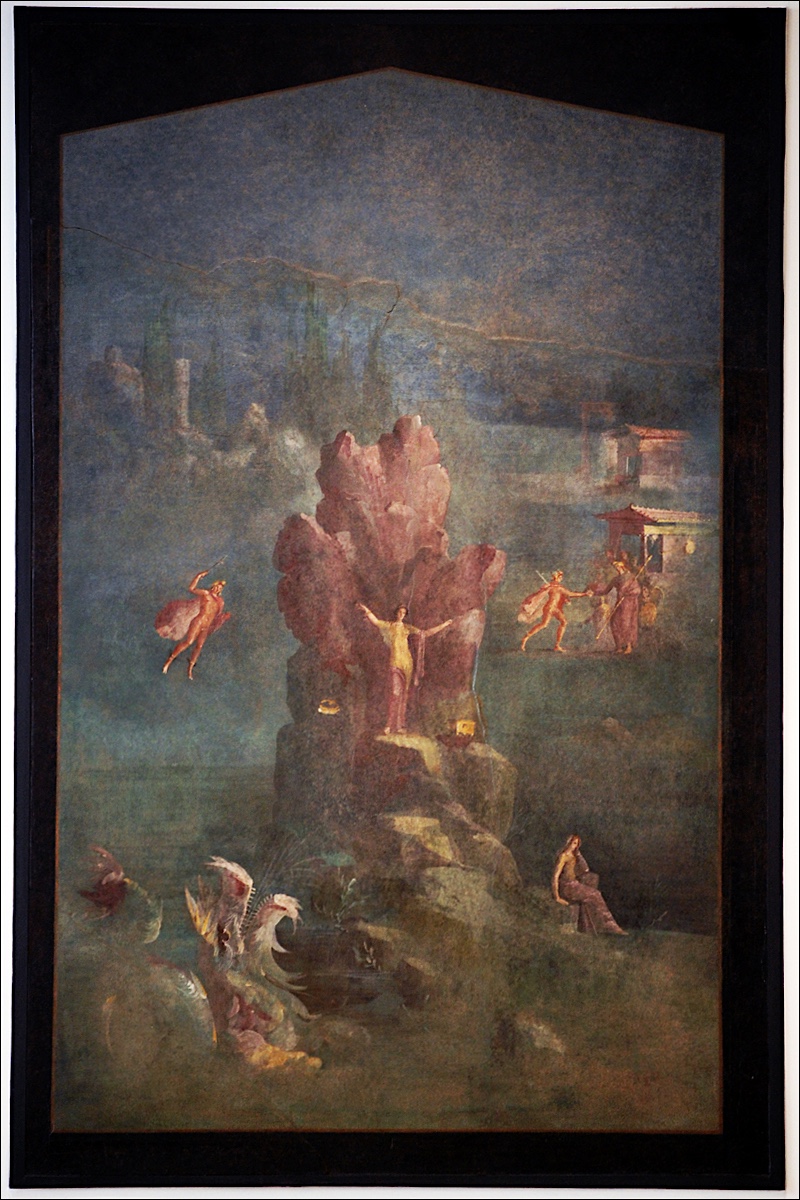
Photo of the Week: Perseus and Andromeda in a Landscape, from the Imperial Villa at Boscotrecase

Wall painting from the villa of Agrippa Postumus at Boscotrecase, the Mythological Room, Roman, last decade of the 1st century B.C., Metropolitan Museum of Art (Photo by New York Scugnizzo)

New Kindle Edition — National Archeological Museum, Naples, Italy: A Book of Photographs

A new title that may be of interest to our readers. Available at Amazon.com

National Archeological Museum, Naples, Italy: A Book of Photographs by Nicholas Taylor

Publisher: N/A
Publication Date: April 21, 2025
Kindle: $ 2.99
Language: English
File size: 18.1 MB

Read description

Click here to see more books

Listing does not imply any endorsement

April 26, 2025

Feast of Santa Franca Visalta

Santa Franca Visalta, ora pro nobis
April 26th is the Feast of Santa Franca Visalta, also known as Franca of Piacenza (1170-1218), Virgin, Abbess, and Foundress of a Cistercian Convent. She is invoked against eye disorders and nightmares.

In celebration, we’re posting a prayer to Saint Franca Visalta. The accompanying photo comes courtesy of Father Eugene Carrella. The holy card is part of Father Carrella’s impressive collection of religious artifacts. Evviva Santa Franca Visalta!

Prayer to Saint Franca Visalta

O St. Franca of Piacenza (Franca Visalta), abbess, humble servant of God, who found true peace in solitude and prayer, intercede for us before the Lord. Help us seek unity and spiritual strength in times of tribulation, and guide us with your wisdom to the heart of the Holy Trinity. Amen.

Moving Past the Francis Pontificate

The Throne of St. Peter by Gian Lorenzo Bernini,
St. Peter's Basilica, Vatican City (Photo by New York Scugnizzo)
It seems I upset a few people by posting a prayer for Pope Francis in light of his passing. As a traditionalist who attends the Latin Mass and has faced my fair share of disappointments regarding his divisive and often controversial papacy, I can empathize with their sentiments. However, as Catholics, we are called to pray for the salvation of his soul. This should not be construed as a condonation of his heterodox pontificate or the harm that has befallen Holy Mother Church during his time as Pope. Detached and without acrimony, let’s move past the Francis papacy and pray for the upcoming Papal Conclave and hope we get a holy and wise successor on the Throne of St. Peter.