|
| Grazie mille Andrew Giordano for sharing your wonderful photo of Gli Occhi di San Gennaro (The Eyes of San Gennaro) carved by Lello Esposito, Renaissance Naples Hotel Mediterraneo, Napoli |
September 19, 2016
Photo of the Week: Gli Occhi di San Gennaro

September 17, 2016
Ponderable Quote From “An Armchair Traveller’s History of Apulia” by Desmond Seward and Susan Mountgarret

On 13 February 1861, King Francis sailed into exile. Gaeta, his last stronghold, surrendered to the Piedmontese besiegers and the Borbone army was disbanded. It was the end of the seven hundred year old Regno.
The Piedmontese tried to win over the Borbone officers, giving over 2,000 of them commissions in the new Italian army or paying pensions to those who preferred to retire, but in March Constantino Nigra, a senior Piedmontese official at Naples, reported they were angry and resentful. As for the other ranks, “we have a horde of Borbone soldiers, disbanded without work or food, who will take to the mountains when spring comes.” He adds that the clergy are hostile and the aristocracy “in mourning for the Borboni.” Farini, governor of ‘The Neapolitan Provinces’, openly admitted that not even a hundred Southerners wanted a united Italy.
Even if the Southern leaders who now emerged were peasants and sometimes criminals, what the Piedmontese called ‘The Brigands’ War’ was none the less a genuine civil war. For a decade 120,000 Piedmontese troops were needed to hold down Southern Italy. Between April 1861 and April 1863 nearly 2,500 “brigands” were killed in combat, over 1,000 shot after surrendering and another 5,500 taken prisoner. These figures are for the Mezzogiorno as a whole – no breakdown is available for Apulia alone – and does not include casualties among the handful of die-hards who went on fighting.
Some of the leaders were former Borbone NCOs, discharged without pensions unlike their officers. Their sole hope was Francis II’s return and they were fighting for his restoration. Large numbers took an oath of loyalty to him, some men continuing to wear the Borbone army’s blue tunic and red trousers, others using as a badge a silver piastre coin with the king’s head. Afraid of losing their pensions, Borbone officers dared not join them openly, but instead organised committees at Trieste, Marseilles and Malta to smuggle guns. Money and more guns came from Rome, where King Francis had established a government in exile, since the Two Sicilies was still recognised by the Papacy and Austria. Papal officials turned a blind eye to gun-running over their frontier and frequently gave shelter to brigands who were pursued by Piedmontese troops.
Bases were set up in the hills or in the Apulian ravines, where self-appointed leaders recruited ex-soldiers returning penniless to their villages. Mounted and flying the Borbone flag, they ambushed enemy troops or, after cutting the telegraph wires, galloped into isolated cities to shoot the sindaco and his officials. They were aided by landowners and former Borbone officials, by priests and peasants. In the opinion of the Peasants, Hare noted, “brigands were always poveretti [poor things], to be pitied and sympathised with.”
* Quoted from “The Brigands’ War”, a selection from An Armchair Traveller’s History of Apulia by Desmond Seward and Susan Mountgarret, Haus Publishing, 2009, p. 287-288
Also see: A Look at “Old Puglia”
September 16, 2016
The Warrior Prelate: Cardinal Fabrizio Ruffo
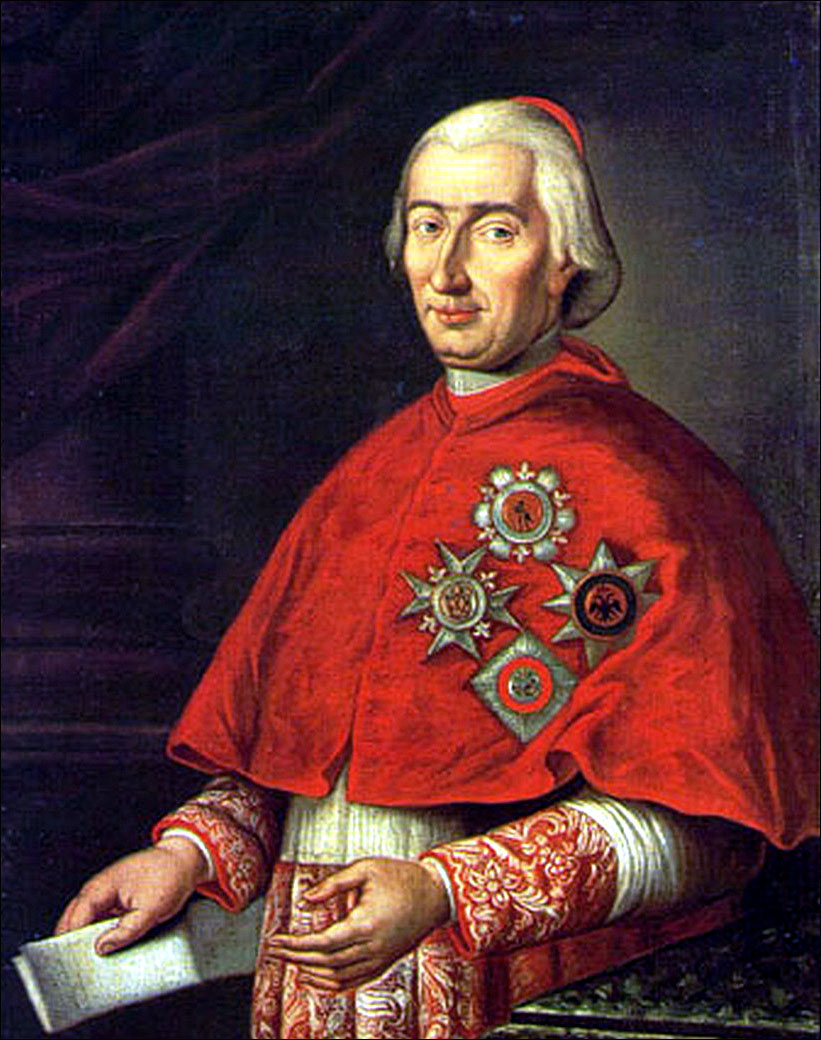 |
| Cardinal Fabrizio Ruffo b. Sept. 16, 1744—d. Dec. 13, 1827 |
Today we remember and honor the great counter-revolutionary hero Cardinal Fabrizio Ruffo, the warrior prelate who liberated the Kingdom of Naples from Franco-Jacobin tyranny.
When Napoleon’s Grande Armée invaded the Kingdom of Naples in December 1798 and installed the Jacobin satellite state (Repubblica Partenopea), Ruffo followed the Bourbon Royal Family to Palermo, Sicily. Named vicar-general on January 25th, 1799, the grey-haired Cardinal crossed the Strait of Messina to his native Calabria with just seven companions to recapture the Kingdom.
On February 8th they landed at Punta del Mezzo in Reggio, Calabria. Armed with only a banner emblazoned with the royal coat-of-arms and a cross, Ruffo began to raise an army. Issuing an encyclical letter commanding the clergy and magistrates to preach the crusade, men from all walks of life readily rallied to defend their faith and traditions, and to restore their legitimate rulers, King Ferdinand IV and Queen Maria Carolina. In less than a month 17,000 Calabrese, including many soldiers from the disbanded Bourbon army, joined the burgeoning ranks of his Royal Christian Army of the Holy Faith (Sanfedisti).
After recovering the whole of Calabria, Ruffo marched on Naples. Propped up with bayonets, the widely unpopular Parthenopean Republic fell like a house of cards when the French retreated north. Ruffo guaranteed the Jacobin ringleaders safe passage to France if they surrendered, but his clemency was overruled by the Royal Family. To his chagrin, the revolutionaries were put on trial and sentenced to death.
Considering the hardships and privations the Jacobin treachery brought with it, one should not be surprised that chaos ensued and old scores were being settled after the withdrawal of the French invaders. Collaborators were punished and the atrocities and brutality of the Franco-Jacobin regime was met in kind, however the retaliation was nowhere near the horrific scale of the "enlightened" Republic.
As many as sixty thousand civilians were killed in the French conquest. Ten thousand Neapolitans died in bloody street fights defending their King and city. Entire towns were razed and the wholesale rape and slaughter of the populace ensued. Faithful Andria was sacked and burned, with as many as four thousand citizens slaughtered. Steadfast in their loyalty, Trani, Ceglie and Carbonara shared Andria’s unfortunate fate.
 |
| Cardinal Fabrizio Ruffo leading the Sanfedisti, protected by St. Anthony |
“It is incontestable that Ruffo’s Calabrians were vindictive,” wrote Acton:
Their pugnacity made up for their lack of discipline. But in the course of his campaign it was the cruelties and excesses of the ‘gentle patriots’ that provoked reprisals, a fact overlooked by hostile historians. After this outrage the republicans could hardly expect to be left off lightly.[1]
So when hostile historians claim the Bourbon restoration was a “reign of terror” because a mere 99 traitors were executed for their crimes, they are being more than a little ingenuous. Knowing what we do now, we lament that a few more traitorous skulls weren’t cracked.
On June 13, 1799, the Feast Day of St. Anthony of Padua, Ruffo and the Coalition allies (Britain, Russia, etc.) liberated Naples and restored the Bourbons to the throne. Losing favor with the Royal Family for showing too much leniency towards the Republicans, the warrior prelate resigned his command to the Prince of Cassero.
When Napoleon retook the Kingdom in 1806, Ruffo surprisingly chose to remain in Naples. For the next decade he lived quietly and unmolested by the French. With Napoleon’s downfall and the subsequent restoration of the Bourbons, the Cardinal was once again received with favor by King Ferdinand. He served as a minister until the death of Pope Pius VII, Servant of God, on August 20, 1823. Leaving for Rome, Ruffo participated in the conclave that elected Pope Leo XII. At the end of 1823 he returned to Naples and resumed his position as the King's trusted advisor and confidant.
Cardinal Fabrizio Ruffo died on December 13, 1827 in Naples. He is interred in his family’s chapel inside the Basilica San Domenico Maggiore. His Eminence lives on in our hearts, his heroic deeds and indomitable spirit even now provide inspiration in our troubled times. Forza e onore!
~ Giovanni di Napoli, Sept. 14, Feast of the Exaltation of the Holy Cross
[1] The Bourbons of Naples (1734-1825) by Harold Acton, Methuen and Co. LTD, 1957, p.377
September 15, 2016
Evviva Maria! A Look at the 9th Annual Festa della Madonna Addolorata in Bensonhurst, Brooklyn
 |
Evviva Maria!
Photos by New York Scugnizzo
|
Thank you President Lucrezia Nardulli and all members of Associazione Culturale Pugliese Figli Maria SS. Addolorata for making Sunday's (Sept. 11th) Festa della Madonna Addolorata at St. Athanasius Church in Bensonhurst, Brooklyn a huge success. As always, it was a great pleasure and honor to celebrate our faith and culture with you. Evviva Maria!
 |
| The statue is carried from the sanctuary out to the expectant crowd |
 |
| (Right) Excitement in the air as the Madonna approaches. (Left) This year's Grand Marshals, Bruno & Bernadette Codispoti, with 2015 Grand Marshals, Stephen & Lucia La Rocca |
 |
| Festivities kicked off with a moving rendition of Ave Maria & the National Anthem |
 |
| Members gather outside the church |
 |
| Participants release the balloons |
 |
| Black and gold balloons soar to the heavens |
 |
| An explosion of confetti greets the Madonna outside the Church |
 |
| Members pose for a picture before the procession |
 |
| The color guard lead the way |
 |
| This year's Regina, Vittoria Cirigliano, and her court |
 |
| (Left) Devotees wear scapulars depicting the Seven Sorrows (Right) Children dress up like the Blessed Mother |
 |
| Members sing hymns and pray |
 |
| (Above & below) Sharply dressed lifters proudly carry the Madonna |
 |
| (Above & below) It's an honor and a privilege to carry the statue |
 |
| (Right) Joseph Nardulli was kind enough to give up one of his turns so I can carry the Sorrowful Mother |
 |
| The procession saunters through the neighborhood |
 |
| Outdoor shrines were set up along the procession's route |
 |
| The Metropolitan Festival Band |
 |
| After a couple of hours, we return to St. Athanasius Church |
 |
| (Left) JoAnn Marinelli, Lucrezia Nardulli and Josephine DiDonna. (Right) Decked out in their destinctive blue mantles, the Knights of the Sacred Military Constantinian Order of St. George partook in the entrance procession |
 |
| After Mass, Msgr. Cassato offered a benediction by the outdoor 9/11 memorial |
 |
| After the benediction, partygoers continued the celebration in the auditorium |
 |
| Bernadette and Bruno were honored during the award ceremony |
 |
| Revelers trip the light fantastic |
September 14, 2016

September 13, 2016
Photo of the Week: A View of Monte Vesuvio from Cantina del Vesuvio, Napoli
 |
| A view of Mount Vesuvius from Cantina del Vesuvio, a picturesque winery situated on the slopes of the volcano, Naples. Photo by New York Scugnizzo |
September 10, 2016
Celebrating the Feasts of the Nativity of the Virgin Mary and the Madonna di Ripalta in NYC
 |
| The Madonna di Ripalta is located inside the Our Lady of Lourdes chapel Photos by New York Scugnizzo |
By Giovanni di Napoli
Thursday evening (Sept. 8th), I met up with some friends at Most Precious Blood Church in Manhattan’s Little Italy to celebrate the Nativity of the Blessed Virgin Mary. Luckily, for the duration of the extraordinary Jubilee Year of Mercy, the Holy Doors remain open until 10:00pm, so those of us who work late still had an opportunity to visit and pay tribute to our glorious Queen.
The day also marks several Marian Feasts under her various titles, including the Madonna di Piedigrotta in Naples and the Madonna dei Martiri in Molfetta. The Feast of the Madonna di Ripalta, patroness of Cerignola, Foggia is also celebrated, and thanks to the tenacious devotion of Stephen La Rocca and members of the Iacobazzo family, her remarkable icon, which was housed for many years at St. Joseph’s Church, is now counted among Most Precious Blood’s impressive collection of southern Italian saints.
 An Oasis of Peace and tranquility in the heart of Lower Manhattan, the sanctuary is a perfect little getaway from the hustle and bustle surrounding it. We prayed, meditated and lit some candles for our ancestors and the earthquake victims in Italy. Because there wasn’t a spot to leave our flower offering by the icon, we placed the modest bouquet inside the niche at the foot of the statue of the Madonna delle Grazie from Santa Caterina Villarmosa, Sicily. Incidentally, the statue made the move to Most Precious Blood with the Madonna di Ripalta when St. Joseph's Church closed.
Afterward, we left Little Italy and strolled over to Ribalta for a celebratory dinner. Located at 48 E 12th Street, Ribalta is one of New York City’s premier Neapolitan pizzeria restaurants. Always awesome, we enjoyed a few classic dishes, such as Paccheri alla Genovese and Cavatelli al ragù Napoletano. Perfectly paired with a bottle of Aglianico, the spicy Brigante pie showed once again why Ribalta regularly features in New York City’s "best pizza" lists. Naturally, we capped off our evening with a final toast to the Blessed Mother, some Amaro Lucano and piping hot espresso. Evviva Maria!
 |
| We offered a modest bouquet of white roses |
 |
| We took the opportunity to restock the fliers for our upcoming Mass for the Feast of St. Michael |
 |
| We joined our pals Rosario and Pasquale at Ribalta for a celebratory dinner |
 |
| We always try to include products from southern Italy in our celebrations |
 |
| The Brigante |
 |
| Paccheri alla Genovese |
 |
| Cavatelli al ragù Napoletano |
September 9, 2016
The Search for our Ancestry (XXVIII)
DNA
By Angelo Coniglio
A couple of years ago I sent a sample of my DNA to AncestryDNA, an offshoot of the subscription genealogy site www.Ancestry.com. My hope was that I could use my experience to inform readers about the use of DNA analysis in genealogical research.
Alas, after sending three separate saliva samples, all were rejected for ‘insufficient genetic material’. That had me wondering if I was really a robot with no DNA, but I asked for and received a refund of the charges (then at about $100). A few months later, I decided to try again, with another vendor, 23andMe, also at a cost of about $100. This wasn’t without obstacles, since when I received my test kit, it came with a warning that due to New York State law, my sample could not be accepted if it was taken and/or mailed back from New York State. This was because 23andMe not only analyzes genealogical connections but also addresses medical and health conditions of its participants, and New York State requires such laboratories to involve a physician in the sample-taking. Note, 23andMe now charges about $200 for an autosomal DNA test, while AncestryDNA’s charge is still about $100. Both venues occasionally have ‘sale prices’.
 Luckily, I had a planned trip to Philadelphia at the time, so I prepared the sample while there and mailed it in from Pennsylvania, which had no such restrictions. But that wasn’t the end of the problems, because shortly after I got acknowledgement of receipt of my sample by 23andMe, stories began circulating that the firm was at odds with the US Federal Drug Administration (FDA), over the same concerns expressed by New York State. Those concerns still exist to some extent, but 23andMe has reached agreement with the FDA and users who so desire can see and share medical results. Since I was never interested in the medical or health aspects of DNSA testing, I am satisfied with the genealogical information revealed. About three months after sending in my sample, I received an e-mail from 23andMe stating that my genealogical results were available on-line.
Before I get into the details of the 23andMe testing and what it can show in a genealogical sense, consider some reasons for having a DNA test:
• To determine a close familial relationship between two specific individuals (for example, a paternity test). This requires DNA from BOTH individuals.
• To determine whether a person is susceptible to a certain disease, a potential carrier of a disease, etc. This can be determined by comparing one’s DNA with a databases of persons with DNA that shows similar tendencies.
Neither of the above reasons are typically genealogical in nature, and while they may be of great interest to some. neither are appropriate for this column. The genealogical reasons for DNA testing include:
• The desire to know one’s broad ethnic or national origins. Tests can determine the regions (approximately) where our ancestors lived from 5,000 to 25,000 years ago, again by comparison to databases collected from thousands of donors, and to the genetic characteristics of various races, etc. This is what I call ‘cute’ DNA analysis: it gives broad answers to questions like “Am I of Jewish descent?”; “Do I have American Indian blood?”; “Were any of my ancestors Black?” and so on. Answers to such questions may be interesting, but they do little to help define the details of a ‘family tree’.
• Determination of ‘pedigrees’, or family trees of direct ancestors, from one’s self to several generations back. DNA testing in and of itself can NOT do this. However, used in conjunction with family trees developed by conventional ‘paper’ research methods, DNA analysis can ‘fill in’ information, help confirm assumed relationships, or help find living relatives.
Coniglio is the author of the book The Lady of the Wheel, inspired by his Sicilian research. Order the paperback or the Kindle version at http://bit.ly/SicilianStory
Coniglio’s web page at http://bit.ly/AFCGen has helpul hints on genealogic research. If you have genealogy questions, or would like him to lecture to your club or group, e-mail him at genealogytips@aol.com
September 7, 2016
A Look at the 102nd Annual Feast of San Giuseppe in Lodi, New Jersey
 |
Evviva San Giuseppe!
Photos courtesy of Joe Santoro
|
Thank you Joe for sharing your wonderful photos from Monday's 102nd Annual Feast of San Giuseppe at St. Joseph's Church in Lodi New Jersey. Evviva San Giuseppe!
 |
| Our friends Ennio, Joe, Bob and Peter from the St. Sebastian Society of Montclair, NJ and the Our Lady of Mount Carmel Fraternal Society show their support |
 |
| (Above & below) The procession wends its way through the streets of Lodi |

 |
| The LaFranca family generously offered refreshments to the participants |
September 6, 2016
A Look at the 2016 Feast of the Madonna del Buoncammino in North Bergen, New Jersey
 |
Evviva Maria!
Photos courtesy of Joe Santoro
|
Thank you Joe for sharing your wonderful photos from Sunday’s Feast of the Madonna del Buoncammino in Buoncammino Park in North Bergen, New Jersey. Evviva Maria!
 |
| Members of the Società Maria SS. del Buoncammino di Altamira carry the statue of the Blessed Mother out of the chapel |
 |
| President Joe Santoro (pictured) and the Our Lady of Mount Carmel Fraternal Society were among this year's special guest of honor |
 |
| Keeping the traditions alive: Family members take turns carrying the statue around the fairgrounds |
 |
| The society's standard |
 |
| A close-up of the beautiful statue of the Madonna del Buoncammino |
Subscribe to:
Posts (Atom)