August 9, 2014

Celebrating a Hundred Years of Devotion to Sant'Agrippina di Mineo in Boston, Mass. (Part 2)

Original society statue of Sant'Agrippina inside St. Leonard's Church 
Photos by New York Scugnizzo
By Giovanni di Napoli

Waking early, I jumped on the T and made my way to Mike’s Pastry shop in the North End for an espresso and croissant. Normally I wouldn’t eat before Mass, but I was warned the day before it would be a long day and I didn’t know when I would get another chance.

Joining members of the Sant'Agrippina Society by the outdoor chapel on Hanover Street, we walked to Saint Leonard’s Church for High Mass. Father Santo, who was visiting from Mineo, Sicily, held the service in Italian. Afterward we returned to the chapel to begin the Grand Procession. Thankfully, the expected rain in the forecast never materialized.

The festivities began with a benediction by Father Santo. After the prayer, he kindly presented the society with a painting from Sicily depicting the spiritual link between Boston and Mineo.

Next came the ritual unveiling of the statue. Symbolizing her martyrdom, a red veil is placed over Sant'Agrippina’s head (she was beheaded). The shroud is lifted, much to the crowd's delight, signifying her ascent to heaven.

After a rousing rendition of the National Anthem by a talented young lady there was a short burst of fireworks. With all the formalities out of the way, the marching bands (there were three!) started playing and with much fanfare the Procession began.

For nearly nine hours we marched and danced our way through the streets of the North End. No small feat, I’m told the statue with its steel poles and stand weighs almost a ton. If carrying the litter-borne statue wasn't hard enough, the men occasionally bounce, run and dance with the saint. To my amazement, they even lifted the statue over their heads three reps at a time!

Periodically stopping for donations outside devotee's homes and local businesses, we also visited several other Italian American benefit societies. In a show of solidarity and friendship, at each stop the lifters would enter the club's chapel and pay their respects to the other saints with three cheers, finishing with their patroness (for example: Viva San Giuseppe! Viva San Giuseppe! Viva San Giuseppe! Viva Sant'Agrippina!).

Warmly received by all the societies, the Madonna Del Soccorso Di Sciacca Society (host of the famous Fisherman's Feast, Boston's oldest continuous Italian festival) had a nice spread prepared for the marchers. However, instead of resting the Meneni brought the party inside with them. Revelers ate and drank, while dancing and singing. I took this opportunity to visit the shrines of San Calogero and Madonna Del Soccorso.

The other societies also offered refreshments, but if they stopped to eat at each one the Procession would never have had enough time to make it back to the clubhouse before their permits expired. Needless to say, I met many friendly people from each society and was lucky enough to visit the shrines of Sant’Antonio, Santa Lucia, Santa Rosalia and San Giuseppe.

Energized, the lifters showed their appreciation by performing the phenomenal "Dance of 20 Men." Arms waving, they lift Santa Agrippina and, exhibiting great physical prowess, dance clockwise in an elliptical fashion.
 
As we neared the fairgrounds, giant wooden signs reading "100th" and "Viva" were set ablaze with flares. This was followed with some more fireworks. A large crowd gathered outside the chapel to watch the traditional tug of war between the front and back half of the litter. After two hard-fought contests, the back half was victorious.

Seemingly tireless, the men lifted the statue over their heads three more times. Society members then danced around the statue singing the Sant'Agrippina theme song (sung to tune of the Yellow Rose of Texas), to the cheers of the crowd.

Welcomed back to the clubhouse for a bite to eat, I mingled and shared a few laughs with the partygoers before returning to my guesthouse exhausted but happy.

I would like to thank all the members of the Sant'Agrippina Society for their hard work and dedication. What an honor it was to celebrate their centennial with them. Evviva Sant'Agrippina!
Father Santo presents the society with a painting
The unveiling of Sant'Agrippina
The Procession makes its way through the neighborhood 
Greater Boston Firefighters Pipes and Drums
Rose and Vincenzo show their support
Italian American Band from Lawrence, Massachusetts
Guests of honor from Mineo, Sicily
The North End Marching Band
Sonny and Kelsi made votive "capes" to drape around the saint
Devotees lower donations attached to ribbons from apartment windows
Some devotees made votive "blankets"
The Mazzaro family show their devotion
Stacey wraps her family's votive offering around the saint
Some people are very creative with their donations
The ribbon girls were all smiles
A new memorial wreath was placed for Edward Marino
Members of the Santa Rosalia and Saint Joseph Societies brought out the statue of Santa Rosalia to greet Sant'Agrippina
A close-up of Santa'Agrippina's relic
They made it look easy
Spirits were definitely high during the Procession
Sonny and the gang imitate the adults
The celebration carried on into the night
The men give one final lift before returning the statue to the chapel

August 8, 2014

Celebrating a Hundred Years of Devotion to Sant'Agrippina di Mineo in Boston, Mass. (Part 1)

Evviva Sant'Agrippina! 
Photos by New York Scugnizzo
By Giovanni di Napoli
I returned to Boston, Massachusetts last weekend for the highly anticipated 100th Anniversary of the Feast of Sant'Agrippina di Mineo. Part of me was a little sad that I was going to miss the Feast of Saint Rocco in Glen Cove and the Feast of Our Lady of Mount Carmel in Bergen Beach, but you only get one opportunity to celebrate a Feast’s centennial. Besides, no matter how much I would like to, there is no way I can attend them all.
After checking into my guesthouse and settling in, I purchased a CharlieCard at the nearest subway station and made my way to Boston’s North End via the Green Line. Exiting at Haymarket Station, I made my way up Hanover Street towards the Sant'Agrippina di Mineo Clubhouse (459 Hanover St.). Unsure of what to expect, my excitement grew as I got closer to the familiar sights, sounds and smells of the Feast. Feeling the electricity in the air, I quickly realized that I was in for something special and whatever reservations I felt about missing the other Feasts was soon put to rest.
Arriving just in time for the parade, I found a spot on the crowded sidelines and watched as the festive participants marched on by. Making its way through the bustling neighborhood the marchers gave us a taste of what was in store for us during the next day’s celebration. Impressively, the “warmup” was larger than many other Feast’s regular parades.
Immediately afterward, I visited the outdoor chapel to pin my donation and say a prayer. As always, members of the society were extremely friendly and happy to talk to me. Answering all of my questions, they offered me advice on what to keep a sharp look out for during the Procession. I was pleasantly surprised by the relative youth of the members and happy to see so many young people pitch in and get involved with the rituals. 
Famished (I hadn’t eaten anything since breakfast), it was time to try some of my favorite festival foods. Starting with some raw clams, I made my usual progression to the obligatory sausage and peppers sandwich. This was followed by a delicious rice ball, stuffed with meat and peas, and smothered in gravy (i.e. marinara). Of course there is no better way to finish off a Sicilian meal than with a freshly made cannoli and espresso. 
Needing a breather, I took a short stroll to historic Sacred Heart Italian Church on the corner of Sun and Moon Streets in North Square, America's oldest public square. During my last visit to Beantown the church was closed, but luckily this time around I was able to enter and explore the amazing interior of the upper church and smaller devotional chapel downstairs containing shrines to Sant’Antonio, Santa Lucia, Santa Rosalia, Our Lady of Pompeii, and the Madonna Addolorata, among others.

After a short rest and a moment of silent prayer, I decided to go back to the Feast. Timed just right, I caught the parade on its way back to the chapel. Upon our return Father Santo (one of several special guests of honor visiting from Mineo, Sicily) offered a benediction. Following the prayer, devotees lined up to kiss the relic (pinkie bone) of Sant'Agrippina on display in an ornate silver reliquary. 
Completely sated, I said my goodbyes and returned to my lodgings looking forward to the next day’s festivities (See part 2).
(Above and below) Members carry the Sant'Agrippina di Mineo Society standards during the parade
The color guard wow the crowd with their flag twirling skills
Sons of Italy Drum and Bugle Corps of Haverhill, Massachusetts
Hanover Street was packed with revelers 
Young devotees eager to carry the saint
Amanda and Justin show their support
There was no shortage of delicious food and friendly faces at the Feast
Deep fried calamari, always a favorite
Sausage and peppers, the quintessential street fare
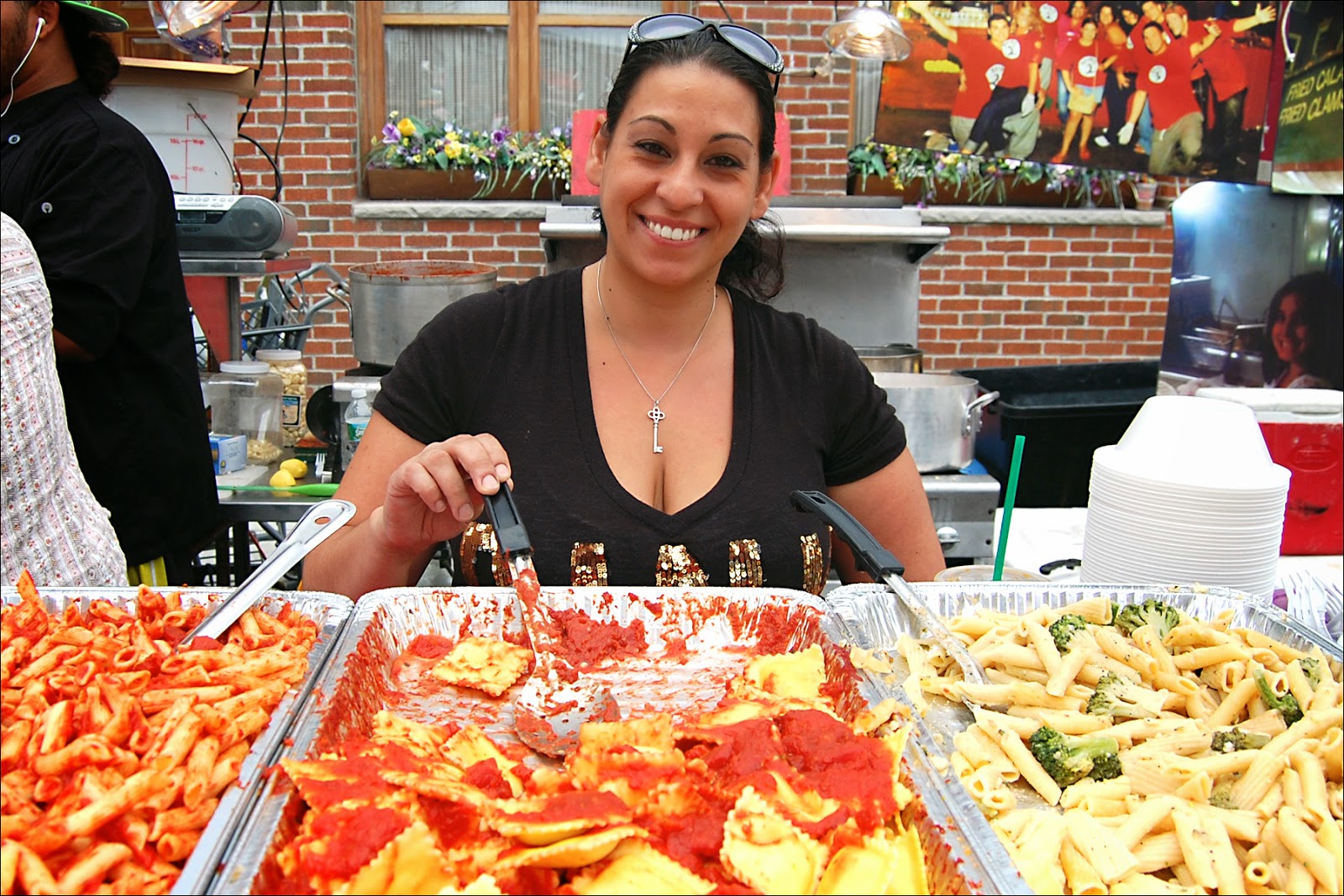
There were plenty of macaroni dishes to choose from
Freshly made cannoli for dessert
Arancini, a Sicilian masterpiece
Dominic and Justin led the parade back to the chapel
Father Santo with the relic of Sant'Agrippina
A look at the outdoor chapel

August 7, 2014

A Look at Hoboken's Madonna Dei Martiri

The original statue of the Madonna Dei Martiri inside St. Ann’s Church
Photos by New York Scugnizzo
Dear readers, in addition to seeing the amazing Santa Febronia Chapel during the 104th Annual Feast of Saint Ann in Hoboken, New Jersey, I also got to see several wonderful statues of the Madonna Dei Martiri (Our Lady of the Martyrs), Patroness of Molfetta, a commune in the Province of Bari. I thought I would share my photos with you.
The first was the original Madonna Dei Martiri Society statue (c. 1930) inside Saint Ann’s Church (Pictured up top). 
The “new” statue of the Madonna Dei Martiri inside St. Francis Church
The second was the “new” statue dating from 1948, inside St. Francis Church at 308 Jefferson Street. This statue is still used during the Annual Procession.
A modern statue inside the Madonna Dei Martiri Society clubhouse
The third statue was inside the Madonna Dei Martiri Society clubhouse chapel at 332 Adams Street.

Also of interest, a bust of Molfetta’s co-patron San Corrado di Molfetta stands sentinel across from the Blessed Mother. He is also carried during the Procession.
San Corrado di Molfetta
The 2014 Feast of the Madonna Dei Martiri will be celebrated from September 4th—7th. The Procession is on Saturday, September 6th. For more info visit www.hobokenitalianfestival.com

August 4, 2014

The Search for our Ancestry (III)

Four Keys to Genealogic Research

By Angelo Coniglio 

I’m often asked questions related to genealogical searches for Sicilian immigrant ancestors.  Usually what these have in common is a lack of specifics, as:  

“Could you help me locate information on my grandmother?  Her name was Margaret Polito, and she came to America with her father James Polito and mother Mary, from Sicily, in about 1911.”

There is little that anyone can help with in this case, based on the small amount of information provided.  Before we can find original (that is, from their native land) birth, marriage, or death records, we need the following key pieces of information about any ancestor: 

1) Name (in its original language); 
2) the Date of immigration to America; 
3) Birth date
4) Place (town and nation) of birth.

Considering these ‘keys’, I would respond to the above question in this way: “So far, you have only parts of the required information about your grandmother: her surname and an Americanized given name, the year of her immigration; no birth date; and  her birth country, but not the town.”  

Starting with the Name:  If your grandmother was born in “Sicily”, it’s unlikely that her given name was Margaret.  Possibilities are Margarita or Margherita.  Check family records (or memories), to see if she was referred to as Margherita or another Italian variation.  Believe it or not, her actual name may have been Domenica (doh-MAIN-ih-kuh), shortened to Mamie, then Maggie, then ‘upgraded’ to Margaret!   Further, her parents’ names in Italy would not have been James and Mary.  James is the English form of Giacomo, and also a common “substitute” name for Vincenzo.  Any searches you do of Italian records or immigration records should use the Italian variations of the given names.  Early census records also may give the “Sicilian” names, before they were Americanized, but watch for mis-spellings.  

Knowing your relative’s name in its original language is important. Before you start searching old records, try to determine the right name and spelling. Below is a short list of given names in English, with Sicilian names from which they may have been derived, and a pronunciation guide, in which the emphasized syllable is shown in CAPITALS.  Note that vowels in Italian have the following sounds: A is “ah”E is “ay” or “eh”I is “ih” or “ee”O is “oh”, and U is “oo”. “ AEIOU” in Sicilian is “ah, eh, ee, oh, oo”!!  The English sound of I (“long i” as in “eye”) is given by the combination “ai” in Sicilian. .  

Some names were translated literally.  Filippo (fih-LEE-poh), became Philip, Giovanni (jo-VAHN-nee) means John, and Michele (mee-KAY-lay) is Michael.  But many names were not translated.  Felice (fay-LEE-chay) means Happy (Felix), but often in America it was modified to Phil or Philip.  Sometimes the name was difficult to pronounce, or one prominent syllable of the name became the basis for the Americanized name. For example, Vincenzo (veen-CHAINZ-oh) became James. Sometimes the person was given a nickname that was later transmuted into a completely different name. Barbaro (BAR-buh-roh) became Bob, which then became Robert, and Alfonso became Al, then Albert or AlfredDiego (dee-AY-goh) became Dick, then Richard; Salvatore (meaning ‘savior’) became Sam, then Samuel.                                                                                               
In Italian, traditional male and female names had different endings, signifying gender. This USUALLY meant a man’s name ended in “o” and a woman’s in “a”, e.g. Angelo and Angela, Vincenzo and Vincenza; Pietro and Pietra, Calogero and Calogera, Antonino and Antonina, Gaetano and Gaetana, etc. 

Exceptions to this rule include: Giovanni and GiovannaMichele and Michela, Felice and Felicia; and Giuseppe and Giuseppa. Sometimes a man’s name does end in “a” as in Nicolá (Nicholas), a variant of which is Nicoló.  The feminine form of Nicolá or Nicoló is Nicolina. An interesting name is Andrea (Andrew), which is from the Greek root 'andros', meaning 'man'.  Andrea means 'manly', and in Italy and Sicily it was exclusively a man's name: there was no feminine form.  See my page at http://www.conigliofamily.com/ItalianNames.htm for a more complete list of  given names in English and Italian.
Coniglio is the author of the book The Lady of the Wheel, inspired by his Sicilian research. Order the paperback or the Kindle version at http://amzn.to/racalmuto  

Coniglio’s web page at http://bit.ly/AFCGen has helpul hints on genealogic research. For genealogy questions, or would like him to lecture to your club or group, e-mail him: genealogytips@aol.com

August 2, 2014

A Look at the 104th Annual Feast of Saint Ann, Hoboken, New Jersey

Evviva Sant'Anna! 
Photos by New York Scugnizzo
By Giovanni di Napoli
Last Saturday (July 26th), my friends and I went to Hoboken, New Jersey for the 104th Annual Feast of Saint Ann. Arriving early, we got in the queue to go to church. At first I was surprised about lining up, but I was glad we did. The line quickly grew and St. Ann’s Church was packed. After a short wait, we were greeted by members of the Monte San Giacomo Society and shown to our seats. Needless to say, the service was beautiful and ended with the most touching rendition of Dell Aurora Tu Sorgi Piu Bella, the unofficial “anthem” of the Feast.
Leaving church to partake in the Procession, I discovered that a throng of revelers had amassed outside for the festivities. Without delay, the John Duke Band got things rolling with the National Anthem and a flurry of festival songs. Covered in jewelry, the statue of Saint Ann was presented to the expectant crowd.
Traditionally carried by members of the Saint Ann’s Guild, in recent years the statue was placed onto a cart. Apparently someone up top thought it would be safer for the women to pull the statue than to carry it. This sounds reasonable, but the problem is the women weren't consulted and many want to keep the tradition of carrying the Saint. Sure it’s difficult, but as one of the ladies told me: “its supposed to be, its a form of penance.” I’m interested to see how this develops. Hopefully next year we’ll see them carry her again.
We walked for five hours through the parish singing, praying and catching up with friends and family. For those of you who haven’t walked in the Procession before, this is not as “grueling” as it may sound. We made several stops along the way, as generous members of the community offered plenty of food and water to the participants. My friends in the Monte San Giacomo Society warned me not to fill-up because they had a feast waiting for us back at the clubhouse, however, it was impossible for me to pass up on some cool watermelon outside the Failla Memorial Home and a slice of pizza from Truglios. 
Naturally we don’t just stop for food, we also visited several religious and historical sites, including the Madonna Dei Martiri Society Clubhouse, St. Francis RC Church and the amazing Santa Febronia Chapel, not to mention a private shrine dedicated to Padre Pio. Of course we also stopped by the Monte San Giacomo Club, where members brought out the Statue of San Giacomo to greet Saint Ann. When the Procession resumed, San Giacomo joined in and led the way back to Saint Ann’s Church.
After the Procession, I hurried back to the Santa Febronia Chapel (just beating the rain) for a short visit (see A Look Inside the Santa Febronia Chapel). When the sky cleared, I returned to the Feast and found my friends inside the Church. Excited to keep the party going, we were invited to the Monte San Giacomo Club for dinner. Warmly welcomed, we were treated to incredible roast beef and hot peppers sandwiches. Afterward, we met up with friends at the fairgrounds for a beer, some wine and, of course, their world-famous zeppole.  
I would especially like to thank Carmine Percontino, Andrew Giordano and all the members of the San Giacomo Society and St. Ann’s Guild for their hard work and dedication, it was truly an honor to celebrate with them. Their warmth and generosity is second to none.
After Mass St. Ann is presented to the expectant crowd
Revelers gather around St. Ann
The color guard stands ready
The Procession makes its way through the neighborhood
Members of the St. Ann's Guild show their support
Members of the Padre Pio Prayer Group join the celebration
The John Duke Band
Our friends at Truglios offered us pizza and sandwiches
(Above and below) Failla Memorial Home handed out watermelon, ice-cream, cannoli and sandwiches
The Madonna Dei Martiri Society had plenty of delicious focaccia and cold water for everyone
San Giacomo greets St. Ann
Donations are pinned on to San Giacomo
San Giacomo joins the Procession
A shrine to St. Ann
A shrine to Padre Pio
The Procession wends its way back to St. Ann's Church
Passing on the traditions
The party was just getting started at the Monte San Giacomo Club

Feast of Our Lady, Queen of Angels

Our Lady, Queen of Angels, ora pro nobis
August 2nd is the Feast of Our Lady, Queen of Angels (Maria SS Regina Degli Angeli), patroness of Sacco (Salerno), Mineo (Catania), and Cassano delle Murge (Bari). In celebration, I’m posting a prayer to Our Lady, Queen of Angels. The accompanying photo was taken at the Shrine Church of Our Lady of Mount Carmel in Williamsburg, Brooklyn before the 2017 renovation. Evviva Maria!

Our Lady, Queen of Angels

August Queen of Heaven, sovereign Mistress of Angels, you who at the beginning received from God the power and the mission to crush the head of Satan, we beseech you humbly, send your holy legions so that, on your orders and by your power, they will track down demons, fight them everywhere, curb their audacity and plunge them into the abyss. Oh good and tender Mother, you will always be our love and our hope. Oh divine Mother, send the Holy Angels and Archangels to defend me and to keep the cruel enemy far from me. Holy Angels and Archangels defend us, protect us. Amen

August 1, 2014

New Books

Some new and forthcoming titles that may be of interest to our readers. All are available at Amazon.com

• How I Became A Bandit
Autobiography by Carmine Crocco

Publisher: CreateSpace
Publication Date: July 13, 2014
Paperback: $7.19
Language: English
Pages: 124

• Politics and Culture in Renaissance Naples by Jerry H. Bentley

Publisher: Princeton Lagacy Library
Publication Date: July 14, 2014
Hardcover: $21.36
Language: English
Pages: 342

• Palermo, City of Kings: The Heart of Sicily by Jeremy Dummett

Publisher: I.B. Tauris
Publication Date: April 30, 2015
Hardcover: $24.19
Language: English
Pages: 272


• Women of Sicily: Saints, Queens and Rebels by Jacqueline Alio

Publisher: Trinacria Editions LLC
Publication Date: May 4, 2015
Paperback: $22.80
Language: English
Pages: 224

Read description

Click here to see more books