October 23, 2011

The Emperor of Philadelphia

No man in the history of the City of Philadelphia was more loved, hated, admired, feared and despised than Mayor Francis L. Rizzo, Sr.
Monument to Mayor Frank Rizzo
Photos by New York Scugnizzo
By Niccolò Graffio
“The streets of Philadelphia are safe.  It’s only the people who make them unsafe.” – Frank. L. Rizzo
“The City of Brotherly Love” began as a settlement founded by William Penn in 1682.  The previous year, Penn had received a charter from King Charles II of England to establish what would eventually become the Pennsylvania Colony.  Penn, a Quaker, had experienced religious persecution in England and was desirous of founding a colony in the New World where there would be absolute freedom of worship.  His “Holy Experiment” included the building of a city this farsighted soul believed would one day form, as he put it, “…the seed of a nation.”

The City of Philadelphia was officially established by Penn with the Charter of 1701.  Penn derived the name of the city from the Greek philos (“love” or “friendship”) and adelphos (“brother”).  At this time the city’s inhabitants were mostly settlers from the British Isles, as well as some Germans, Finns, Dutch and slaves from Africa.  True to Penn’s vision, many religious minorities settled the area.  In addition to Quakers, Mennonites, Catholics, Pietists and even some Jews helped to build the early city.  As it grew, Philadelphia began to emerge as an important regional commercial center, facilitating trade between the Caribbean and British colonies in the northeast.

Almost from the beginning William Penn’s vision suffered a series of setbacks, including a number of riots usually initiated by drunk and loutish British sailors against the city’s pacifistic Quaker and German-Mennonite populations.  The most spectacular of these incidents occurred during the infamous “Bloody Election” of October, 1741. 

In addition, after the analytical and orderly William Penn left Philadelphia for the last time on October 25th, 1701, those he entrusted to continue his “Holy Experiment” allowed the city to fall by the wayside.  Streets were littered with garbage and stray animals were everywhere!  Numerous streets were left unpaved and laws in general were poorly enforced.  As a result, petty thieves ran rampant!  In addition, working in city government had such a poor reputation that fines had to be imposed on citizens who refused to do so if chosen.  One fellow even fled from the city to avoid serving as mayor!

By the mid-18th century, however, all that began to change as Philadelphia grew into a large commercial center.  Numerous edifices were erected and many important cultural and learning centers were founded.  One of the most important early figures in helping to develop the city culturally and scientifically was James Logan.  Logan, who had served as secretary for William Penn, founded what was to become one of the largest libraries in all the American colonies.  He served as mayor of the city during the 1720s.  During his tenure as mayor and afterwards, he guided many of the city’s more learned residents to encourage them in their endeavors.  Among these was a young man named Benjamin Franklin.

Philadelphia served as the seat of the Continental Congress during the American Revolutionary War (1775-83). It was occupied by the British for 10 months from September, 1777 to June, 1778.  Before the end of the war the U.S. Congress relocated to New York City.

During the early part of the 19th century large numbers of German and Irish-Catholic immigrants poured into the city, leading to overcrowding, poverty, disease epidemics and gang violence. Nativist groups like The Know Nothing movement often resorted to violence against many of these immigrants, whom they perceived to be a threat to America’s Anglo-Saxon Protestant culture.

Though many in the city sympathized with grievances aired by American southerners, all that changed with the outbreak of the American Civil War (1861-65). Mobs of Union loyalists often attacked the homes of suspected Confederate sympathizers. At one point it was believed the city would be invaded by the Confederate Army, but those fears were allayed when Gen. Robert E. Lee’s forces were repelled at the Battle of Gettysburg (July 1-3, 1863).

Following the end of the war the city continued its growth with new immigrant groups arriving from Southern and Eastern Europe. Chief among these new arrivals were Ashkenazi Jews and Southern Italians. The latter group mainly settled in the section of the city known as South Philadelphia.  In addition, large numbers of American blacks settled in the city.  Their numbers were further bolstered in the early part of the 20th century by the so-called “Great Migration” of American blacks from the American South towards cities in the Northeast, Midwest and West.

The arrival of all these new groups caused Philadelphia’s upper classes to flee the city for the suburbs.  By the beginning of the 20th century Philadelphia had earned a reputation as being a dull, lifeless city.  In addition, a political machine erected by the local Republican Party dominated the landscape.  Graft and corruption were rampant!  It was in this suffocating environment the subject of this article was born; a man of humble origins who would irrevocably carve his initials into the history of The City of Brotherly Love.

Francis Lazarro “Frank” Rizzo, Sr. was born on October 23rd, 1920 in South Philadelphia to Raffaele Rizzo, an immigrant tailor from Chiaravialle Centrale, a town in Calabria, Italy and his wife Theresa (née) Erminio.  His father, upon arriving in Philadelphia, gave up the occupation of tailor in favor of becoming a police officer. Raffaele Rizzo was a no-nonsense cop who was well-respected by his neighbors and idolized by his young son.

Young Frank dropped out of high school and joined the Navy, serving for about a year until he was forced out with a medical discharge due to incipient diabetes.  Unwilling to work the menial jobs that were the destiny of most dropouts, in 1943 he followed his father into the ranks of the Philadelphia police force.  A year previously he had married Carmella Silvestri.  Together they had a son, Francis Jr. and a daughter, Joanne.  

Standing at 6’2”, 240 lbs., broad-shouldered and with an imposing gaze, Frank made a formidable cop!  His first brush with fame came when he suffered severe burns helping to put out a fire.  Seven years later the press dubbed him “the Cisco Kid” for throwing himself in a fight between two gangs, quickly restoring order.  Punitive beatings were still regularly doled out by policemen back then, and several times during his stint as a police officer he was brought up on charges of beating suspects in his custody with a blackjack.  Each time the charges were dropped.

Frank Rizzo rose through the ranks of the Irish-dominated Philadelphia Police Department, eventually becoming Police Commissioner in 1967.  He brought with him the same taciturn, brooding manner to the job he had cultivated as a cop on the street.  By this time he had already earned a reputation as a polarizing and divisive figure in Philadelphia politics.  Civil rights advocates questioned his tactics in dealing with criminals and members of Philadelphia’s black community.  Law and order advocates, meanwhile, cheered his hard-nosed approach to crime control and lauded the fact that during his five-year tenure as Police Commissioner Philadelphia had the lowest crime rate of the ten largest cities in America.

Frank Rizzo had one way of running the Philadelphia Police Department…his way!  This caused him at times to be at odds with his boss, Mayor James H.J. Tate.  His combative attitude towards the media plus his iron-fisted approach to dealing with the Black Panther Party (a revolutionary leftist organization) made him something of a living urban legend.

His relationship with Philadelphia’s African-American community was always tense, if not volatile, at best.  Nevertheless, his tactics, while questionable, produced results.  During his tenure as police commissioner Philadelphia was spared the racial violence (replete with rioting, looting and burning) that engulfed cities like Detroit and Los Angeles, especially during the years 1966-68.  

During one particularly tense occasion of racial unrest in the city, Rizzo held a press conference to lay out his plans for dealing with the problem.  At this time Andrea Mitchell, then a young reporter for NBC-affiliate KYW-TV, asked him, “What about the Black Panthers?”  Staring her straight in the eyes he loudly responded, “Andy Mitchell, when I’m through with them, I’m gonna make Attila the Hun look like a faggot!”   It was not an empty promise.  It was also the beginning of a long, antagonistic relationship between the two that would last almost until the time of Rizzo’s death.

Rizzo’s war with the Black Panthers would continue.  In late August, 1970 the Black Panther Party declared war on police officers nationwide.  On August 31st, 1970, just a week before the Panthers planned to convene a “People’s Revolutionary Convention” at Temple University, Philadelphia police stormed Panther headquarters in the city, seizing numerous illegal shotguns, rifles and pistols.  
Adding insult to injury, the police then strip-searched the Panthers and invited cameramen to photograph their naked buttocks.  The next day, photos appeared on the Associated Press wire and were seen around the world.  Despite intense media criticism, Rizzo commended police for their handling of the raid and gloated to reporters, “Imagine the big Black Panthers with their pants down!”

The Black Panthers’ convention at Temple University from September 6th to 8th went ahead as scheduled…with 1,000 members of the Philadelphia Police Department ready to pounce at a moment’s notice!  Needless to say, no incidents were reported.  Afterwards, leading members of Philadelphia’s business and civic communities publicly contacted Rizzo to express their gratitude to him for maintaining order and stability in the city during the convention.

Rizzo’s reputation as a stern, law-and-order type endeared him to both the city’s white ethnics as well as its business/civic leaders.  One of the most memorable pictures of Rizzo shows him leaving a black-tie affair with police nightstick sticking out of the cummerbund of his tuxedo in order to lead “my men, my army” to break up a riot.  Deciding to capitalize on his popularity, he resigned as police commissioner and ran for mayor on the Democratic ticket, winning in November, 1971.  

Rizzo was barely in his new position when he came under fire by three of Philadelphia’s leading newspapers on charges ranging from police brutality to using the Philadelphia Police Department to conduct espionage against political opponents.  Two months after winning the election, in a move that would infuriate allies within the Democratic Party, he publicly endorsed then-President Richard Nixon for re-election.

His endorsement of Nixon won him friends in high places.  In return for his support, the Nixon Administration found its way to secure Federal funding for Philadelphia.  Despite near-constant media criticism, Rizzo tried to court favor with members of Philadelphia’s press corp.  According to Andrea Mitchell, he was even able to secure a meeting between them and President Nixon in the Oval Office, something almost unheard of for a local Democratic politician to do at the time!

As his popularity increased, so too, did Rizzo’s dreams of higher office.  He now had his sights set on the Governor’s office of the State of Pennsylvania.  Unfortunately for him, his endorsement of Nixon cost him friends and clout within his own party.  Peter Camiel, then-Chairman of the Democratic City Committee of Philadelphia, publicly accused Rizzo of offering Camiel patronage jobs in exchange for allowing Rizzo to choose the candidates for District Attorney and City Comptroller.  Rizzo responded by calling Camiel a liar!

To settle the dispute, a reporter from the Philadelphia Daily News asked both Rizzo and Camiel if they’d submit to a polygraph test. Both men agreed.  Rizzo appeared confident he’d pass, even declaring just before taking the test “If this machine says a man lied, he lied!”  

To his horror, however, the machine seemed to indicate he did indeed lie, and that Camiel appeared to be truthful.  The scandal that followed ruined any chance Rizzo may have had for running for higher office.  It also put an end to Rizzo’s attempts at building rapport with the press, as he discontinued any further press conferences for two years.  

Camiel would much later be convicted of 11 counts of mail fraud in connection with his involvement in a scam involving placing “ghost workers” on the State Legislature’s payroll.  The convictions would later be set aside by a Federal judge due to “insufficient evidence”.

Deciding to run for re-election, in the 1975 Democratic Primary Rizzo defeated State Senator Louis Hill, who was supported by Camiel.  In typical Rizzo eloquence, he campaigned among Philadelphia’s electorate with the following promise: "Just wait after November you'll have a front row seat because I'm going to make Attila the Hun look like a faggot." 

Rizzo won re-election, but not without problems.  He had campaigned on the slogan, “He held the line on taxes” but then after his victory he succeeded in getting the City Council to raise the city’s wage tax from 3.31% to 4.31%, among the highest nationwide!

The tax increase infuriated Rizzo’s opponents and galvanized them to find a way to remove him from office.  Philadelphia’s city charter contained a provision that provided for a recall if 25% of the registered voters signed a recall petition.  The effort gained a large number of volunteers and contributions.  Rizzo’s supporters, in turned, challenged many of the signatures and the constitutionality of the recall procedure itself.  The whole matter eventually went before the Pennsylvania Supreme Court, the highest court in the state, where by one vote it was decided the recall provision was unconstitutional.  

While he was fighting to keep his job as mayor, construction started on The Gallery at Market East shopping mall in the downtown part of the city.

Faced with a two consecutive-term limit mandated by the Philadelphia city charter, Rizzo succeeded in having a charter change placed on the ballot that if passed, would have allowed him to run for a third consecutive term in 1979.  It backfired.  Philadelphia’s electorate voted two to one against changing the limitation.  In 1979 former Congressman William J. Green was elected mayor.  In one of the more sordid parts of this affair, Rizzo’s enemies in the media repeatedly accused him of criminal activity and mob associations while offering little in the way of hard evidence to back up those accusations.

Even though he was no longer in office, Rizzo could not remain out of the spotlight, or controversy, for very long.  Between 1983-91 he hosted a local radio talk show; his presence and charisma making it by far the most popular show of its kind.  During this time he also served as a security consultant for The Philadelphia Gas Works, drawing fire from critics since he was getting a city pension at the same time.

In 1983 he ran unsuccessfully for the Democratic Party nomination for mayor against W. Wilson Goode, who went on to become Philadelphia’s first black mayor.  On May 13th, 1985, responding to months of complaints by local area residents against members of the MOVE Headquarters in the Cobbs Creek area of West Philadelphia, police attempted to evict them.  They were fired upon.  A police helicopter then dropped a 4-lb. bomb containing C-4 plastic explosive.  The fire that resulted killed 11 occupants of the building (including 5 children) and burned 61 homes to the ground!

Rizzo was quick to condemn Goode’s handling of the situation, correctly pointing out that during his tenure as mayor, when faced with a similar situation, he was able to extricate MOVE members from their Powelton Village holdup without having to kill anyone, even though a police officer had been shot.  Surveying the carnage with reporters, Rizzo remarked, “There goes the neighborhood!”  Afterwards, he would frequently refer to Goode as “The Bomber.”
The Mayor Frank Rizzo Mural in Philadelphia's Italian Market
Frank Rizzo’s fame (or infamy, depending on your opinion of him) spread out much farther than just Philadelphia and wound up in some very interesting places.  John J. Dilulio Jr., Prof. of Political Science at the University of Pennsylvania, recounted meeting a delegation of the USSR’s Supreme Soviet and Congress of People’s Deputies while they were visiting the United States in 1990.  One delegate asked him where he had grown up.  When Dilulio responded “Philadelphia, Pennsylvania” the man smiled and nodded knowingly, which Dilulio took to mean the man was thinking of Benjamin Franklin.  The delegate, however, stunned Dilulio by asking, "Dear John, Philadelphia is the city of Rizzo. A great man of the people, true?"

In 1986 Frank Rizzo switched his party allegiance and ran as a Republican in the mayoral election.  He lost.  In 1991 he set out again to run for mayor; this time he succeeded in defeating former Philadelphia District Attorney (and later Chief Justice of the Pennsylvania Supreme Court) Ron Castille.  Changing his tactics from earlier times, Rizzo had campaigned in black neighborhoods, reminding residents of his having integrated Philadelphia’s police force and his commitment to keep neighborhoods free from violent crime and drugs.

Shortly before his victory in the Republican Party Primary, he was interviewed by his old media nemesis, NBC-TV correspondent Andrea Mitchell.  Mitchell was curious as to why Rizzo would give up a lucrative job as a radio talk show host to go back into the muck and grime of politics.  "I love the challenge," he said, adding, "You know the best part? Dealing with the press. I love to go head-to-head with some of them suckers. I really do."

Shortly after his upset victory over Ron Castille in the Republican Party Primary, “the Italian John Wayne” did something no one, friend or foe, expected him to do…he died!  On July 16th, 1991 he suffered a massive heart attack.  He was pronounced dead at 2:12 PM EDT at Thomas Jefferson Hospital.

There was a large turnout for his funeral.  Mourners lined the streets to say good bye to “Chairman Frank” as his detractors liked to call him.

His legacy, like his career, remains controversial.  After Benjamin Franklin, he remains the most quoted political figure in Philadelphia history (though admittedly, not nearly as eloquent as Ben).  He was one of the most polarizing figures in modern American history; a man you either loved or hated!  

Yet his impact was undeniable, for while his tactics might seem rough by today’s standards, the fact is Philadelphia under his aegis was largely spared the racial violence that engulfed other large cities like Detroit and Los Angeles.  Crime actually went down appreciably!  The city’s police force was likewise largely integrated during his mayoralty at a time when few if any other cities achieved similar results.

When asked once what he wanted as an epitaph, he jokingly replied “He’s really dead.”  Perhaps, though, it was his nemesis Andrea Mitchell who provided the most fitting one.  According to her, she was watching a budget debate from NBC’s Senate broadcast booth when she received a call from a Philadelphia reporter asking her to comment on Rizzo’s death.  

Upon hearing the news, she broke down and cried.

Further reading:
• S.A. Paolantonio: Frank Rizzo: The Last Big Man in Big City America; Camino Books, 1993

October 18, 2011

Fiaccolata di San Rocco, 2011

Viva San Rocco! Protector of Quaglietta
By Giovanni di Napoli

Last Saturday (October 15th), some friends and I headed to Astoria, Queens, to participate in the annual Fiaccolata di San Rocco, or candlelight procession, sponsored by the Societá Gioventú Quagliettana. Holding candles, the women and children sang traditional songs and prayers commemorating the death of their patron while the men carried a litter bearing the saint. The somber procession began at the society's social club (3704 28th Ave.) and made its way through the neighborhood to the beautiful St. Joseph's Church, where services were held. 
The faithful gather outside the social club
After mass the congregation made its way back to the social club, where we were invited in to mingle and partake in their sumptuous feast. Warmly greeted, we were given a quick tour of their facilities. Naturally, the statue of Saint Rocco was given a place of honor under a wooden baldachin in the building's makeshift chapel. We learned that the figure was imported from Naples and a cloth relic from the Chiesa di San Rocco (the saint's resting place) in Venice was prominently on display. Blessed bread was distributed to all the guests.
The candlelight procession makes its way through the neighborhood
I especially enjoyed the old black-and-white photographs of past members, showing the long history of the benevolent society. Maps, flags and photos of Quaglietta, a small bucolic hamlet in the Campanian region of Southern Italy, also decorated the walls. An older gentleman passionately regaled us with the Saint's story and tales of the old country. He proudly recalled the important charitable work the confraternity provided to the early immigrants and the aid ("soccorso") it still offers to those in need. I was deeply touched by the love he holds for his adopted country and how grateful he is for the opportunity it gave him to provide for his wife and children.
Leaving Saint Joseph's
I also had the great pleasure of talking with Tina Carpinelli, the women's president, who took time from her busy schedule to make sure we felt at home and answered all of our questions. Through her we learned that in addition to the Fiaccolata di San Rocco the society hosts a number of other cultural events, including a Festa della Donna e Gara dei Vini (Women festival and Contest of Wines) in March, which sounds vaguely reminiscent to the ancient Bacchanal celebrations of Magna Graecia.

In August they have a Festa di San Rocco (Saint Rocco Festival), which Mrs. Carpinelli assured me draws large crowds and is a lot of fun. Photos I've seen of some recent festivals clearly corroborate her claim. In September they have a Sagra dei Fusilli (Fusilli festival). The very idea of a pasta festival makes my mouth water, so I needed little persuasion to become interested. She had me at fusilli.
The shrine to Saint Rocco
The Societá Gioventú Quagliettana also holds an annual dinner dance for its members and this year's (November 5th at 6:00 PM) will mark the group's 100th anniversary. A photo of last year's Christmas celebration shows that they're blessed with enough children to potentially be around another one hundred years.

Considering how long they've been around I'm embarrassed to say that I only just discovered this wonderful organization and subsequently been missing out on their many celebrations; but now that I met them and experienced first hand their warm, generous hospitality I plan on supporting our Quagliettana brothers and sisters by attending as many of there public events as possible. If these other gatherings are anything like the Fiaccolata di San Rocco they'll definitely be worthwhile.
Tina Carpinelli with Luca Sessa, Presidente Associazione Tre Sicilie, before the shrine. (Photos by New York Scugnizzo)

October 13, 2011

Columbus Day 2011 Retrospective

A look at the 67th Annual Columbus Day Parade on Fifth Avenue, NYC
Luca Sessa, Presidente Associazione Tre Sicilie, shows his true colors 
Photo by New York Scugnizzo
By Giovanni di Napoli

Normally, I attend Manhattan's Annual Columbus Day Parade as a spectator, but this year I had the great privilege of marching with the East Harlem Giglio Society and the Sons of San Paolino di Nola from Long Island. I cannot begin to describe the warm welcome the members of these two gracious societies gave my friends and I. They treated us like family and spoiled us with typical Southern Italian hospitality. What a festive bunch; we felt right at home.
Members of the East Harlem Giglio Society and Sons of San Paolino di Nola make their way down Fifth Avenue (New York Scugnizzo) 
Our procession made its way down a packed Fifth Avenue with great fanfare. To the joy of the crowd, Danny Vecchiano's Giglio Band led the way, playing traditional Southern Italian and patriotic American tunes. Accompanied by the women and children, the menfolk took turns carrying the statues of San Paolino di Nola and San Antonio di Padova. Highlights included a blessing by the clergy outside Saint Patrick's Cathedral and a raucous performance by the band on the red carpet. We certainly couldn't ask for better weather; the sky was blue and the temperature was mild. If there was one downside to marching at all, it was not being able to see the other groups in the parade. Usually I love watching the various contingents and their interesting performances, but it was worth missing to be a part of the spectacle.
Standard bearers lead the way (New York Scugnizzo) 
While this was the first time I marched in the Columbus Day Parade it was in fact the second time I got to march down Manhattan's Fifth Avenue. Back in the early '90s, before the collapse of the Iron Curtain, I participated in the Captive Nations Day, which was a multi-national demonstration against Communist regimes by Eastern European expatriates and dissidents. I drew a lot of attention back then by carrying the Italian flag (at the time I did not have a Due Sicilie flag). When questioned "Why?" people were surprised to here my view of Southern Italy as an occupied state (among other things). 
Leaving Saint Patrick's Cathedral 
Photo courtesy of Bobby Maida
This time, it was my Due Sicilie flag that drew some attention. I was approached by several people who did not recognize the flag and were curious about its meaning. My explanation of its historical significance and its defiant symbolism against Northern Italian cultural hegemony seemed to go over well. However, some were wondering why an ethnocentric Southern Italian would celebrate the exploits of a Northerner. 
Viva San Paolino! Viva San Antonio! 
New York Scugnizzo 
At the risk of repeating myself (and for our newer readers who may be unfamiliar with my opinions on the subject) I would like to explain why I observe Columbus Day.

Firstly, I celebrate the day because I'm an American not because I'm "Italian." To me, a proud Neapolitan-American, this is a patriotic holiday, not an Italian-American one. His accomplishment, whether it was on purpose or not, set in motion the chain of events that led to the founding of this great country. That is why Cristoforo Colombo, and not the great Leif Erikson (who came before him) is a national icon. 
Giglio Girls (above) and The Daughters of San Paolino (below) partake in the festivities (Photos by New York Scugnizzo and Bobby Maida)
Also, if I can admire Mozart, Nikola Tesla, and Sun Tzu, none of whom are Southern Italian or American, then I can do the same for the famous Genoese maritime explorer without it being a conflict of interest.
A labor of love 
New York Scugnizzo
Secondly, by honoring his legacy I'm challenging the growing anti-Western sentiment in this country and all those trying to vilify its traditional heroes by rewriting American history. With the way things are going I know that its only a matter of time before this parade (and others like it) will be cancelled to pacify un-American worldviews, but for now I'll take every opportunity I get to enjoy these events. 
Danny Vecchiano's Giglio Band kept the party going 
New York Scugnizzo
Finally, attending this parade is a wonderful opportunity for me to interact with my own people. Whether they realize it or not, many of the celebrants are Southern Italian and quite frankly it makes me happy to be in their company. The generic Italian-American identity they embrace is simply a matter of misinformation; after all, I felt much the same way before I started studying our history.
The Giglio Boys (left) and the Sons of San Paolino (right) proudly carry their respective patrons (Photos courtesy of Bobby Maida)
Afterward, in what is happily becoming a tradition, a bunch of us went to Naples 28 on Carmine Street in Greenwich Village for some delicious Neapolitan-style pizza. As usual, it was the perfect way to cap-off an outstanding day. 
A work of art from Naples 28
New York Scugnizzo
For more photos of the parade please visit Bobby Maida's Shutterfly album

October 7, 2011

Preserving Living History: Interview with Oral Historian and Photographer, Anthony V. Riccio

(Part One)
By Olivia Kate Cerrone

Anthony V. Riccio 
History, as documented through the voices of those who have lived it, has become all too often a rare and underrepresented presence in contemporary Italian Americana. If we are to take ourselves seriously as a culture, it is imperative upon us to engage with those former generations who carried the language, folklore and heritage of Southern Italy to the United States.  Theirs is the truth that continues to shape and define us, one that must be honored, so that the understanding and representation of our people’s identity is not mangled and dictated by the likes of Jersey Shore. For over four decades, Anthony V. Riccio has committed his life to capturing the testimonials of those individuals who serve as a living embodiment of some of the first Italian American neighborhoods on the East Coast. Through a beautiful and startling array of photography and personal reflections, Riccio has produced a series of brilliant oral history collections preserving the legacy of those immigrants who originally persevered through countless economic and social hardships to thrive in the New World.  Mr. Riccio is one who remains passionately driven in what he describes as “a race against time” to document this fading generation before their experiences, largely unwritten until recent years, become irrevocably lost.  His books include Boston’s North End: Images and Recollections of an Italian-American Neighborhood, The Italian American Experience in New Haven: Images and Oral Histories, Cooking with Chef Silvio: Stories and Authentic Recipes from Campania and the forthcoming Farms, Factories and Families: Italian-American Women of Connecticut from SUNY Press. A native of New Haven’s Italian American Annex neighborhood, Riccio earned a Masters degree in Renaissance Art History from Syracuse University and spent extensive time on a university-granted “Florentine Fellowship” enriching his photography skills through a tour of Southern Italy. His work as an oral historian soon began after returning to the United States and working as Director of the North End Senior Citizen Center of Boston, a position that bonded him to the residents of that historic neighborhood. Riccio’s accomplishments as a researcher and archivist led him to a career at Yale University, where he’s served as the stacks manager of the Sterling Memorial Library for almost fifteen years.  I recently had the enormous privilege to conduct a three-part interview with Mr. Riccio, focusing on each of his community-based oral history collections. This interview speaks to the first of his published works: Boston’s North End: Images and Recollections of an Italian-American Neighborhood.

Olivia Kate Cerrone: Boston’s North End: Images and Recollections of an Italian-American Neighborhood is the first of three oral history collections, this book in particular documenting one of the most significant enclaves of Southern Italians and Sicilians on the East Coast, through engrossing photography and rich, vivid personal accounts detailing the everyday realities, joys and hardships that defined this working class neighborhood.  Prior to its publishing, you served as director of the North End Senior Citizen Center in Boston, but hail originally from New Haven, CT.  What inspired you to focus on this community in particular?  Was this project, and the subsequent others, prompted by the position you took at the Center or was it one that you wished to pursue before moving to Boston?

Anthony V. Riccio: When I returned after graduate school in Florence, Italy, I answered an advertisement in the Boston Globe that read “work in a neighborhood setting, must speak Italian.” Writing books of Italian oral history began more because of serendipity than design; I found myself in one of the last intact Italian neighborhoods where elders spoke native dialects — Sicilian, Calabrese, Neapolitan Abruzzese — and still lived in antiquated walk-up cold water flats, carrying on their old world lifestyle against the backdrop of a major American city.  Since I ran a drop-in center for the elderly, I became very close to many elders who no longer lived in the same tenement houses with sons and daughters who had  left to pursue the American Dream.  Because they told me such compelling life experiences with such eloquence, I began recording their stories and photographing them, knowing that I was in a race against time to save their legacies.  With each book project since the North End of Boston, I have always found myself working with the same fever to document stories and capture images before they disappear and are lost by the passage of time.   

Mariangela DiAntonio, a North End resident
OKC: Joe Petringa, one of the North End contributors to the book, expresses how he “was beginning to forget childhood stories because there weren’t any older people left to keep the memories alive,” at the time of his interview.  You later mention in an article published in Boston.com, how “the ‘60s and ‘70s were the last gasp of the North End families,” before the onslaught of urban development and gentrification.  With the breakdown of these ethnic enclaves and the passing of those generations who called such neighborhoods home, what is at stake here, culturally-speaking?  Why should we take oral histories seriously?  What might they provide in terms of cultural preservation?

AVR: Growing up in a traditional Italian American family, I realized that Italian American culture is not a written culture, but lives in the spoken word, in the life history stories and proverbs and allegories passed down from our elders.  In southern Italy, the ability to learn writing skills was usually reserved for the upper classes and there was no such thing as a meritocracy available for the working poor.  So our history is not written anywhere.  Joe Petringa’s story is symbolic of many Italian Americans who try to keep Italian American historical consciousness alive through the oral tradition and fear that it might be lost. There were many Joe Petringas in the North End who had a story to tell, a legacy to pass on, but there were few to listen.  Using Joe Petringa as a point of departure to peer into the third and fourth generation’s awareness of their cultural roots through the transmitting of our history through stories, our elderly storyteller voices have become feint echoes.  Italian American families seldom have three generations living together where stories are told by grandparents who keep cultural memory alive.  Once old voices are silenced, we lose our history. The loss of our cultural identity might explain why a fair amount of Italian Americans accept the Soprano and Jersey Shore characters as embodiments of Italian American culture.  What alternatives do Italian Americans have to counteract the lowest common denominator of themselves projected on the screen to remind them of the fullness and beauty of their culture?

Tom Bardetti, a North End resident
OKC: Herbert J. Gans’s famous sociological study, The Urban Villagers: Group and Class in the Life of Italian-Americans (1962) focuses on the first-and second-generation community of Italian Americans in Boston’s West End neighborhood, which he described as undergoing “approximately the same ethnic succession pattern as the North End.”  He then goes on to state how “West Enders could be understood better by their class position than by their ethnic background.”  Do you agree with this?  Was the working class status a key feature in keeping the North End Italians close-knit as a community?  Is it possible to regenerate that sense of community in the face of acculturation and middle-class American suburbia?

AVR: Gans made a fair assessment saying that the entire West End neighborhood, which was composed of many ethnicities — Polish, Jewish, Portuguese, Italian and Irish — were united more by economic conditions being of the same class than by their different cultures and traditions. Economic conditions determined where and how you lived and what type of job you held. It trumped where you worshipped, what language you spoke and which traditions you followed.  But the North End I found in the late 1970s had been an insulated, intact, working-class Italian neighborhood since the turn of the century.  What happened in the North End happened to many Italian Americans across the country: working-class parents worked labor-intensive jobs to send their children to college to attain degrees and professional careers. Having achieved middle class status, they moved to the suburbs.  In 1981, the North End Nursing Home opened to institutionalize elderly Italian living on their own and unable to care for themselves, an that had been unthinkable in Italian families a generation before.  

J & N Market (Photos Courtesy of Anthony V. Riccio)
OKC: So many fascinating, even unsettling aspects are revealed through the memories of the North End Italians, including the depictions of the hard labor that most faced for very little money, the discrimination that working Italian American women struggled against with their earnings, and the “tribute money” that all workers from the neighborhood were expected to pay to presiding Mafiosi. But the most positive, consistent element at play in all of the stories shared was the powerful impact of community. I was particularly touched by the story of little Jimmy, a Sicilian boy who is consistently fed and practically adopted by a neighboring Abruzzese family, after his family can no longer feed he and his siblings. Here is a society before the time of effective social service programs, one that would rather turn inward. As resident Al Mostone described: “in the tenement houses… we’d have six, seven, and even twelve families living in one building.  We were practically one family. Or if you needed assistance or if we even thought you needed assistance, it was given to you—what little we could—you got it.”  What do these oral histories reveal about the importance of community among Italian Americans?  Why is community something worthy of being valued?

AVR: Italian oral histories teach us — remind us — that one of the most enduring features of Italian American culture was a genuine concern for the less fortunate, which has its roots in the small village experience of southern Italy. Most Italian Americans of the second and third generation learned those important values — empathy and compassion for the sick and elderly in the family or in the neighborhood — growing up in families where parents and grandparents set examples of goodwill for others by their actions.  In retrospect, the North End way of life — their identity as “North Enders” — and the heartfelt sharing and caring that existed between people now sound like a fairy tale.

Stay tuned for our second interview with Anthony V. Riccio, where we will be discussing The Italian American Experience in New Haven: Images and Oral Histories.

Click here to read Part Two
Click here to read Part Three

Please reach Anthony V. Riccio at http://anthonyriccio.com/

You can contact Olivia Kate Cerrone at: Olivia.Cerrone@gmail.com

October 4, 2011

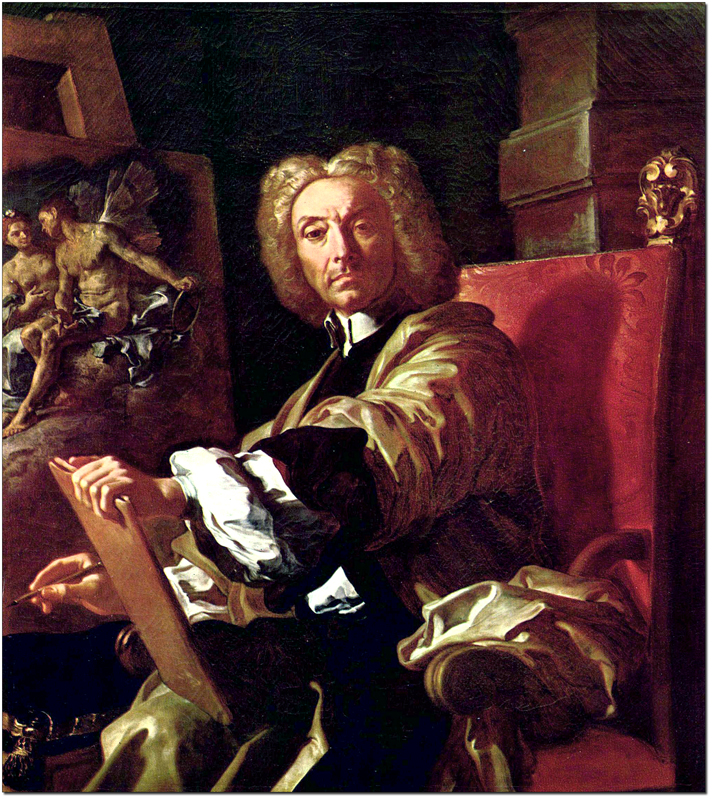
Francesco Solimena, a Forgotten Baroque Master

Self-portrait, Francesco Solimena
By Giovanni di Napoli
"Painting possesses a truly divine power in that not only does it make the absent present (as they say of friendship), but it also represents the dead to the living many centuries later, so that they are recognized by spectators with pleasure and deep admiration for the artist." – Leon Battista Alberti (1404-1472) *
As is my custom, I will visit the Metropolitan Museum of Art today to view Francesco Solimena's remarkable The Birth of the Virgin (ca. 1690) in honor of the artist's birthday. I do this whenever possible because I feel that members of our ethnos are part of my extended family and deserve (especially the great ones) the same respect and veneration afforded to my direct ancestors. Viewing the masterpiece in person, like reading the prose of a great writer or attending a concert by a preeminent composer, is my way of communing with our forebears.
While doing biographical research for this sketch I was unable to find a single book dedicated to Solimena. If that wasn't bad enough, with the exception of A Taste For Angels (Yale University Art Gallery, 1987), which has one chapter dealing with Solimena, and The Golden Age of Naples Vol. 1 (The Detroit Institute of Arts with The Art Institute of Chicago, 1981), which has eight pages, the rest of my art books devote only a page or two, at best, to the artist. This dearth is shocking when you consider some of the accolades written about him:
"Francesco Solimena was one of the most notable and influential figures in Neapolitan art, virtually dominating the scene from the end of the 17th until the mid-18th century. In fact, his vast and accomplished oeuvre, very much in demand throughout his career not only in Naples but throughout Europe, epitomizes the culture of southern Italy as it evolved over the course of the 18th century." (The Golden Age of Naples Vol. 1, p. 140)
"Francesco Solimena brought Neapolitan art to its greatest glory. After the death of Carlo Maratta in 1713, he was unarguably the most famous painter in Europe." (A Taste For Angels, p.163)
Art historian Pellegrino Antonio Orlandi (from Bologna), a contemporary and admirer of Solimena claimed, "Everyone has wished, and wishes to have his works" and an inscription on a portrait by famed caricaturist Pierleone Ghezzi (from Comunanza) says, "He is the best master we have this century." (Ibid)

One would imagine, with the ready availability of books about Andres Serrano, Robert Mapplethorpe or some two-bit graffiti artists that there would be no problem acquiring a book about one of Europe's renowned painters; but this is not the case. The paucity of books about Southern Italians in general (gangsters aside) is compounded with the fact that Baroque art, an exuberant idiom fully embraced by Southern Italy during the seventeenth century, has become unfashionable. With the exception of Caravaggio and Gian Lorenzo Bernini very few Baroque masters get the attention they deserve. 

I agree with the pundits when they say the Western masses are out of touch with and completely removed from their past, but this still doesn't explain the available alternatives. Sure, people aren't hanging prints of Jusepe de Ribera's Mystic Wedding of St. Catherine or Massimo Stanzione's Judith with the Head of Holofernes on their walls anymore, but I don't know anyone who has a copy of Serrano's Piss Christ either.
Mystic Wedding of St. Catherine by Jusepe de Ribera (New York Scugnizzo)

The lack of interest in Southern Italian art is often attributed to Giorgio Vasari (1511-1574), a Florentine painter, architect and writer, whose influential Lives of the Artist concentrates on the work of Northern Italian artists. While Vasari may have played a part in the marginalization of Southern Italian art, I think this is an oversimplification of the problem. As Bianca De Divitiis explains in her excellent essay, Building in Local All'Antica style: The Palace of Diomede Carafa in Naples:
"While the highly negative treatment of Neapolitan art and architecture can certainly be traced back to the writing of Giorgio Vasari, the influence of his ideas would not have been so harmful if they had not been reinforced by a range of different problems which arose in subsequent centuries. The attitudes of nineteenth- and twentieth-century historiographers were crucial not only in creating a homogeneous image of a backward southern Italy, which remained behind the rest of Italy and Europe, but also in interpreting the earlier history of the region in the light of this image. This particular historiographical approach has led to the creation of inadequate concepts such as centre and periphery, and development and backwardness, which have provided the framework within which the relationship between the Neapolitan quattrocento and the Renaissance in the rest of Italy have been interpreted and evaluated, not least by Neapolitan scholars themselves." (Art and Architecture in Naples, 1266-1713, Edited by Cordelia Warr and Janis Elliot, Wiley-Blackwell 2010, p. 83-84)
Subsequently, Northern Italian cultural hegemony has negatively influenced Italian-American scholars as well, who mostly hail from Southern Italy. Anyone doubting the veracity of this accusation should peruse Tom Verso's South of Rome—West of Ellis Island blog at i-Italy. Mr. Verso, whose essays are archived for anyone interested, documents the deplorable state of Southern Italian studies in America and cogently asserts the reasons why. This Northern bias contributes to fewer English translations of Southern Italian works.  For example, Vasari's Lives is readily available in English; however, Bernardo De Dominici's (1683-1759) Lives of the Neapolitan artists, which was written to fill the void left by Vasari, is not.

Ms. De Divitiis continues:
"The so-called 'questione meridionale', or 'southern question', which arose after Italy's unification in the 1860s, not only relegated the south to a subordinate position in the national context as a whole, but also weakened the territorial and art-historical awareness which had been prevalent in the local and regional culture. ...Thus, since Naples has been regarded as a peripheral city merely waiting for the influence of the new Florentine style to reach it, little attention has been paid to the original character of local architectural forms and no detailed attempt has been made to understand the specific interpretation of the new language inspired by the antique which developed there during the quatrocento." (Ibid, p. 84)
Some might have noticed that, in apparent contradiction to Ms. De Divitiis, I used quotes from two Northern Italian artists who praised Solimena's work. This was done on purpose, not to contradict her, but to prove her point. Both artists made these statements prior to the Risorgimento. Before unification some animosity between regions did exist, but there was also a positive cultural exchange. It is ironic that the movement to unify Italy under one government (Savoy) did more to alienate its people from one another than unite them.

With this in mind, it is no longer surprising that most Baroque collections found in American museums lack Southern Italian paintings. Also, as taste changed and Baroque art fell out of favor, many collectors lost interest in the genre in its entirety. I suppose I should just be grateful the Met has a Solimena on display at all; very few American institutions do. The museum acquired The Birth of the Virgin in 1906, when it was misidentified as the work of Luca Giordano.
The Birth of the Virgin by Francesco Solimena (Photo by New York Scugnizzo)

Two additional institutions containing his work are The Memorial Art Gallery of the University of Rochester, NY, which houses several paintings by important Southern Italian artists, including Solimena's The Triumph of Judith; and, for our readers out on the West Coast, the J. Paul Getty Museum in Los Angeles, CA., which has three paintings by Solimena in their collection. However, as a word of caution, just make sure the paintings are on view beforehand; as of this writing two are currently NOT on view. 

Ultimately, one must still visit the palaces and churches of Southern Italy if one wants to get a fair assessment of Southern Italian Barocco.

Francesco Solimena was born in Canale di Serino, near Avellino, on October 4, 1657 to Angelo Solimena and Marta Grisignano. He was trained in the naturalistic tradition of painting by his father, a student of Francesco Guarino. Father and son collaborated on many paintings in Naples and its environs. The wonderful Vision of Saint Cyril of Alexandria, an alter piece for the Chiesa di San Domenico, Solofra, is perhaps the pair's finest work together. The canvas is an early example of Francesco's move from naturalism towards the more colorful and vigorous style of Luca Girodano, one of the most influential painters of the period.

In 1674, at age seventeen, Francesco arrived in Naples and studied in the workshop of Francesco di Maria. The impudent young Solimena quickly rejected di Maria's methods preferring to paint pictures than study figure drawing. According to De Dominici, Solimena told his mentor that it was paintings that were on display in churches and palaces, not drawings.

Nicknamed "abbate ciccio," Solimena, studied canon law and would later take minor clerical orders. In one amusing anecdote, Cardinal Vincenzo Orsini (later Pope Benedict XII) chided Angelo for encouraging his son to study law instead of pursuing art, insisting that one great artist was more valuable than many "dottori." 

Solimena soon fell under the influence of Giovanni Lanfranco and Mattia Preti, combining naturalism with tenenbrism and the baroque, creating his own unique style. He came-of-age in the 1680s acquiring many independent commissions, including the magnificent frescoes for the Chiesa di San Giorgio in Salerno. Solimena's work deeply impressed Luca Giordano on his triumphant return from Spain. For a short while the two masters vied for supremacy with Solimena playing second fiddle, but soon he would come to dominate the Neapolitan art world.

Solimena had a long and successful career producing many masterworks for the Church and private collections. His extensive oeuvre included still-lifes, landscapes and portraits, but was distinguished above all for his religious paintings. He was also a sculptor, architect and poet. Despite never traveling further than Rome, his artistic genius was celebrated across Europe and his work was in great demand. For over forty years he operated an impressive studio-academy, training many up-and-coming Neapolitan artists, most notably Gaspare Traversi, Francesco de Mura, Giuseppe Bonito and Corrado Giaquinto.  

At the age of 90, Francesco Solimena died at Barra, near Napoli, on April 3, 1747.
Madonna and Child with San Mauro Abate by Francesco Solimena 
(Photo by New York Scugnizzo)

* Leon Battista Alberti (1404-1472) was a north Italian polymath born in Genoa to a Florentine father and Bolognese mother. Quoted from the Metropolitan Museum of Art's introduction to the upcoming exhibit, The Renaissance Portrait from Donatello to Bellini (December 21, 2011-March 18, 2012).

The following sources proved invaluable to this post:
• Francesco Solimena, 1657-1747 by Carmen Bambach Cappel, A Taste for Angels: Neapolitan Painting in North America 1650-1750, Yale University Art Gallery, 1987
• The Golden Age of Naples: Art and Civilization Under the Bourbons, 1734-1805, Vol. 1, The Detroit Institute of Arts with The Art Institute of Chicago, 1981
• Art and Architecture in Naples, 1266-1713, Edited by Cordelia Warr and Janis Elliot, Wiley-Blackwell 2010
• Going for Baroque, Metropolitan Museum of Art, 2005
Painting in Naples from Caravaggio to Giordano edited by Clovis Whitfield and Jane Martineau, Royal Academy of Art, 1982