March 11, 2024

From NEUE to Old

Marble portrait head of the Emperor Constantine I,
Roman, Constantinian period, ca. 325-370 A.D.
As mentioned last week, we rescheduled our visit to the Ronald S. Lauder NEUE GALERIE Museum for German and Austrian Art in Manhattan, and as expected this time around there were no lines. After a long stretch of good outings at New York City’s various art and cultural institutions, our luck finally came to an end and like young Icarus who heedlessly flew too close to the sun we inevitably came crashing back to reality and plunged into the turbulent sea of modernity.


With few exceptions, my friends and I aren’t fans of modern art, but we went with an open mind, hoping to discover something new and expose ourselves to fresh experiences. Sadly, except for a few interesting examples of decorative art (furniture, clocks, jewelry, etc.) from 1890 to 1940, a handful of Gustav Klimt’s (1862-1918) early figure drawings, and two miniature portraits of Emperor Franz Joseph I of Austria (1830-1916), I found precious little to justify the exorbitant ticket price.


The old photographs of Klimt, various reproductions of his work, and copies of Ver Sacrum magazine, the official periodical of the avant-garde Vienna Secession art movement, were interesting for historical purposes. As for the permanent collection of paintings and ongoing Austrian Masterworks and Klimt Landscapes exhibitions, the nicest thing I can say is that they leave a lot to be desired. Normally, I would share examples but photography was not allowed.


We all agreed Gustav Klimt’s Idylle (1884) was our favorite, however, his portrait of Adele Bloch-Bauer I (1903-7) is clearly meant to be the Museum’s showpiece. Normally, whenever I see a celebrated work of art in person I can’t help but notice how the reproductions online or in print did them no justice (e.g. Botticelli’s Birth of Venus or the Leaning Tower of Pisa). Surprisingly, with Klimt, the exact opposite happened. I found his work to be drab and uninspiring. My less generous friend said, “It looked like he painted them with dirty dishwater.”


Like the Brooklyn Museum, NYPL, Whitney, MoMA, and Guggenheim—where I haven’t returned since the fantastic Chaos & Classicism installation in 2010—I have no intentions of ever going back until they host a special exhibit that I find worthy and interesting. Unless you like modern and decadent art, I cannot recommend visiting these institutions. Go at your own discretion.

The Osborn Gates, bronze, 1953, Paul Howard Manship
More than a little underwhelmed and dejected, we decided to walk over to the Metropolitan Museum of Art to get our much-needed fix of high art. On the stroll over, we passed by the entrance to Central Park’s Ancient Playground at East 85th Street to admire the Osborn Gates. Dedicated to William Church Osborn (1862-1951) in 1953, the bronze gates were made by sculptor Paul Howard Manship (1885-1966) and depict scenes from Aesop's Fables. Without exaggeration, I enjoyed them more than the collection at the NEUE GALERIE.


Unsure what we wanted to see at first at the Met, we briefly viewed the Italian Renaissance Bronze Sculpture: 1450-1600 (Gallery 536) and the eclectic Jack and Belle Linsky Collection (Gallery 537) on the first floor before deciding to explore the museum’s extensive Greek and Roman Art Galleries.


Even though we knew it already and there are countless other indicators, I can’t begin to tell you how apparent the decline of the West is when you juxtapose the fruition of the downfall to the august dawn of Occidental Civilization. Going from the distorted and disturbing depictions of the early twentieth century to the beauty and grandeur of the Classical World could not be more jarring.


Astonishingly, considering where we’re at now and where we're heading, that period wasn’t even the nadir of Western art. Nor, in truth, was Greco-Roman art the zenith. Still, it's hard to wrap your head around the fact that the same people produced such divergent and incongruous art forms.


Spirits lifted and a bounce in our gait, we left the Met reinvigorated and inspired. Not even the canaglie on the subway ride home (another sign of Western decadence) could bring our spirits down that night. Believe you me, they tried but they failed.


~ Giovanni di Napoli, March 10th, Remembering the Martyrs of Tradition

(L) Emperor Charles V (1500-1558) and his son Philip II of Spain
(1527-1598), onyx, Leone Leoni (ca. 1509-1590), Milan, 1550.
(R) The Jungle Book, 1913, author Rudyard Kipling
Aquamanile in the form of lion, copper alloy, North German, made about 1200
(L) Wild Man, brass, Flemish, 16th century. (R) Virgin and Child Enthroned, Jet, traces of gilding, Spanish, Santiago de Compostela, possibly 16th century
Marble bust of the Emperor Hadrian, Roman, Hadrianic period,
ca. 118-120 A.D. Found in Hadrian's Villa at Tibur (modern Tivoli)
(L) Marble head of Homer, Roman, Imperial period, ca. 1st–2nd century A.D.
Copy of a Greek statue of the 2nd century B.C. (R) Marble head of Socrates,
Roman Imperial period, 1st–2nd century A.D. Copy of a Greek bronze
statue of ca. 350 B.C. often attributed to Lysippos
(L) Marble head of Herakles, Roman, Imperial period, 1st century A.D. Copy
of Greek statue of the second half of the 4th century B.C. attributed to
Lysippos. (R) Marble bust of Herodotos, Roman, Imperial period, 2nd
century A.D. Copy of a Greek bronze statue of the 1st half of the 4th
century B.C. Found in Benha, ancient Athribis, Lower Egypt
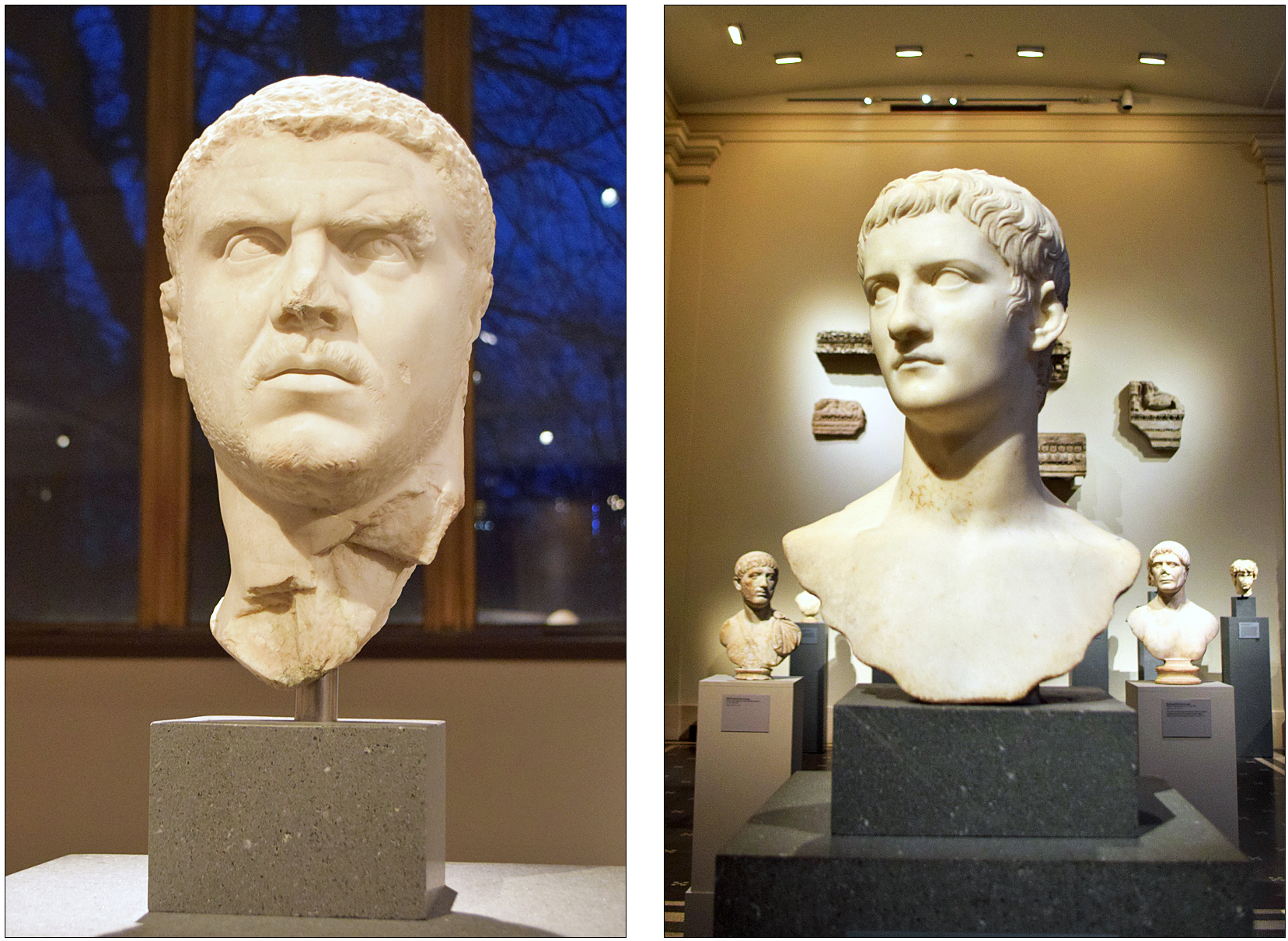
(L) Marble portrait of the Emperor Caracalla (M Aurelius Antoninus), Roman,
Severan period, 212-217 A.D. (R) Marble portrait bust of the emperor
Gaius, known as Caligula, Roman, Julio-Claudian period, 37-41 A.D.
Marble statue of the Three Graces, Roman, Imperial period,
2nd century A.D. Copy of Greek work, 2nd century B.C.
(L) Marble head of a Greek general (possibly the strategos Phokion),
Roman, Imperial period, 1st–2nd century A.D. Copy of Greek bronze
statue of the mid-4th century B.C. (R) Marble relief fragment
with the head of Mars, Roman, early 3rd century A.D.
(L) Marble portrait of a young woman, Roman, Trajanic period,
ca. 98-117 A.D. (R) Marble statue of Venus (Aphrodite) emerging
from her bath, Roman, 1st century B.C.–1st century A.D.
Cubiculum (bedroom) from the Villa of P. Fannius
Synistor at Boscoreale, Roman, ca. 50-40 B.C.
Wall painting of seated woman wearing a diadem and playing
a kithara from main reception hall 
in the villa of P. Fannius
Synistor at Boscoreale
, Roman, Late Republican, ca. 50—40 B.C.
(L) Marble statue of the Capitoline Aphrodite, Roman, 1st–2nd century A.D.
(R) Marble statue of Dionysos leaning on an archaistic female figure,
Roman. Augustan or Julio-Claudian period, 27 B.C.–68 A.D.
Adaptation of a Greek work of the 4th century B.C.
(L) Terracotta statuette of a goddess (Tyche ?), Greek, mid- to late
2nd century B.C. (R) Marble statuette of Dionysos Melanaigis (of
the Black Goatskin), Greek, early 3rd century B.C.
, said to
have been found at Koukouvaones in Attica
(L) Diabase statue of Aphrodite, Roman Imperial period, late 1st-early 2nd
century A.D., adaptation of a Greek work 3rd century B.C., known as
the Medici Aphrodite. (R) Marble statue of Aphrodite Anadyomene
(hair-binding), Greek, Hellenistic, 2nd century B.C.
(L) Life-sized bronze statue of an aristocratic boy, Roman, Augustan
period, 27 B.C.–14 A.D. Found on the eastern Mediterranean island
of Rhodes. (R) Bronze statue of Artemis and a deer, Greek or
Roman, Late Hellenistic or Early Imperial, ca. 1st century
B.C.–1st century B.C.–1st century A.D.
Bronze statue of Eros sleeping, Greek, Hellenistic or Augustan, 3rd
century B.C.—early 1st century A.D. Said to from the island of Rhodes
(L) Bronze cavalry sports mask, Roman, 2nd century A.D. (R) Bronze
portrait bust of a young boy (Nero ?), Roman, Julio-Claudian, ca. 50-68 A.D.
(L) Bronze portrait bust of a Roman matron, Roman, ca. 50-65 A.D.
and Bronze portrait bust of the emperor Gaius (Caligula), Roman,
ca. 37-41 A.D. (R) Silver-gilt horse rhyton (vase for libations
or drinking), Greco-Parthian, Hellenistic, 2nd century B.C.
(L) Bronze statuette of Venus or Isis, Roman, 1st century A.D. (R) Bronze
plaque of Mithras slaying the bull, Roman, mid-2nd–early 3rd century A.D.
Pair of serpentine gold armbands representing male and
female tritons holding a small winged Eros, Greek, ca. 200 B.C.
Terracotta lekanis (dish) with lid and finial, Greek,
Sicilian, Centuripe, 2nd half of 3rd century B.C.
Marble portrait head of the Emperor Constantine I,
Roman, Constantinian period, ca. 325-370 A.D.
Before breaking our Lenten fast with a light dinner (sans meat,
eggs and dairy) we stopped off at the Strand bookstore on Broadway
looking for a new art monograph. Instead, I found a couple of nice
paperback editions of poetry by Fernando Pessoa (1888-1935)

March 10, 2024

Holy Mass in Honor of the Martyrs of Tradition

Photo courtesy of Gianandrea de Antonellis @Carlismo1964
S. Messa in onore dei Martiri della Tradizione celebrata nella chiesa del Gesù a Castellammare di Stabia (Regno di Napoli), conclusa dal canto dell'Oriamendi

Holy Mass in honor of the Martyrs of Tradition celebrated in the church of Gesù in Castellammare di Stabia (Kingdom of Naples), concluded by the singing of the Oriamendi

March 9, 2024

10 marzo 2024, IV Domenica di Quaresima (Laetare): S. Messa cantata in Rito Romano antico nel Santuario di San Gaetano, ore 11.30

www.messatridentinanapoli.com
10 marzo 2024 – IV Domenica di Quaresima
ore 11.30 S. Messa cantata
Santuario di San Gaetano
Piazza San Gaetano, 78 – Napoli

March 7, 2024

New Music: La Nascita del Violoncello: Napoli - Bologna - Modena

New music that may be of interest to our readers.


• La Nascita del Violoncello: Napoli - Bologna - Modena performed by Bruno Cocset and Les Basses Reunies

Label:‎ Alpha
Release Date: February 1, 2024
Audio CD: $39.99
Number of Discs: 2

Available at Amazon.com

Read description

March 6, 2024

"A Scuola di Politica," Seminario di Formazione della Fondazione il Giglio

"A scuola di politica". Giovedi 7 marzo il seminario dei formazione della Fondazione il Giglio con Guido Vignelli. Commento a "L' Azione" di Jean Ousset

March 4, 2024

Act of Reparation to the Sacred Heart of Jesus for France

Sacré-Cœur

Our thoughts and prayers go out to the good people of France, whose godless political leaders voted to enshrine abortion as a right in the constitution. This “historic” decision will only serve to hasten the decline and fall of the so-called "Eldest Daughter of the Church." May Saint Genevieve, Saint Joan of Arc, and Saint Denis protect and watch over you, because your secular overlords certainly are not.

Act of Reparation to the Sacred Heart of Jesus


O Jesus, divine savior, deign to cast a look of mercy upon your children, who assemble in the same spirit of faith, reparation, and love, and come to deplore their own infidelities, and those of all poor sinners, their brethren.


May we touch your divine heart by the unanimous and solemn promises we are about to make and obtain mercy for ourselves, for the world, and for all who are so unhappy as not to love you. We all promise that for the future:


For the forgetfulness and ingratitude of men, we will console you, O Lord.
For the way you are deserted in your holy tabernacle, we will console you, O Lord.
For the crimes of sinners, we will console you, O Lord.
For the hatred of the impious, we will console you, O Lord.
For the blasphemies uttered against you, we will console you, O Lord.
For the sacrileges that profane your sacrament of love, we will console you, O Lord.
For the outrages against your divinity, we will console you, O Lord.
For the injuries of which you are the adorable victim, we will console you, O Lord.
For the coldness of the greater part of your children, we will console you, O Lord.
For the contempt of your loving invitation, we will console you, O Lord.
For the infidelity of those who called themselves your friends, we will console you, O Lord.
For the abuse of your grace, we will console you, O Lord.
For our own unfaithfulness, we will console you, O Lord.
For the incomprehensible hardness of our hearts, we will console you, O Lord.
For our long delay in loving you, we will console you, O Lord.
For our tepidity in your holy service, we will console you, O Lord.
For your bitter sadness at the loss of souls, we will console you, O Lord.
For your long waiting at the door of our hearts, we will console you, O Lord.
For the heartless scorn that grieves you, we will console you, O Lord.
For your loving sighs, we will console you, O Lord.
For your loving tears, we will console you, O Lord.
For your loving imprisonment, we will console you, O Lord.
For your loving death, we will console you, O Lord.


Let us pray: O Jesus! divine savior, from whose heart comes forth this bitter complaint, "I looked for one that would comfort me, and I found none," graciously accept the feeble consolation we offer you, and aid us so powerfully by your grace, that we may, for the time to come, shun more and more all that can displease you, and prove ourselves in everything, and everywhere, and forever your most faithful and devoted servants. We ask it through your sacred heart, O Lord, who live and reign with the father and the Holy Spirit one God, world without end. Amen.

Impromptu Visit to the Metropolitan Museum of Art

Two Men Contemplating the Moon, ca. 1825-30,
oil on canvas, Caspar David Friedrich
Last Friday, we made an impromptu visit to the Metropolitan Museum of Art after canceling our long-awaited trip to the Ronald S. Lauder NEUE GALERIE Museum for German and Austrian Art in Manhattan. Unfortunately for us, every first Friday of the month the NEUE GALERIE is free and as you'd imagine there was a crowded queue stretching around the block. Reluctant to wait, we decided to reschedule our visit and go to the Met instead.
Final Study for the Monument to Balzac,
modeled 1897, cast 1972, bronze, Aguste Rodin
Normally, we would have some sort of itinerary worked out, however, being last minute and having nothing planned, we just wandered aimlessly through the sundry galleries. Picking up where we left off during our last visit, we sauntered through the world-class European painting galleries on the second floor. Otherwise enjoyable, I would be remiss if I did not mention that the Jean-Baptiste-Camille Corot and neighboring Romanticism and Barbizon school galleries were poorly lit that day. Way too dark to properly view, this should be inexcusable; especially since the museum only recently completed a five-year-long major overhead lighting renovation project.
Ville-d'Avray, 1790, oil on canvas, Camille Corot
The biggest surprise for me was seeing Two Men Contemplating the Moon (ca. 1825-30) by Caspar David Friedrich. I didn’t mention it in my previous writeup, but last month I mistakingly thought the upcoming exhibit, Caspar David Friedrich: The Soul of Nature, was scheduled to open in February. Somehow, in my excitement and haste, I misread the dates on the website, which clearly says, February 7, 2025–May 11, 2025. Not one to make excuses, but in my defense, the online overview does say, “Presented in honor of the 250th anniversary of Friedrich’s birth in 2024.” As you can imagine, I was more than a little embarrassed when we showed up and there was no Friedrich on display.
(L) Reverie, ca. 1860-65, oil on wood, Camille Corot.
(R) The Muse: History, ca. 1865, oil on canvas, Camille Corot
Seeing as they’re promoting the Friedrich exhibit over a year in advance and it will be the first comprehensive exhibition dedicated to the artist held in the United States, I think my eagerness can be forgiven. At least I keep telling myself that.

It should be noted, as of this writing, that the museum’s website wrongly states that Friedrich's Two Men Contemplating the Moon is currently not on view.

Saltash with the Water Ferry, Cornwall, 1811,
oil on canvas, Joseph Mallord William Turner
Making our way through the various European Painting galleries; Late Roman, Early Byzantine and Late Medieval Secular Art galleries; and the Henry R. Luce Center for the Study of American Art gallery, a visible-storage facility that displays more than ten thousand works of American fine and decorative art; we spent the majority of our visit in the American Wing. 
(L) Study of a Female Nude, 1840, oil on canvas, Henri Lehmann.
(R) Brigand and His Wife in Prayer, 1824, oil on canvas, Léopold Robert
Admittedly, I don’t visit the American Wing as often as I should. The quality of the collection should command more attention. Among my favorites are Madame X (Madame Pierre Gautreau) by John Singer Sargent (currently not on view), Repose by John White Alexander, Spanish Music Hall by Everett Shinn, and Leatherstocking’s Rescue by John Quidor. Hauntingly beautiful, A Rose by Thomas Anshutz is the spitting image of my old friend Charlotte. She humbly disagrees.
Repose, 1895, oil on canvas, John White Alexander
Despite the recent spate of modern installations, tired anti-Western bias and unwanted ideological “perspectives,” the Met’s permanent collection is so grand and multifarious it’s virtually impossible to not enjoy yourself there.

Hopefully, next time we will be able to visit the NEUE GALERIE; but if not, the Met is just down the block.
(L) Mr. and Mrs. I.N. Phelps Stokes, 1897, oil on canvas, John Singer Sargent.
 (R) A Rose, 1907, oil on canvas, Thomas Anshutz
Leatherstocking's Rescue, 1832, oil on canvas, John Quidor
(L) Genius of Mirth, 1842; this carving, 1843, marble, Thomas Crawford.
(R) Nydia, the Blind Flower Girl of Pompeii, ca. 1853-54;
this carving, 1859, marble, Randolph Rogers
Spanish Music Hall, 1902, oil on canvas board, Everett Shinn
Aquamanile in the form of a Lion, 1100-1200,
copper alloy with glass inlay, North German
Through the 400s and 500s, the Visigoths minted gold coins mimicking Byzantine imperial coins. Early Visigothic issues closely resemble their imperial models, but by the mid-500s the images and inscriptions had strayed far from Byzantine designs. In the late 500s and 600s, Visigothic rulers minted coins in their own names and showed themselves in simple frontal portraits. Top to bottom, left to right: Two Gold Tremisses of Emperors Justinian I (r. 527-65) and Maurice Tiberius (r. 582-602), Byzantine, Minted 527-602 in Constantinople; Two Gold Solidi Imitating Those of Emperor Valentinian III (r. 425-55), minted about 450-60, probably in Toulouse, southern France; Two Gold Solidi Imitating Those of Emperor Justinian I (r. 527-65), minted mid-500s; Two Gold Tremisses Imitating Byzantine Imperial Tremisses, minted mid 500s; and Gold Tremissis of King Reccared (r. 586-601) minted 586-601 in Mérida, western Spain.

Feast of San Casimiro

San Casimiro, ora pro nobis
March 4th is the Feast of St. Casimir Jagiellon (1458-1484), Chaste Prince, Knight, Ascetic and Confessor of the Faith. Devoutly religious, the dutiful Prince was a skilled and prudent leader. Acquiring a reputation of holiness, he was uninterested in the allures of power. Afflicted with tuberculosis, the court doctors could not heal him. The hour of his death was revealed to him, and he prepared for it. Taking a crucifix in his hand, St. Casimir commended his spirit to the Lord and died. Many miracles have been attributed to the saint’s intercession. St. Casimir is the patron saint of Poland, Lithuania and young people.

In celebration, we’re posting a prayer to Saint Casimir. The accompanying photo was taken in the rectory of St. Rita’s Church in Staten Island, New York. Evviva San Casimiro!


Prayer to Saint Casimir 


O God, who didst preserve thy servant Casimir constant and faithful in thy service amidst the delights of a court, and the attractive allurements of the world, grant, we beseech thee, that by his intercession thy people may despise the transitory things of the world and eagerly pursue things which are eternal: through Jesus Christ our Lord.

March 3, 2024

The Fall of the Rebel Angels

The Fall of the Rebel Angels (ca. 1666),
Luca Giordano, Kunsthistorisches
Museum, Vienna, Austria
In this second installment of my "virtual chapbook," I sing of the downfall of the Luciferians. Never realizing my plan to pen my own epic poem in the vein of Joost van den Vondel's Lucifer (1654), I neatly summarized the War in Heaven and its repercussions in Campania in three short stanzas.

The Fall of the Rebel Angels

Angelic trumpets sound
And the rebels stormed the gate.
The Morningstar cast down,
Diadem knocked from his pate.

A piece of Heaven fell with him,
Plunging into the Siren’s Bay.
Avernus retched its foul air,
Vesuvius convulsed and quaked.

Weeping over the desolation,
Christ’s tears fecundate.
The land of bells lies forever
Between the realms of love and hate.

Photo of the Week: Dante Alighieri Monument

Dante Alighieri by Tito Angelini in Piazza Dante, Napoli 
Photo by New York Scugnizzo

Southern Italian Music for Holy Week

• Passione

Read description


• La Voce Della Passione


Read description


• Tenebrae: Neapolitan Music for the Holy Week


Read description


• Passio Secundum Joannem by Francesco Feo


Read description


All are available from Amazon.com

March 2, 2024

3 marzo 2024, III Domenica di Quaresima: S. Messa cantata in Rito Romano antico nel Santuario di San Gaetano, ore 11.30

www.messatridentinanapoli.com

New Book — The Martyrs of Castelfidardo

Forthcoming title that may be of interest to our readers. Available at aroucapress.com


• The Martyrs of Castelfidardo by Anatole-Henri-Philippe, Marquis de Ségur, and edited by Brendan Cassell

Publisher: Arouca Press
Publication Date: Spring, 2024
Paperback: $n/a
Language: English
Pages: n/a

Read description

Click here to see more books

Listing does not imply any endorsement

March 1, 2024

New Kindle Edition — The Science of Naples: Making Knowledge in Italy’s pre-eminent city, 1500-1800

Forthcoming title that may be of interest to our readers. Available at Amazon.com


• The Science of Naples: Making Knowledge in Italy’s pre-eminent city, 1500-1800 edited by Lorenza Gianfrancesco and Neil Tarrant

Publisher: UCL Press
Sold by: Amazon Digital Services LLC
Publication Date: January 8, 2025
Kindle: $1.49
Paperback: n/a
Harback: n/a
Language: English
File size: n/a

Read description

Click here to see more books

Listing does not imply any endorsement