June 30, 2025

Simple Pleasures: The Flag of Galicia

I always enjoy seeing people take pride in their regional and Catholic heritage. So you can imagine how happy I was to spot the flag of Galicia outside Tomiño Taberna Gallega while walking along Grand Street, between Mulberry and Mott, in Little Italy, New York. (Heaven forbid any of the Italian businesses fly anything other than the geometric eyesore that is the Jacobin tricolore.)

While the current state flag was officially adopted in 1981, its design is based on the historic banner of the former Kingdom of Galicia. It features a white field with a diagonal sky blue band, overlaid with the royal coat of arms: a golden chalice bearing a silver Host on a royal blue shield, surrounded by seven crosses and topped with a crown.


Photo of the Week: Teasing a Sleeping Girl by Gaspare Traversi

Teasing a Sleeping Girl, oil on canvas, Gaspare Traversi (c. 1722-c. 1770),
Metropolitan Museum of Art. Photo by New York Scugnizzo

June 29, 2025

Simple Pleasures: Fleur-de-lis Finials

If one looks past the filth and squalor of our modern metropolis, one can still glimpse long-forgotten architectural treasures from a bygone civilization. Amid the teeming cobblestones of SoHo, I came upon an old wrought-iron gate on Crosby Street, crowned with fleur-de-lis finials—an ancient symbol of the House of Bourbon.

New Book — Monasticism & Renewal in Southern Italy: The Chronicle of Montecassino by Leo Marsicanus, C. 529-1075

A forthcoming title that may be of interest to our readers. Available at Amazon.com


Monasticism and Renewal in Southern Italy: The Chronicle of Montecassino by Leo Marsicanus, C. 529-1075 by Graham Loud

Publisher: Manchester University Press
Publication date: February 3, 2026
Hardcover: $140.00
Language: English
Pages: 392

Read description

Click here to see more books

Listing does not imply any endorsement

June 28, 2025

Simple Pleasures: A Materan Cucù

A friend brought back a traditional cucù from his trip to Matera. A timeless symbol of the Sassi city, this hand-painted terracotta bird whistle blends local folklore with artisanal craftsmanship. Once given as a congratulatory gift, it is an ancient good luck charm and a symbol of prosperity.

June 26, 2025

Gothic Fiction Reawakened: Dracula and Frankenstein Return in 2025

"In seeking life, I created death." ~ Victor Frankenstein
Around this time last year, I shared my excitement for the then-upcoming films Nosferatu (2024) and Hellboy: The Crooked Man (2024). Now, once again, I find myself eagerly anticipating two new releases: Guillermo del Toro’s Frankenstein and Luc Besson’s Dracula. Both trailers look promising, and hopefully—like last year’s offerings—they’ll live up to expectations. As a longtime fan of horror and gothic fiction, I’m always looking forward to authentic retellings of classic tales.

Having said that, Besson’s Dracula appears to lean more toward a reimagining of Gary Shore’s Dracula Untold (2014) than a faithful adaptation of Bram Stoker’s 1897 novel. Given how nearly impossible it would be to surpass Robert Eggers’ Nosferatu, perhaps that’s for the best.

Watch the Dracula trailer
Del Toro’s Frankenstein, on the other hand, makes me especially hopeful. If he remains faithful to Mary Shelley’s Frankenstein; or, The Modern Prometheus (1818), we may finally get a cinematic version that captures the novel’s philosophical depth and romantic soul—qualities so often lost in film adaptations.

Watch the Frankenstein trailer

Luc Besson’s Dracula is scheduled for release on July 30, 2025, while Guillermo del Toro’s Frankenstein is set to premiere on Netflix in November.

June 25, 2025

Simple Pleasures: A Thoughtful Gift for My Name Day

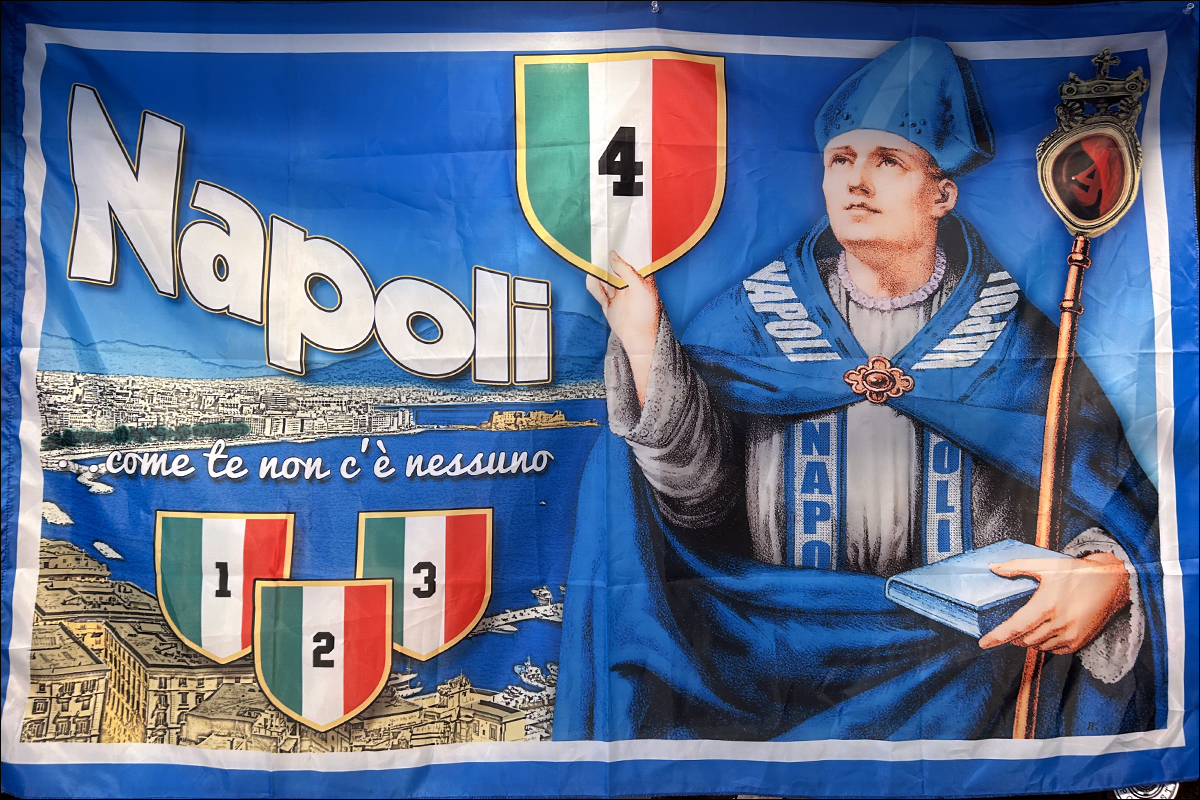
For my name day (the Feast of San Giovanni Battista), a friend gave me a new flag commemorating Napoli’s fourth Scudetto. Perhaps blurring the line between the sacred and the profane, the flag depicts San Gennaro—the patron saint of our glorious capital—arrayed in Napoli’s colors and triumphantly brandishing the fourth Scudetto. Forza Napoli Sempre!

June 24, 2025

Praying for Peace

Our Lady of Fatima, ora pro nobis
"I shall come to ask for the Consecration of Russia to My Immaculate Heart…If people attend to My requests, Russia will be converted and the world will have peace.” ~ The Virgin Mary at Fatima (July 13, 1917)
In this dark hour, as the fires of conflict rage across the Middle East, consume Ukraine, and now threaten to engulf Iran, we raise our voices—not in hatred, but in warning, and in hope.

The world stands perilously close to the brink of a war that could devastate not only nations but also the very future of mankind. The specter of World War III is no longer a distant nightmare; it looms near, born of reckless pride and the ideological delusions of power-hungry madmen.

We condemn the warmongers on all sides—especially those among our own leaders—driven by power and profit, hell-bent on dragging these United States into yet another foreign conflagration.

And so, as children of a sorrowful age, we turn not to politicians or parties, but to Heaven. We humbly implore the intercession of Our Lady. In union with the faithful across the world, we renew the Consecration of Russia to your Immaculate Heart, as requested at Fatima. Though long delayed and imperfectly fulfilled, we pray that this act be accepted—in spirit and in truth.

A Solemn Act of Consecration to the Immaculate Heart of Mary

Most Holy Virgin Mary, tender Mother of men, to fulfill the desires of the Sacred Heart of Jesus and the request of the Vicar of Your Son on earth, we consecrate ourselves and our families to your Sorrowful and Immaculate Heart, O Queen of the Most Holy Rosary, and we recommend to You, all the people of our country and all the world.

Please accept our consecration, dearest Mother, and use us as You wish to accomplish Your designs in the world.

O Sorrowful and Immaculate Heart of Mary, Queen of the Most Holy Rosary, and Queen of the World, rule over us, together with the Sacred Heart of Jesus Christ, Our King. Save us from the spreading flood of modern paganism; kindle in our hearts and homes the love of purity, the practice of a virtuous life, an ardent zeal for souls, and a desire to pray the Rosary more faithfully.

We come with confidence to You, O Throne of Grace and Mother of Fair Love. Inflame us with the same Divine Fire which has inflamed Your own Sorrowful and Immaculate Heart. Make our hearts and homes Your shrine, and through us, make the Heart of Jesus, together with your rule, triumph in every heart and home.

Amen.

Photo of the Week: Pulcinella Figurine

Pulcinella, Neapolitan (Capodimonte) or Spanish (Real Fabrica de Buen Retiro), soft-paste porcelain, 1759-80, Giuseppe Gricci (ca. 1700-1770). Metropolitan Museum of Art. It is unclear whether this figure of Pulcinella was produced at Capodimonte in Italy or its successor factory at Buen Retiro in Spain. When Charles VII of Naples became Charles III of Spain in 1759, he moved the entire operation, including forty workers and five tons of raw material, from Capodimonte to the palace of Buen Retiro, outside of Madrid. The factory mark of a fleur-de-lis remained in use in the new location, and thus it is often difficult to distinguish wares and figures made in the last years at Capodimonte from the early products of Buen Retiro. Photo by New York Scugnizzo

Il Primo Reggimento Re Sara Presente al Corteo Storico della Real Colonia di San Leucio

June 23, 2025

Mourning Under the Watchful Gaze of Santa Rosalia

Santa Rosalia, ora pro nobis
Seated beneath the polychrome statue of Santa Rosalia—Palermo’s 12th-century noblewoman who renounced marriage and courtly privilege to live as a hermit on Mount Pellegrino—I prayed and reflected on the recent deaths of loved ones.

Clutching a cross in her hand, with a skull resting at her discalced feet, the statue embodies the medieval Christian motif of memento mori. More than a grim reminder of death, the image is a visual summons to contemplation, penitence, and sacred understanding.

In the stillness of Our Lady of Grace Church in Brooklyn, Rosalia’s figure stood as both warning and comfort—a testament to the inevitability of death, and an intercessor at the liminal threshold between life and the hereafter, offering prayers, guidance, and solace to souls crossing over.

Eternal rest grant unto them, O Lord, and let perpetual light shine upon them. May their souls, and the souls of all the faithful departed, through the mercy of God, rest in peace. Amen.

Happy Birthday Princess Maria Carolina!

HRH was born in Rome, Italy on June 23, 2003
Photo courtesy of Real Casa di Borbone
Happy Birthday, Princess Maria Carolina of Bourbon-Two Sicilies, Duchess of Palermo and Calabria!

On this special day, may Heaven bless you with grace, joy, and unwavering peace. May the noble legacy you bear continue to shine through your life with beauty and dignity.

Auguri di cuore, Altezza!

June 22, 2025

Solemn Corpus Christi Procession Following the Traditional Latin Mass in Brooklyn

Venite adoremus Dominum
Following Sunday’s Traditional Latin Mass at Our Lady of Peace Church in Gowanus, Brooklyn, around a hundred faithful took part in the annual solemn Corpus Christi procession. Winding its way around the church and pausing at the station altars, the faithful knelt in adoration as the priest, bearing the Eucharist in the monstrance, offered benediction. Flower girls scattered rose petals along the path, preparing the way for the procession. Acolytes carried the Crucifix and candles, swinging censers of incense, while the ombrellino shaded the Sacred Host. Throughout, the choir chanted hymns, lifting hearts to Heaven during this radiant Catholic tradition.

June 19, 2025

Brief Excerpt From “Of Particular Sovereignties and Nations” by Joseph De Maistre

Nations are born and die like individuals; nations have fathers, in the literal sense, and founders ordinarily more famous than their fathers, although the greatest merit of these founders is to penetrate the character of the infant-people and place it in circumstances wherein it may most fully develop its powers.

Nations have a general soul and a true moral unity which makes them what they are. This unity is especially manifested through language.

The Creator has marked out over the globe the limits of nations, and St. Paul has spoken philosophically to the Athenians when he said to them: And (He) hath made of one blood all nations of men for to dwell on all the face of the earth, and hath determined the times before appointed, and the bounds of their habitation (Acts, XVII, 26). These bounds are visible, and we always see each people tending to fill completely one of the enclosed spaces between these bounds. Sometimes invincible circumstances hurl two nations into one another and force them to mingle: then their constituent principles interpenetrate, and the result is a hybrid nation which may be more or less powerful and famous than if it were of pure stock.

But several national precepts thrown into the same receptacle may cause mutual harm. The seeds are squeezed and smothered; the men who compose them, condemned to a certain moral and political mediocrity, will never attract the eyes of the world despite a great number of individual merits, until a great jolt, starting one of these seeds germinating, allows it to engulf the others and assimilate them to its own substance. Italiam! Italiam! (1)

Sometimes one nation subsists amid a much more numerous one, refusing to amalgamate because there is not enough affinity between them, and retains its moral unity. Then, if some extraordinary event comes to disorganize the dominant nation, or prompts a great movement, we will be very surprised to see the other resist the general impetus and produce a contrary movement. Hence the miracle of the Vendée. The other malcontents of the kingdom, though in much greater numbers, could not have accomplished anything of this kind, because these discontented men are only men, whereas the Vendée is a nation. Salvation can even come from this, for the soul that presides over these miraculous efforts, like all active powers, has an expansive force that makes it tend constantly to enlarge, so that it can, in gradually assimilating what resembles itself and pressing out the rest, finally acquire enough supremacy to achieve a prodigy. Sometimes the national unity is strongly pronounced in a very small tribe; as it cannot have a language of its own, to console itself it appropriates that of its neighbours by an accent and particular forms. Its virtues are its own, its vices are its own; in order not to have the ridiculous ones of others, it makes them its own; without physical strength, it will make itself known. Tormented by the need to act, it will be conqueror in its own way. Nature, by one of those contrasts that it loves, will place it, playfully, beside frivolous or apathetic peoples who will make it noticed from afar. Its brigandage will be cited in the realm of opinion; at last, it will make its mark, it will be cited, it will succeed in putting itself in the balance with great names, and it will be said: I cannot decide between Geneva and Rome. (2)

Notes:
(1)  <The keen vision of one J. de Maistre is not required to recognize with him the disadvantages of the excessive fragmentation of Italy. But the constant adversary of the Revolution, the honest and Christian politician, would with all his energy have disapproved of the methods of a Cavour and a Garibaldi. There was a way to unite the forces and resources of the brilliant peninsula while respecting its righis> [Count Camillo Benso di Cavour described by Benjamin Disraeli as "utely unscrupulous”—sometime Prime Minister of Piedmont-Sardinia, convinced King Charles Albert to revert to constitutional monarchy and to go to war against Austria, leading to the king's abdication; he also exacerbated the waning infuence of the Catholic Church by ordering the closure of half of the monastic houses within Sardinian territories. Garibaldi, general, popular hero, and intense anticlerical and social reformer, was privately supported and publicly opposed by Cavour in his expedition against Sicily, later winning Naples and ostensibly leading a private expedition against the Papal States, but with the secret complicity of the Italian government.]

(2)  [For Maistre, in the world-historical struggle between the forces of secularism and those of religion, Geneva and Rome stand for the latter; yet Protestant Geneva is only nominally on the same side as Catholic Rome. In his Oeuvres, Maistre characterizes Protestantism as "le sans-cullottisme de la religion", and in Considerations on France, p. 73, states that Protestantism and the French Revolution partake of a common source.]

* Reprinted from Major Works, Vol. 1: Generative Principle of Political Constitutions, Considerations on France, Study on Sovereignty, Joseph De Maistre, Imperium Press, 2021, pp.174-175.

June 18, 2025

Congratulations to the Viola Family and Their Victorious Panthers

Concept logo by New York Scugnizzo
There are moments in sports that transcend the game—when determination, strategy, grit, and leadership converge to carve history into stone—or in this case, into the Stanley Cup. Last night was one of those moments, as the Florida Panthers clinched their second consecutive championship, prevailing over the Edmonton Oilers in a hard-fought final.


At the heart of this triumph stands the Viola family, who have quietly, steadily, and passionately guided the franchise toward greatness.

Three cheers to the entire Viola family, whose stewardship has delivered not only back-to-back titles but also a renewed spirit to South Florida hockey. Winning one Stanley Cup is a dream; winning two in a row? That’s a statement.

They’ve transformed the Panthers from underdogs into a dynasty in the making.

Go Cats Go!

June 17, 2025

Feast of Beata Teresa del Portogallo

Beata Teresa del Portogallo, ora pro nobis
Blessed Theresa of Portugal was a 13th-century Portuguese infanta known for her piety, charitable works, and commitment to religious life. She was the daughter of King Sancho I of Portugal and Queen Dulce of Aragon, and the sister of St. Sancha and King Afonso II.

In 1191, Theresa married King Alfonso IX of León, a union that was later annulled by the Church on the grounds of consanguinity. Despite the annulment, she continued to maintain a dignified relationship with Alfonso and took a deep interest in the welfare of their children. After the separation, she returned to Portugal and dedicated herself to a life of prayer, penance, and charity.

Theresa retired to the Monastery of Lorvão, which she transformed into a Cistercian convent. There, she eventually took religious vows and became an abbess. She was known for her humility, generosity to the poor, and support of monastic reform.

Blessed Theresa of Portugal died on June 17, 1250. She was beatified by Pope Clement XI in 1705. Her feast day is celebrated on June 17th. Evviva Beata Teresa del Portogallo!

Prayer to Blessed Theresa

Pour out upon us, Lord, the spirit of knowledge and love of you, with which you filled your handmaid, blessed Teresa, so that, serving you sincerely in imitation of her, we may be pleasing to you by our faith and our works. Through our Lord Jesus Christ, your Son, who lives and reigns with you in the unity of the Holy Spirit, God, forever and ever. Amen.

Photo of the Week: Water Jar with Tritons and Return of a Mounted Warrior

Terracotta hydria, Greek, South Italian, Campanian, red-figure, ca. 350-320 B.C., attributed to the Group of Naples 3227, Metropolitan Museum of Art.
Photo by New York Scugnizzo

June 16, 2025

In Loving Memory of My Aunt and Uncle

Madonna and Child with the Poor and Forgotten
Souls in Purgatory
by Luca Giordano
This week, our family said goodbye to two extraordinary people. My Aunt Angie and Uncle Joey passed away just days apart, both after courageous battles with cancer. Surrounded by family and loved ones, they left this world together—and we believe, they entered the next together too—to receive their eternal reward after death.

Their loss comes just a week after the passing of our dear friend Anna. It has been a time of deep sorrow, reflection, and remembrance.

We kindly ask you to keep them in your prayers.

Eternal rest grant unto them, O Lord, and let perpetual light shine upon them. May their souls, and the souls of all the faithful departed, through the mercy of God, rest in peace. Amen.

Happy Birthday Princess Beatrice di Borbone!

HRH was born in Saint-Raphaël, France, on June 16, 1950
Il Regno
 would like to extend our warmest birthday wishes to Her Royal Highness Princess Beatrice di Borbone delle Due Sicilie, Dame Grand Cross of Justice and Grand Prefect of the Sacred Military Constantinian Order of St. George. May God continue to shower you with all the blessings you truly deserve. Auguri Altezza Reale!

June 14, 2025

A Brief Overview of “La ‘Vandea’ d’Italia” by Salvatore C. Ruta

Salvatore C. Ruta’s article, “La ‘Vandea’ d’Italia” (The “Vendée” of Italy), originally published in L’Alfiere: Pubblicazione Napoletana Tradizionalista, Numero Unico (Luglio–Agosto 1960), offers an incisive historical examination of Sicily during the French Revolution. This exceptional work of revisionist scholarship highlights the island’s unique counter-revolutionary identity. Through thorough analysis, Ruta portrays Sicily as Italy’s own “Vendée”—a steadfast bastion of monarchy and tradition amid the revolutionary tides that swept across Europe between 1781 and 1812.

What makes this article particularly compelling is the author’s nuanced understanding of the island’s socio-political landscape and its resistance to revolutionary ideology. By emphasizing the lack of a strong bourgeoisie to translate Enlightenment ideals into action—and by highlighting the entrenched power of the aristocracy, the clergy, and the deeply rooted religious beliefs of the people—he convincingly argues that Sicily’s conservatism was not a reactionary stagnation but rather a coherent and organic response grounded in historical and cultural realities.

Viceroy Domenico Caracciolo
by Gaetano Mangano
The figure of Domenico Caracciolo, Viceroy of Sicily, is presented with critical complexity. Ruta acknowledges Caracciolo’s administrative brilliance, yet does not shy away from showing how his Enlightenment zeal and reforms, undertaken without regard for local traditions and institutions, alienated every major stratum of Sicilian society.

“In 1780, when the Marquis Domenico Caracciolo became viceroy—an early forerunner of the deeds of the admiral from the same family—he began that extremely delicate process in which the politically valid forces of the island were shifted toward positions of such radicalism as to lead, in due course, to the fateful split, first emotional and then political, between Sicily and the Neapolitan mainland. Caracciolo, having spent a long time in Paris as a diplomat and deeply imbued with Enlightenment eclecticism (his friendships with the Jacobin intellectuals of the time are well known), came to Palermo with the conviction that a series of reforms and laws would suffice to bring the people ‘up to speed with the times.’ Demonstrating a remarkable capacity for action, he neglected the island’s historical, political, and social traditions, suppressed local religious orders and the Sicilian Tribunal of the Holy Office, promoted the construction of roads and the organization of convoys to make sea navigation—hindered by pirates—safer, increased the power of the police, and allied himself with the bourgeoisie in order to elevate it to a political class. His aim was explicitly to equalize all citizens in front of the authority of the State.”

Caracciolo’s attempt at modernization, undertaken without regard for the island’s historical rhythms, emerges not as visionary statesmanship but as a politically tone-deaf experiment, doomed to fail in the face of deep-rooted loyalties and social bonds.

“All this industriousness did not bring him popularity. Strangely enough, this earned him little, if any, sympathy—partly because he personally maintained a contemptuous attitude toward tradition, the aristocracy, and the culture of the Island. Before long, the antipathy he had stirred up turned into distrust and then into hostility, from the nobles who saw in him someone intending to diminish their political power, from the clergy alarmed by the suppression of religious orders, from the bourgeoisie closely linked by economic ties to the nobility, and from intellectuals who generally shared the views of the nobility and cultivated legal doctrines in defense of feudal rights and historical sciences that supported separatist arguments. He was eventually recalled.”

One of the article’s greatest strengths lies in its ability to balance political and cultural history. Ruta vividly conveys how the monarchy retained the loyalty of the Sicilian people not through coercion but through a complex web of historical memory, religious devotion, and aristocratic identity. He explains how, even in the face of Napoleonic aggression, the Sicilians did not merely defend a regime—they defended a worldview. His documentation of the popular resistance to French incursions, the failure of Jacobin propaganda, and the widespread abhorrence of Enlightenment radicalism is thorough and compelling.

“In Sicily, the French Revolution, despite the activities of emissaries and propagandists, did not give rise to subversive movements. It was rightly viewed as a seditious phenomenon. Writers such as Logoteta, l’ Ayala, the Controsceri, and Santacolomba encouraged Sicilians to remain faithful to religion and to their age-old devotion to the monarchy and thundered against ‘incendiary papers' while being pleased that their fellow countrymen were keeping themselves far away 'from the fire of an unbridled revolt...to overturn all the political ideas most solidly established by common sense and the experience of the centuries and to overthrow with one stroke the Church and the Monarchy under the lie of regeneration.’ These were clear ideas concerning the counterrevolutionary spirit, expressed by Antonino Pepi in his Discourse on the Natural Inequality Among Men.”

Furthermore, Ruta’s use of primary voices—such as Queen Maria Carolina and counter-revolutionary writers like Logoteta and Pepi—gives the article a grounded authenticity.

“How little the ideas from beyond the Alps suited the Sicilians was evident once again when the Neapolitan court moved to Sicily under pressure from the French army. In Sicily, Queen Carolina wrote to the Marquis Gallo, ‘THE VERY NAME OF THE FRENCH IS ABHORRED,’ while a lively polemic was underway, one in which Abbot Meli participated, against the "philosophers, Freemasons, know-it-alls, and politicians" from across the sea.”

The author’s recounting of the failed French military incursion at Mili and the noble-led popular resistance is as stirring as it is significant, highlighting the islanders’ willingness to defend their traditions with arms.

“The only military expedition attempted by the French against the Island ended in disaster: shortly after a division of 3,000 men under Marshall Cavaignac had attempted to establish a bridgehead, on September 18, 1810, at Mili (ten kilometers south of Messina), they were thrown back into the sea by a poorly armed populace led by the local nobles even before English troops under Campbell arrived.”

At a time when historical narratives often focus narrowly on revolutionary progress and liberal transformation, Ruta’s essay offers a welcome counterbalance. It challenges readers to reconsider the legitimacy of conservative and monarchist positions, not as mere reaction or inertia, but as coherent, deeply rooted worldviews worthy of serious engagement. Sicily, in Ruta’s hands, is not a backward province lagging behind modernity, but a conscious actor in European history, choosing continuity and faith over rupture and ideology.


“La ‘Vandea’ d’Italia” is a rich and thought-provoking contribution to the study of Sicilian history and counter-revolutionary Europe. By repositioning Sicily not as a passive backwater but as an active and conscious defender of the ancien régime, Salvatore C. Ruta offers readers a new lens through which to view one of Italy’s most misunderstood regions. This article is essential reading for historians of the Revolution, Monarchy, and the enduring power of tradition.


By Giovanni di Napoli, June 6th, Feast of St. Norbert


* Translations are my own

June 13, 2025

The Timeless Work of Michela De Vito (Part 3)

Viewing my friend’s newly acquired collection of timeworn, delicate hand-painted illustrations by Michela De Vito—a 19th-century Neapolitan painter and draughtswoman, and the daughter of the artist Camillo De Vito—was a rare and wonderful experience. Each piece offered a vivid window into the past, capturing the traditional folk costumes of the various regions of the old Kingdom of Naples with remarkable sensitivity. Her brushwork, both detailed and elegant, conveyed not only the attire but also the dignity and spirit of the people she portrayed—preserving, through art, the intimate soul of a civilization now lost to time


Part 1, Part 2

The Timeless Work of Michela De Vito (Part 2)

Viewing my friend’s newly acquired collection of timeworn, delicate hand-painted illustrations by Michela De Vito—a 19th-century Neapolitan painter and draughtswoman, and the daughter of the artist Camillo De Vito—was a rare and wonderful experience. Each piece offered a vivid window into the past, capturing the traditional folk costumes of the various regions of the old Kingdom of Naples with remarkable sensitivity. Her brushwork, both detailed and elegant, conveyed not only the attire but also the dignity and spirit of the people she portrayed—preserving, through art, the intimate soul of a civilization now lost to time


Part 1, Part 3