March 21, 2024

Conversaciones de La Esperanza

El tradicionalismo hispánico y su cuatrilema: Dios-Patria-Fueros-Rey

El Consejo de Estudios Hispánicos Felipe II invita a la quinta sesión del ciclo formativo correspondiente al curso 2023/2024 de las Conversaciones de La Esperanza, que tendrá lugar (D.m.) el sábado 23 de marzo de 2024, a las 20:00 (ocho de la tarde, hora oficial de Madrid; ver otros husos horarios).

Se reanuda así el curso «El tradicionalismo hispánico y su cuatrilema: Dios-Patria-Fueros-Rey» tras las vacaciones estivales del hemisferio sur.

Se podrá acceder a la sesión, que se impartirá desde la plataforma Zoom, a través de este enlace.

Quienes no estén inscritos con anterioridad deberán enviar nombre, apellidos, número de teléfono y lugar de residencia al correo electrónico conversaciones@periodicolaesperanza.com

Algunas indicaciones para la conferencia en ZOOM:

• Se ruega a los asistentes que pongan su nombre y apellidos completos al ingresar en la plataforma. No se admitirán nombres de usuario anónimos ni incompletos.
• Durante el desarrollo de la conferencia no se permitirán ni cámaras ni micrófonos abiertos. Antes y después, su uso es libre y deseable para que los presentes se saluden.
• Durante el desarrollo de la conferencia no se permitirá el uso del chat salvo en el momento de admitirse preguntas al conferenciante. Antes, después y durante, se ruega que el uso del chat sea moderado y lo más ordenado posible.
• Las preguntas al conferenciante han de ser acordes y pertinentes al tema expuesto, claras y breves. Por norma general no se atenderán comentarios ni apreciaciones, sino exclusivamente preguntas.

March 20, 2024

Remembering HRH Prince Don Ferdinando Maria Andrea Alfonso Marco of Bourbon-Two Sicilies

28 May 1926 - 20 March 2008
In memory of His Royal Highness Prince Ferdinand of Bourbon-Two Sicilies, late Grand Master of the Sacred Military Constantinian Order of St. George, we pray for the happy repose of his soul.

Let us pray:

O God, the Creator and Redeemer of all the faithful, grant to the souls of the brethren, relations, and benefactors of our Order, and especially the late Grand Master, Ferdinand, the remission of all their sins, that they may obtain the clemency which they have always desired by pious supplications, and rejoice in the heavenly homeland with the Saints and Thy elect. Through Christ our Lord. Amen.

Eternal rest grant unto them O Lord, and let perpetual light shine upon them. May their souls and the souls of all the faithful departed, through the mercy of God, rest in peace. Amen.

Sanfedisti

In this third installment of my "virtual chapbook," I pay homage to the great counter-revolutionary hero Cardinal Fabrizio Ruffo (1744-1827) and his Army of the Holy Faith (Sanfedisti), who defeated the subversive Jacobins and liberated the Kingdom of Naples in 1799.

Sanfedisti

Vermilion raiment at the head of the host
Answering His Majesty’s call,
To defend faith, family and hearth
From Napoleonic Gaul.

The warrior prelate from old Magna Graecia
Raised an unwavering array,
Like Patrizia over the “maiden-voiced”
The Army of the Holy Faith delivered Parthenope.

Routing the traitorous Jacobin
They felled the “Trees of Liberty,”
And restored to his rightful throne
His Sicilian Majesty.

New Book — The Neapolitan Creative Economy: The Growth of the Music Market and Creative Sector in Naples, 17th – 19th Centuries

Forthcoming title that may be of interest to our readers. Available at Amazon.com


The Neapolitan Creative Economy: The Growth of the Music Market and Creative Sector in Naples, 17th – 19th Centuries by Rossella Del Prete

Publisher: Palgrave Macmillan
Publication Date: June 9, 2024
Hardcover: $129.99
Language: English
Pages: 250

Read description

Click here to see more books

Listing does not imply any endorsement

March 19, 2024

The Bells of Santa Maria delle Grazie a Toledo

In the Chiesa di Santa Maria delle Grazie on the Via Toledo in Naples, sit two bells by the side entrance depicting the portraits of King Ferdinando II, Beato Maria Cristina di Savoia, and the royal coat of arms of Bourbon–Two Sicilies.

Erected in 1628 in honor of the Madonna di Loreto by the Theatine Fathers of the Holy Apostles, the church underwent remodeling in 1721. Expelled by the French in 1806, the church was temporarily used as a tribunal by the pretenders to the throne Joseph Bonaparte and Joachim Murat.

In 1835, His Majesty King Ferdinando II commissioned the architect Carlo Parascandolo to renovate the church and entrusted it to the Reale Arciconfraternita di Nostra Signora dei Sette Dolori dei nobili di Santo Spirito di Palazzo.

The main altar was created in 1759 by Giuseppe Sanmartino based on the design by Michelangelo Porzio. It is flanked by statues of Faith and Hope by the sculptor Tito Angelini. Throughout the church interior can be found many fascinating works of art, including neoclassical paintings, wooden sculptures and, of course, these two magnificent bells.

~ Photos courtesy of Angela Cuccillato (Facebook)

March 18, 2024

Celebrating the Fourth Annual Sanfedisti Tavola di San Giuseppe in Brooklyn, New York

This year's Tavola di San Giuseppe
After Mass, some thirty devotees gathered at Amunì Ristorante (7217 3rd Avenue) in Bay Ridge, Brooklyn, Sunday afternoon to celebrate our Fourth Annual Sanfedisti Tavola di San Giuseppe.

San Giuseppe, ora pro nobis
Heartfelt thanks to our dear friends from the Sacred Military Constantinian Order of St. George, the Roman Forum, the Hapsburg Restoration Movement, San Rocco Society of Potenza in NYC, the Italian Enclaves Historical Society, the Brooklyn Latin Mass Society, the Italian Mass Project, and the Holy Name Society of the Shrine Church of St. Bernadette for joining us in the festivities.

Special thanks to Chef Vincent Dardanello, who treated us to another delicious Sicilian repast. His warmth and hospitality are second to none. We are especially grateful to Fr. Basil for joining us on this joyous occasion and blessing our table and bread. As always, celebrating our faith and culture together was a great honor and pleasure. We are looking forward to doing it again next year. Evviva San Giuseppe!
(L) Another look at the table. (R) Portrait of SG Francesco II of the Two Sicilies
Miniature traditional Sicilian cart
Prayer cards for SG Francesco II of the Two Sicilies
Prayer cards for Beata Maria Cristina di Savoia
Fr. Basil blessed our table and bread
Caponata
Arancini
Stuffed artichoke
Pasta con sarde with toasted breadcrumbs
Pasta alla Norma
Eggplant parmigiana
Shrimp oreganata
Stuffed swordfish
Zeppole and sfingi di San Giuseppe from Fortunato Brothers' Bakery
A good time was had by all
(L) The Cross of Burgundy and Kingdom of the Two Sicilies flags. (R) Amaro dell'Etna  
Thirty loaves of blessed Pane di San Giuseppe
were generously donated by the Sanfedisti
After dinner, partygoers took a commemorative photo with the
flags of the Kingdom of the Two Sicilies and
Cross of Burgundy
The Sanfedisti hierarchy

Photo of the Week: Detail of the Seven Archangels Vanquishing Demons, Chapel in the House of St. Pius V in the Vatican

Photo by New York Scugnizzo

"The Grand Coalition of the Status Quo and the Temptation to Obey the Zeitgeist (1000s-1500s)" Lecture by Dr. John C. Rao in New York City

March 17, 2024

La Bandiera di Gaeta (2024)

Le Associazioni "1° Reggimento Re", i "Cacciatori Ass. MILITES LUCI - IMAGO HISTORIAE" e il "Reggimento Real Marina" saranno presenti a Gaeta per l'alza Bandiera del Regno delle due Sicilie, Domenica mattina, 24 Marzo a cura del Capitano Alessandro Romano, in occasione del Raduno Identitario del 22 - 23 - 24 Marzo!

March 14, 2024

Remembering S.A.R. Don Sisto Ferdinando di Bourbon Parma and Braganza

1 August 1886 — 14 March 1934
In memory of S.A.R. Don Sisto Ferdinando di Bourbon Parma and Braganza, Infant of Spain, Prince of Parma and Piacenza, we pray for the happy repose of his soul.

Eternal rest grant unto him, O Lord and let perpetual light shine upon him. May his soul, and the souls of all the faithful departed, through the mercy of God, rest in peace. Amen.

Remembering Servant of God Empress Zita of Austria-Hungary

9 May 1892 – 14 March 1989
In memory of Servant of God Empress Zita of Austria-Hungary, Princess of Bourbon-Parma, we pray for the happy repose of her soul.

Eternal rest grant unto Her Majesty, O Lord and let perpetual light shine upon her. May her soul, and the souls of all the faithful departed, through the mercy of God, rest in peace. Amen.

March 13, 2024

My Book Dilemma and Other First World Problems

“Remember, the firemen are rarely necessary. The public itself stopped reading of its own accord.” ~ Ray Bradbury, Fahrenheit 451
I have a problem. Granted, it’s a First World problem, but a problem nonetheless. A bit of a bibliophile, I currently have an estimated 1,500 books in my library. I had more, but a few years ago I started purging my collection and gave about 500 others away to friends. This may seem like a lot, but compared to the teetering stacks of some other people I know this is actually small potatoes.

I’m not a bibliomaniac, nor do I suffer from some obsessive-compulsive disorder, I just love to read. I keep them because I sometimes re-read them and use them as references for my writing and research. Few have any monetary value, and if they do it is purely coincidental; that is not why I acquired them. Yes, I value books, but not as fetish properties or investments.

To be clear, the problem isn’t that I have so many books or not enough shelving to accommodate them, I’m concerned about what happens to them after I die. Unlike my very modest coin and stamp collections, which can be easily stored or quickly sold off, it’s asking a lot of people to find a suitable home for them, let alone keep or store them.

Sad to say, no one in my family shares my enthusiasm for books or has shown the slightest interest in reading any of them. On the other hand, my friends who do share my interests, are in the same boat as me and voiced similar concerns when I broached the topic with them. Like me, they will be trying to figure out what to do with their own private collections when their time comes.

Truth be told after I die I couldn’t give a damn about what happens to my beat-up old paperback editions of The Moon Maid by Edgar Rice Burroughs, Cousin Bette by Honoré de Balzac, or Moby-Dick by Herman Melville. Not because I don’t love them or think people shouldn’t read them (they should), but because they are still readily available online and in print. I’m more concerned about my hard-to-find and “politically incorrect” material that is out of print or being suppressed.

Suppression of certain books is a real thing. Public libraries are hotbeds of revolutionary ideologues who quickly toss books they dislike down the memory hole. I’m not being over-sensational here, I’ve seen the garbage containers brimming with book donations with my own eyes. Schools, of course, are no better. Teachers tend to be just as progressive and ideologically driven as librarians, if not worse. I’ve also been to enough thrift shops and second-hand bookstores to know that they rarely if ever carry these types of books on their shelves.

While bouncing my thoughts off a friend in preparation for this post, he played devil’s advocate and said “Maybe this is because the books are unpopular and wouldn’t sell.” If this is the case, then why are there so many other awful books on the shelves? I know people aren’t reading a lot of the drivel being churned out, but publishing houses, distributors and sellers are still making them readily available to the public.

As Ray Bradbury astutely pointed out in his dystopian novel Fahrenheit 451 (1953), “A book is a loaded gun.” Considering the left’s authoritarian penchant for censoring “thoughtcrimes” (i.e. uncomfortable truths and different opinions) and disarming the populace, this comparison of books with guns is apt. Ever striving to make that irrevocable leap from soft to hard totalitarianism, the left’s war on freedom of speech and law-abiding citizens' right to bear arms is a fundamental part of their disordered agenda. "Knowledge is power," after all, and they dictate what information the masses consume.

This brings me to another point: the failure of the right to defend our cultural heritage. There is a serious dearth of institutions dedicated to traditional Western studies. Even Catholic schools are woefully deficient in teaching proper catechesis. The so-called “Culture War” was won by anti-cultural radicals a long time ago. Except for a handful of marginalized religious groups and online websites, practically every institution of note is in the hands of philistines. Before you point out some area of GOP prepotency, remember, to me republicans, neocons and their ilk are just “moderate” or crypto leftists (i.e. controlled opposition).

If I live to a ripe old age, then there shouldn’t be a problem. Hopefully, by then I will have found deserving recipients and I can bequeath and distribute the books through my senescence accordingly and hang up my virtual quill in peace. My fear, after my recent health scare and the general uncertainty of life, especially while living in a dangerous city, is what will happen to them if I suddenly drop dead or I'm pushed in front of a subway car by a repeat offender out on the streets without bail.

Ultimately material possessions count for naught for the deceased. As the old saying goes, “You can’t take it with you when you die.” However, people and institutions inherit wealth, property, heirlooms, photographs, and other keepsakes from the dead. In my case, this includes books. I’m simply trying to look after a precious, though underappreciated and misunderstood, part of my estate.
A relatable meme from @WrathOfGnon
While books aren’t everything, good ones are an invaluable wellspring of knowledge, inspiration, entertainment and so much more. Among other things, they foster critical thinking, improve vocabulary, and hone creativity—all things seriously lacking in today’s youth hooked on mind-numbingly stupid pursuits and unhealthy diversions. Television, film, and social media are poor substitutions for books. Get into the habit of reading before it goes the way of penmanship.

My hard-to-get or expensive art monographs and history books, which are overwhelmingly focused on Southern Italy, should be easy to unload. Ideally, I would like them to go to a worthy Italian American institution; however, the key word here is “worthy.” Many, unfortunately, leave a great deal to be desired. These books taught me so much about my ethnocultural heritage, it would be a dream if some other Duosiciliano youths could benefit from them the way I did.

In the case of my diverse religious, political and philosophical works, they contributed mightily to my formation and helped bring me back to the Faith when I was lost. Amid the spiritual and intellectual morass that is modern society, books helped me, and continue to help me, learn more about the Faith and the salvation of my soul. Not surprisingly, considering the deplorable state of the church hierarchy, I learned more about our religion from books than I did in all my years of Catholic school. I believe they can potentially help enlighten future readers in the same way.

Please don’t write me and tell me you’re interested in taking them off my hands; I don’t plan on dying (God willing) for at least another fifty years. Truth be told, I already have a young man in mind. He doesn't know it yet, but I’m just waiting for a few key pieces to fall into place. The point is it shouldn’t be this difficult to safely donate this trove. If we were living in a healthy society, my extended kin would be envious of my heir and vying for possession in order to augment their own collections.

The purpose of this little exercise was to highlight the cultural hegemony of the left and the abject failure of the right’s counter-cultural efforts to carve out real live centers of learning, formation and fellowship for ourselves in the cultural and moral cesspool that is modern Amerika. We need to work harder in creating spaces and supporting people that actually teach, value and protect our cultural heritage and traditions if we are to pass them on to future generations.

~ Giovanni di Napoli, March 12th, Feast of San Gregorio Magno

Music of the Holy Roman Empire

www.musicatransalpina.org
March 28, 29, & 30 at 12 noon.

Ss. Peter & Paul Church
515 West Opp Street
Wilmington, CA 90744.

Additional parking can be found at: Ss. Peter & Paul Grammar School:
706 Bay View Ave,
Wilmington, CA 90744

All performances are free of charge, but we welcome donations in lieu of ticket purchases. Please note that parking is limited, but additional parking can be found at the parochial school situated a quarter of a mile away from the church.

On Saturday March 30th, we encourage patrons to arrive closer to one o’clock, when the music is set to begin.

For more information visit www.musicatransalpina.org

March 12, 2024

Landscape with Perseus and Andromeda

Landscape with Perseus and Andromeda, wall painting, Roman,
Augustan, last decade of the first century B.C. From the villa of
Agrippa Postumus at Boscotrecase, the Mythological Room (19)
Oops—In our recent post, From NEUE to Old, I accidentally left out my photo of a Landscape with Perseus and Andromeda, an impressive wall painting from a cubiculum nocturnum (bedroom) from the villa of Agrippa Postumus at Boscotrecase, the Mythological Room (19). Since I’m taking the time to post it now, I thought we would also include a few bonus pics from that outing.
Details from the cubiculum (bedroom) from the Villa of
P. Fannius Synistor at Boscoreale, Roman, ca. 50-40 B.C.
Wall painting with garlands and objects related to Dionysiac rites,
Roman, Late Republican, ca. 50–40 B.C. From the villa of
P. Fannius Synistor at Boscoreale, exedra (L)
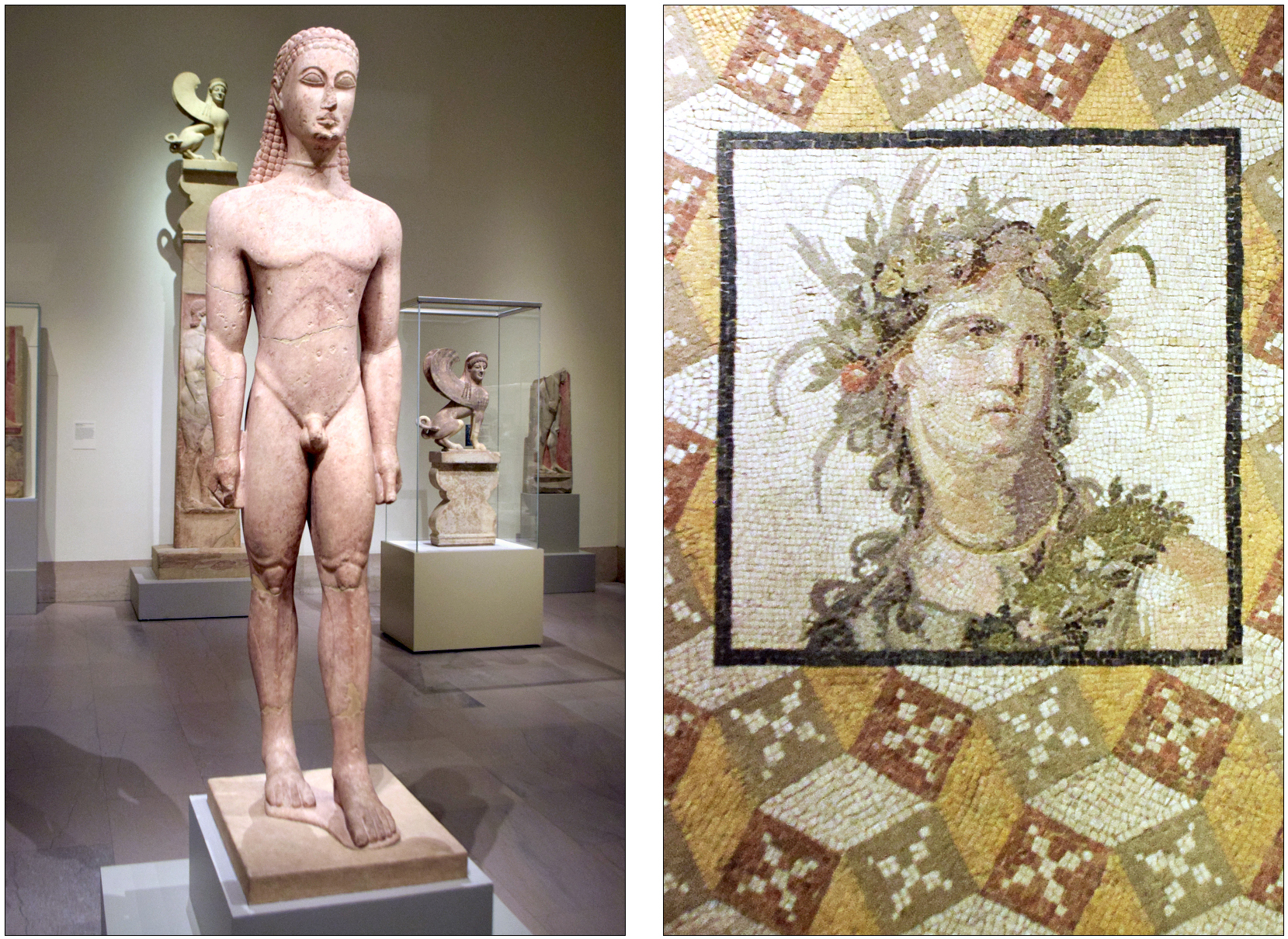
(L) Marble statue of a kouros (youth), Greek, Attic, ca. 590-580 B.C. (R) Detail
of mosaic floor panel, Roman, Imperial, 2nd century A.D. Excavated from
a villa at Daphne near Antioch, the metropolis of Roman Syria
Bronze statue of a horse, Greek, direct
lost-wax casting, late 2nd–1st century B.C.

Photo of the Week: Detail of the Seven Archangels Vanquishing Demons, Chapel in the House of St. Pius V in the Vatican

Photo by New York Scugnizzo

La Real Cittadella di Messina: Nel 163° nella sua difesa (12 marzo 1861 - 12 marzo 2024)

A Messina, nel ricordo dei difensori del Real Cittadella, il 16-17 marzo per il recupero del storica fortezza.

March 11, 2024

From NEUE to Old

Marble portrait head of the Emperor Constantine I,
Roman, Constantinian period, ca. 325-370 A.D.
As mentioned last week, we rescheduled our visit to the Ronald S. Lauder NEUE GALERIE Museum for German and Austrian Art in Manhattan, and as expected this time around there were no lines. After a long stretch of good outings at New York City’s various art and cultural institutions, our luck finally came to an end and like young Icarus who heedlessly flew too close to the sun we inevitably came crashing back to reality and plunged into the turbulent sea of modernity.


With few exceptions, my friends and I aren’t fans of modern art, but we went with an open mind, hoping to discover something new and expose ourselves to fresh experiences. Sadly, except for a few interesting examples of decorative art (furniture, clocks, jewelry, etc.) from 1890 to 1940, a handful of Gustav Klimt’s (1862-1918) early figure drawings, and two miniature portraits of Emperor Franz Joseph I of Austria (1830-1916), I found precious little to justify the exorbitant ticket price.


The old photographs of Klimt, various reproductions of his work, and copies of Ver Sacrum magazine, the official periodical of the avant-garde Vienna Secession art movement, were interesting for historical purposes. As for the permanent collection of paintings and ongoing Austrian Masterworks and Klimt Landscapes exhibitions, the nicest thing I can say is that they leave a lot to be desired. Normally, I would share examples but photography was not allowed.


We all agreed Gustav Klimt’s Idylle (1884) was our favorite, however, his portrait of Adele Bloch-Bauer I (1903-7) is clearly meant to be the Museum’s showpiece. Normally, whenever I see a celebrated work of art in person I can’t help but notice how the reproductions online or in print did them no justice (e.g. Botticelli’s Birth of Venus or the Leaning Tower of Pisa). Surprisingly, with Klimt, the exact opposite happened. I found his work to be drab and uninspiring. My less generous friend said, “It looked like he painted them with dirty dishwater.”


Like the Brooklyn Museum, NYPL, Whitney, MoMA, and Guggenheim—where I haven’t returned since the fantastic Chaos & Classicism installation in 2010—I have no intentions of ever going back until they host a special exhibit that I find worthy and interesting. Unless you like modern and decadent art, I cannot recommend visiting these institutions. Go at your own discretion.

The Osborn Gates, bronze, 1953, Paul Howard Manship
More than a little underwhelmed and dejected, we decided to walk over to the Metropolitan Museum of Art to get our much-needed fix of high art. On the stroll over, we passed by the entrance to Central Park’s Ancient Playground at East 85th Street to admire the Osborn Gates. Dedicated to William Church Osborn (1862-1951) in 1953, the bronze gates were made by sculptor Paul Howard Manship (1885-1966) and depict scenes from Aesop's Fables. Without exaggeration, I enjoyed them more than the collection at the NEUE GALERIE.


Unsure what we wanted to see at first at the Met, we briefly viewed the Italian Renaissance Bronze Sculpture: 1450-1600 (Gallery 536) and the eclectic Jack and Belle Linsky Collection (Gallery 537) on the first floor before deciding to explore the museum’s extensive Greek and Roman Art Galleries.


Even though we knew it already and there are countless other indicators, I can’t begin to tell you how apparent the decline of the West is when you juxtapose the fruition of the downfall to the august dawn of Occidental Civilization. Going from the distorted and disturbing depictions of the early twentieth century to the beauty and grandeur of the Classical World could not be more jarring.


Astonishingly, considering where we’re at now and where we're heading, that period wasn’t even the nadir of Western art. Nor, in truth, was Greco-Roman art the zenith. Still, it's hard to wrap your head around the fact that the same people produced such divergent and incongruous art forms.


Spirits lifted and a bounce in our gait, we left the Met reinvigorated and inspired. Not even the canaglie on the subway ride home (another sign of Western decadence) could bring our spirits down that night. Believe you me, they tried but they failed.


~ Giovanni di Napoli, March 10th, Remembering the Martyrs of Tradition

(L) Emperor Charles V (1500-1558) and his son Philip II of Spain
(1527-1598), onyx, Leone Leoni (ca. 1509-1590), Milan, 1550.
(R) The Jungle Book, 1913, author Rudyard Kipling
Aquamanile in the form of lion, copper alloy, North German, made about 1200
(L) Wild Man, brass, Flemish, 16th century. (R) Virgin and Child Enthroned, Jet, traces of gilding, Spanish, Santiago de Compostela, possibly 16th century
Marble bust of the Emperor Hadrian, Roman, Hadrianic period,
ca. 118-120 A.D. Found in Hadrian's Villa at Tibur (modern Tivoli)
(L) Marble head of Homer, Roman, Imperial period, ca. 1st–2nd century A.D.
Copy of a Greek statue of the 2nd century B.C. (R) Marble head of Socrates,
Roman Imperial period, 1st–2nd century A.D. Copy of a Greek bronze
statue of ca. 350 B.C. often attributed to Lysippos
(L) Marble head of Herakles, Roman, Imperial period, 1st century A.D. Copy
of Greek statue of the second half of the 4th century B.C. attributed to
Lysippos. (R) Marble bust of Herodotos, Roman, Imperial period, 2nd
century A.D. Copy of a Greek bronze statue of the 1st half of the 4th
century B.C. Found in Benha, ancient Athribis, Lower Egypt
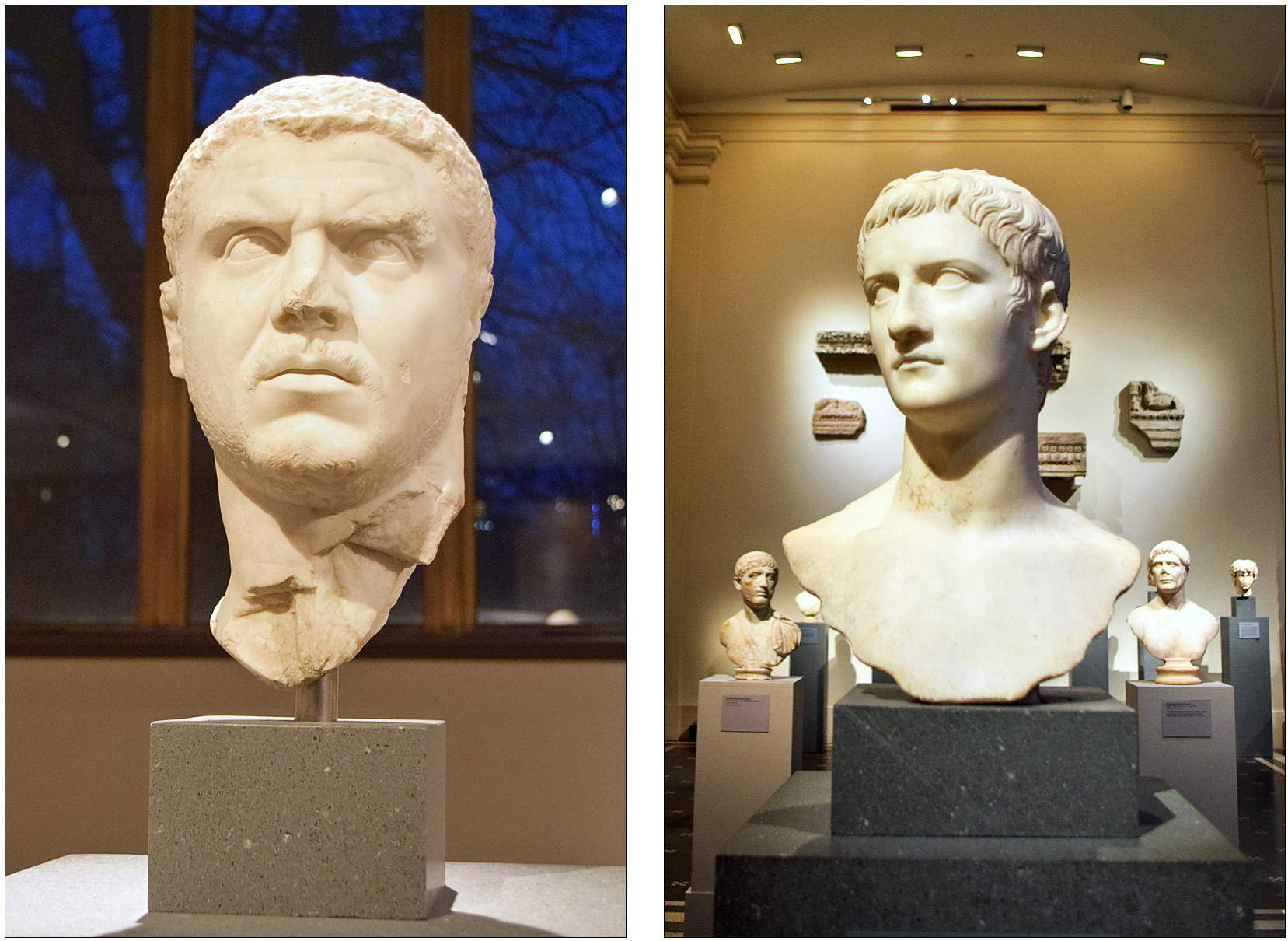
(L) Marble portrait of the Emperor Caracalla (M Aurelius Antoninus), Roman,
Severan period, 212-217 A.D. (R) Marble portrait bust of the emperor
Gaius, known as Caligula, Roman, Julio-Claudian period, 37-41 A.D.
Marble statue of the Three Graces, Roman, Imperial period,
2nd century A.D. Copy of Greek work, 2nd century B.C.
(L) Marble head of a Greek general (possibly the strategos Phokion),
Roman, Imperial period, 1st–2nd century A.D. Copy of Greek bronze
statue of the mid-4th century B.C. (R) Marble relief fragment
with the head of Mars, Roman, early 3rd century A.D.
(L) Marble portrait of a young woman, Roman, Trajanic period,
ca. 98-117 A.D. (R) Marble statue of Venus (Aphrodite) emerging
from her bath, Roman, 1st century B.C.–1st century A.D.
Cubiculum (bedroom) from the Villa of P. Fannius
Synistor at Boscoreale, Roman, ca. 50-40 B.C.
Wall painting of seated woman wearing a diadem and playing
a kithara from main reception hall 
in the villa of P. Fannius
Synistor at Boscoreale
, Roman, Late Republican, ca. 50—40 B.C.
(L) Marble statue of the Capitoline Aphrodite, Roman, 1st–2nd century A.D.
(R) Marble statue of Dionysos leaning on an archaistic female figure,
Roman. Augustan or Julio-Claudian period, 27 B.C.–68 A.D.
Adaptation of a Greek work of the 4th century B.C.
(L) Terracotta statuette of a goddess (Tyche ?), Greek, mid- to late
2nd century B.C. (R) Marble statuette of Dionysos Melanaigis (of
the Black Goatskin), Greek, early 3rd century B.C.
, said to
have been found at Koukouvaones in Attica
(L) Diabase statue of Aphrodite, Roman Imperial period, late 1st-early 2nd
century A.D., adaptation of a Greek work 3rd century B.C., known as
the Medici Aphrodite. (R) Marble statue of Aphrodite Anadyomene
(hair-binding), Greek, Hellenistic, 2nd century B.C.
(L) Life-sized bronze statue of an aristocratic boy, Roman, Augustan
period, 27 B.C.–14 A.D. Found on the eastern Mediterranean island
of Rhodes. (R) Bronze statue of Artemis and a deer, Greek or
Roman, Late Hellenistic or Early Imperial, ca. 1st century
B.C.–1st century B.C.–1st century A.D.
Bronze statue of Eros sleeping, Greek, Hellenistic or Augustan, 3rd
century B.C.—early 1st century A.D. Said to from the island of Rhodes
(L) Bronze cavalry sports mask, Roman, 2nd century A.D. (R) Bronze
portrait bust of a young boy (Nero ?), Roman, Julio-Claudian, ca. 50-68 A.D.
(L) Bronze portrait bust of a Roman matron, Roman, ca. 50-65 A.D.
and Bronze portrait bust of the emperor Gaius (Caligula), Roman,
ca. 37-41 A.D. (R) Silver-gilt horse rhyton (vase for libations
or drinking), Greco-Parthian, Hellenistic, 2nd century B.C.
(L) Bronze statuette of Venus or Isis, Roman, 1st century A.D. (R) Bronze
plaque of Mithras slaying the bull, Roman, mid-2nd–early 3rd century A.D.
Pair of serpentine gold armbands representing male and
female tritons holding a small winged Eros, Greek, ca. 200 B.C.
Terracotta lekanis (dish) with lid and finial, Greek,
Sicilian, Centuripe, 2nd half of 3rd century B.C.
Marble portrait head of the Emperor Constantine I,
Roman, Constantinian period, ca. 325-370 A.D.
Before breaking our Lenten fast with a light dinner (sans meat,
eggs and dairy) we stopped off at the Strand bookstore on Broadway
looking for a new art monograph. Instead, I found a couple of nice
paperback editions of poetry by Fernando Pessoa (1888-1935)