June 9, 2022
June 8, 2022
Remembering Louis-Charles, Dauphin of France, Titular King Louis XVII of France

Domine salvum fac Regem et exaudi nos in die qua invocaverimus te.1
In memory of Louis-Charles (27 March 1785 – 8 June 1795), Dauphin of France, Titular King Louis XVII of France, we pray for the happy repose of his soul. Vive le roi!
Eternal rest grant unto His Majesty, O Lord and let perpetual light shine upon him. May his soul, and the souls of all the faithful departed, through the mercy of God, rest in peace. Amen
Note:
(1) Lord, save the King, and hear us when we call upon thee.

June 7, 2022

June 6, 2022
Congratulations Amalfi on Winning the 66th Annual Palio Delle Antiche Repubbliche Marinare
 |
| La nobilissima, l'illustrissima, l'agiatissima opulentissimaque |
A Prayer for Owo, Nigeria
Our thoughts and prayers go out to the victims of the horrific terror attack on Pentecost Sunday at St. Francis Catholic Church in Owo, Ondo State, Nigeria. May St. Patrick, St. Francis of Assisi, and Blessed Cyprian Michael Iwene Tansi watch over you.
St. Patrick, ora pro nobis
Loving God, welcome into your arms the victims of violence and terrorism. Comfort their families and all who grieve for them. Help us in our fear and uncertainty, and bless us with the knowledge that we are secure in your love. Strengthen all those who work for peace, and may the peace the world cannot give reign in our hearts. Amen.
June 4, 2022
Three Bourbon Statues in the Pacini Garden in Catania
 |
| King Ferdinando I with scepter and sword was inaugurated in 1853 |
 |
| King Francesco I in classical regalia was inaugurated in 1833 |
 |
| King Ferdinando II also in classical garb was inaugurated in 1842 |
June 2, 2022
Startling Discovery of an Unintended Time Capsule Dating Back to the Early Twentieth Century – Part 2
I was meaning to share this sooner, but I’ve been busy with work, and life in general, and unable to take pictures of some of these historical artifacts before now. These latest findings from our exploration of a dank storage facility in Clinton Hill, Brooklyn are arguably more interesting and a little more varied than the first haul we unearthed back in April [See Startling Discovery of an Unintended Time Capsule Dating Back to the Early Twentieth Century]. With only a fraction of the collection examined thus far, we are sure to uncover much, much more.
Mint lapel pin for the Società Italiana degli Autori ed Editori from 1935
Clearly, the person who once owned these objects had a strong fascination with the ventennio fascista, which admittedly is not all that surprising. If we’re being honest, when I was a teen I remember a lot of older people in the community speaking fondly of Il Duce. “If only” they would often lament, “he didn’t get caught up with that other guy.” It was not that uncommon to see Mussolini’s portrait or bust on display in a store or café in the Eighties, so one can only imagine how popular he was during the Roaring Twenties and Thirties, when most of these objects are from.
Times have certainly changed. Other than childishly calling someone a “fascist” when they disagree with you, the expired system and its bellicose progenitor are virtually forgotten. Not surprisingly, other than our inquisitive circle of history buffs, and a few socialist professors with a morbid curiosity for all things fascist, few people have shown any real interest in our discoveries.
Despite what I may or may not think about these items, or how they contrast with my own Monarchist political leanings, I remain detached and concern myself only with their historical significance and preservation. We cannot learn from history without examining it, and we cannot examine the past if it remains buried.
~ Giovanni di Napoli, June 1, Feast of Sant’Annibale Maria di Francia
 |
| The pin, with fasces logo, is sewn to the envelope |
 |
| Oversized postcards dated 4 May 1916 with the goddess Minerva pointing the way to victory |
 |
| A couple of interesting books from the 1920's |
 |
| MNH 1931 Marca da Bollo revenue stamp |
 |
| 1940 US stamp commemorating the 400th anniversary of the exploration of the Southwestern United States by Francisco Vasquez de Coronado and his Captains |
 |
| (L) Stacks of Neapolitan sheet music. (R) Post card with embossed American and Kingdom of Italy flags |
 |
| (L) Metal etching with traces of ink. (R) Postcard with famed Neapolitan singer Gilda Mignonette (Grisela Andreatini) |
 |
| Postcard with a dapper looking Mussolini and untarnished replica medal |
 |
| Envelope from Naples dated 1936 filled with postcards (see below) |
 |
| King Victor Emmanuel III of Italy and Benito Mussolini |
 |
| Il Duce and Sciaboletta |
 |
| A stoic looking Mussolini in helmet |
 |
| Equestrian portraits of Il Duce |
 |
| Mussolini wearing the Arditi style fez |
 |
| (L) Il Duce with the diminutive King during le grandi manovre. (R) Dressed in black shirt, Mussolini harangues a large crowd of followers in Piazza Venezia |
 |
| Princess Marie José of Belgium and Umberto, Principe di Piemonte |
 |
| Prince Umberto di Savoia, the future King Umberto II of Italy |
 |
| Prince Umberto of Piemonte, later the May King |
 |
| General Pietro Badoglio, Viceroy of Italian East Africa |
 |
| (L) Count Gian Galeazzo Ciano. (R) Pietro Badoglio |
 |
| Pietro Badoglio, Maresciallo d'Italia |
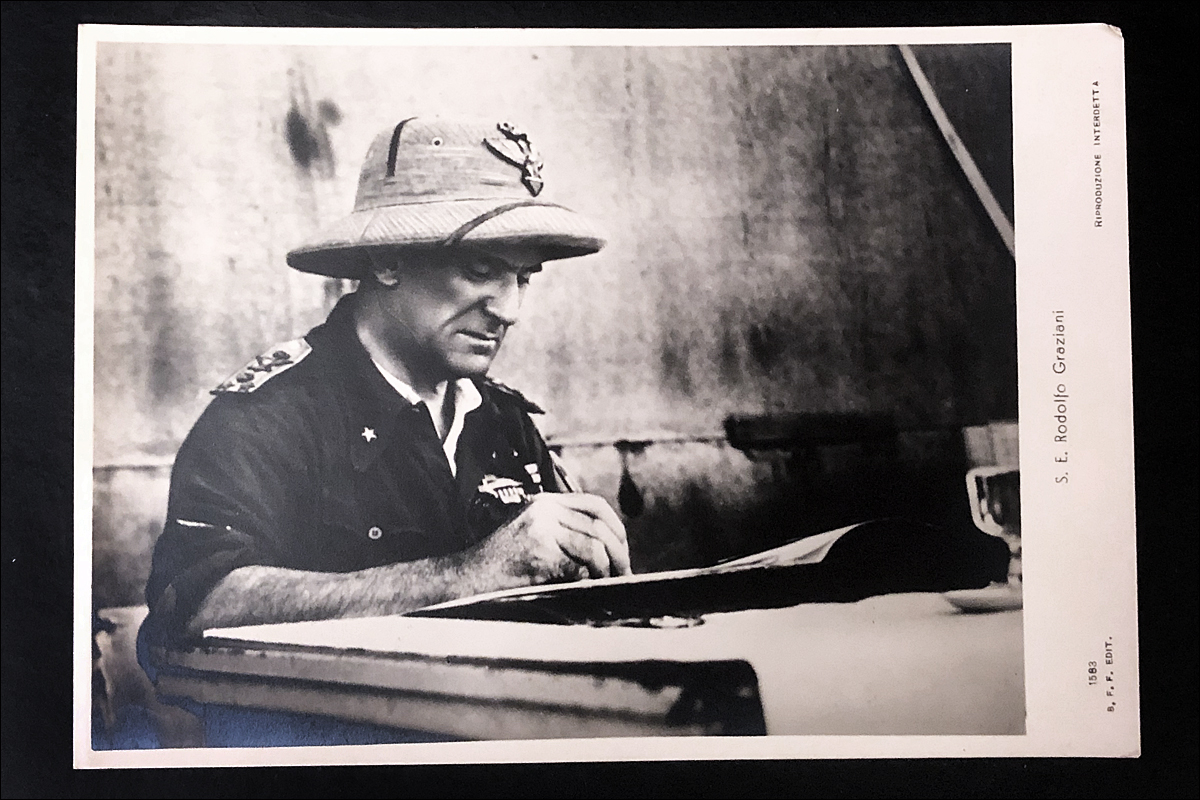 |
| Rodolfo Graziani, Marquess di Neghelli |
May 30, 2022
Feast of San Ferdinando III, King of Castile and León
 |
| San Ferdinando III, ora pro nobis |
Prayer to St. Ferdinand of Castile
O God, who was pleased that blessed Ferdinand should fight thy battles and overcome the enemies of faith: grant that, protected by his intercession, we may be delivered from the enemies of mind and body. Amen.

May 29, 2022
A Look at the Unveiling of the Monument Dedicated to King Ferdinand IV of Bourbon in San Leucio, Caserta

Photos by Angela Cuccillato and Gennaro Conte were liberally gleaned from Facebook.


May 27, 2022
This Morning Caserta Shines for the Bourbons Again
Statue of King Ferdinand I of the Two Sicilies being installed this morning in San Leucio, Caserta. It will officially be unveiled on Sunday 29 May. Viva 'o Rre!
Photo courtesy of Movimento Neoborbonico
Ponderable Quote from ‘The Diary of a Writer’ by F.M. Dostoevsky

Portrait of Dostoevsky in 1872 by Vasily Perov
“Take the instance of Count Cavour,—wasn’t his a great mind? Wasn’t he a diplomat?—I am citing him because his genius is generally recognized and also because he is dead. Yet what did he do, look: Oh, he did achieve his aim, he did unite Italy, but what was the result?—For 2,000 years Italy bore in herself a universal unifying idea—not some abstract idea, not a speculation of some theoretical mind, but a realistic, organic idea; the fruit of the national and universal life. This was the unification of the whole world—first, the ancient Roman and later—the papal unification. The peoples who have been growing and disappearing in Italy in the course of these two and one-half millennia, understood that they were the bearers of a universal idea, while those who did not understand it felt and divined it. Science, art—everything was invested and permeated with this universal significance. Oh, let us admit that, at length, this universal idea became worn out and wasted there (although hardly so!). But what—in the long run—has come in its stead? Upon what can Italy be congratulated? What advantage has she achieved after Count Cavour’s diplomacy? —There rose a united second-rate little kingdom which had lost every kind of a universal aspiration; which exchanged it for the most worn-out, bourgeois principle—the thirtieth repetition of this principle since the French revolution a kingdom fully content with its unity which means nothing, a mechanical, and not a spiritual unity (i.e., not the former universal unity), and on top of that—a kingdom burdened with insolvent indebtedness, and, in addition,—one specifically content with its own second-rateness. This is what came of it; such was Count Cavour’s creation!”
Reprinted from The Diary of a Writer (1877, May-June, Chapter II: Former Agriculturists—Future Diplomats) by Fyodor Mikhailovich Dostoevsky, translated and annotated by Boris Brasol, George Braziller, Inc., 1954, P.718-719
May 25, 2022
A Look at the Fourteenth Annual Battle of Bitonto Commemoration in New York City
 |
| Battle of Bitonto (c.1750) by Giovanni Luigi Rocco |
Moved forward on account of the Minor Rogation Days, Ascension Thursday and Memorial Day Weekend, revelers exchanged Bourbon-themed gifts, won raffle prizes and, as always, enjoyed a bountiful Sicilian repast.
We honored the fallen on both sides with prayers and toasts. Viva 'o Rre!
We honored the fallen on both sides with prayers and toasts. Viva 'o Rre!
 |
| Carciofi fritti |
 |
| Arancini |
 |
| Milinciani fritta (breaded eggplant, roasted peppers and mozzarella) |
 |
| Pizza |
 |
| Cavatelli with sausage, broccoli and pignoli |
 |
| Braciola di maiale al forno |
 |
| Montepulciano d'Abruzzo |
 |
| Raffle prizes included artisanal soaps from Casa Amalfi and a tie with the coat-of-arms of the Kingdom of the Two Sicilies |
 |
| Artisanal soaps, fleur-de-lis placemats and repurposed Argenio watch boxes with King Carlo di Borbone filled with various Kingdom of the Two Sicilies lapel pins |
Subscribe to:
Posts (Atom)