April 12, 2018

Help Restore the Statue of the Madonna del Soccorso di Sciacca at Most Precious Blood Church

Madonna del Soccorso di Sciacca, Sicily
Please consider a donation to help restore the newly acquired statue of the Madonna del Soccorso di Sciacca at the Shrine Church of the Most Precious Blood (113 Baxter St.) in Little Italy, New York. Once belonging to the San Calogero Society on Elizabeth Street, the beloved statue was rescued from abandonment by members of the community and kept stored at the Italian American Museum (155 Mulberry St.) for the past ten years. Now, with the museum closing for planned long-term renovations the statue has found a new home at the historic church. Unfortunately, time has not been kind to the statue; it is over one hundred years old and in need of restoration. You can help return the statue of the patroness of Sciacca, Sicily to its original glory. 
For information or to donate for its restoration call the office of the Church at 212-226-6427.
(Above and below) Some details of the statue

April 11, 2018

The Search for our Ancestry (XLVII)

Spelling Bee
By Angelo Coniglio
Researchers of Sicilian and Italian genealogy are blessed by the wealth of original records of birth, baptism, marriage and death that may be found for many ancestral towns, on microfilm or on line. Often those original records may have misspellings, or valid variations of given names or surnames. In many cases, misspellings by English-speaking clerks went unrecognized by illiterate immigrants, and the misspelled name became the ‘official’ name of the person and his descendants. In today’s computer-centric records, errors in spelling are often due to mis-reading and mis-transcription; for example, by enumerators on original censuses. And when using search engines on sites like ellisisland.org, familysearch.org or Ancestry.com, spelling mistakes by indexers can make searches maddeningly difficult.     
I can’t possibly cover every spelling error by every clerk or indexer, but I’ll address some common ones here.  The names initially given below are the names as they would have been spelled on original records in ‘the old country’.  When I spell something phonetically, I am using English phonetics.
GIUSEPPE (joo-SEHPP-ee) and GIUSEPPA (joo-SEHPP-uh) are the masculine and feminine forms of the English the given name Joseph. These are very likely the most misspelled names of any. If you knew your ancestor as Joseph or Josephine, their passenger manifests would probably list them as Giuseppe or Giuseppa (Giuseppina, a diminutive form of Giuseppa, led to the English version, Josephine). The ‘I-U’ in these names is notoriously transposed in many on-line search engines as ‘U-I’.  If you have no luck with the proper spellings, try ‘Guiseppe’ and ‘Guiseppa’. Note that these are not valid variations, but misspellings of the names. Another error is the spelling of Giuseppe as ‘Giuseppi’ or ‘Guiseppi’.
The surnames GIUDICE (JOO-dih-chee) or Lo GIUDICE literally mean ‘judge’ or ‘the judge’.  ‘Guidice’ or ‘Lo Guidice’ have no meaning, but try those spellings if the correct ones don’t lead to success.
The surname TAGLIAFERRO means ‘cuts iron’, but often was pronounced and spelled ‘Taliaferro’ and even ‘Tolliver’.  The name may be given on an original U. S. Census as ‘Tolliver’, but if the individual is Sicilian or Italian, the name on the passenger manifest and ancestral town records would be Tagliaferro.
CASTELLO is a surname meaning ‘castle’.  But pronounced in the Italian language it is ‘kah-STELL-oh’, so it may be misspelled ‘Costello’ on American censuses.
IPPOLITO, IANNELLO, IACONO and other surnames beginning with an upper-case ‘I’ may confuse indexers to no end. This is because the script ‘I’ is mistaken for a ‘T’ or a ‘J’, or a ‘G’, etc.  Researchers of Italian descent will immediately recognize that ‘Tppolito’, ‘Jppolito’, ‘Gppolito’ and so on, are unpronounceable and non-existent Sicilian or Italian surnames, but you will find them indexed that way! Also, names like Iannello and Iacono often were spelled phonetically by census enumerators, and became forevermore ‘Yannello’ and ‘Yacono’.
MARCELLO is an interesting surname. It’s properly pronounced ‘mar-TCHEHLL-oh’ (‘cello’ as in the name of the stringed instrument), so many enumerators thought it should be spelled ‘Marcello’. But ‘Marchello’ is pronounced ‘mar-KELL-oh’ in Italian, so many with the surname Marcello became known as Markello.  
BONGIOVANNI, CALANDRA, and LANZA all contain the letter ‘N’. Written in cursive, a lower-case ‘n’, in certain handwriting, looks like a lower-case ‘u’, so these surnames get transcribed as ‘Bougiovanni’, ‘Calaudra’ and ‘Lauza’. Really!! If your surname has the letter ‘n’ in it, try replacing one or more of them with the letter ‘u’ and search again!
These are but a few of the many naming errors that are encountered by genealogists. Try to familiarize yourself with valid Sicilian and Italian surnames. If there’s a doubt, go to http://www.cognomix.it/mappe-dei-cognomi-italiani which is a site that shows modern-day distributions of the selected surname (‘cognome’ in Italian). For spellings and English versions of given names, see my page at http://bit.ly/SicilianNames 
Coniglio is the author of the book The Lady of the Wheel, inspired by his Sicilian research. Order the paperback or the Kindle version at http://bit.ly/SicilianStory Coniglio’s web page at http://bit.ly/AFCGen has helpul hints on genealogic research. If you have genealogy questions, or would like him to lecture to your club or group, e-mail him at genealogytips@aol.com

April 10, 2018

New Book: One Country Under Blood

New title that may be of interest to our readers. Available at Amazon.com

• One Country Under Blood by Antonio Ciano

Publisher: Ali Ribelli Edizioni
Publication Date: April 3, 2018
Paperback: $15.00
Kindle: $8.99
Language: English
Pages: 288

One Country Under Blood debunks the myth of a happy unification of Italy. What was made to pass as a struggle for independence, was truly an invasion perpetrated by the House of Savoy and its masonic affiliates with the connivance of the Mafia and Camorra cartels. After the annexation of the Kingdom of the Two Sicilies, the riches of southern Italy were transferred to banks in the north to fuel the industrial development of Lombardy and Piedmont. Disfranchised and impoverished, millions of southern "Italians" had no other choice but to turn into outlaws or leave their ancestral homeland and immigrate to the United States, Australia and Southern America in search of a new beginning.
Click here to see more books

New Kindle Editions by Antonio Ciano

New titles that may be of interest to our readers. Available at Amazon.com

• Kingdom of the Two Sicilies by Antonio Ciano

Publisher: Ali Ribelli Edizioni
Publication Date: March 29, 2018
Kindle: $5.99
Language: English

Read description

• Massacres of the Italian Risorgimento by Antonio Ciano

Publisher: Ali Ribelli Edizioni
Publication Date: March 29, 2018
Kindle: $5.99
Language: English

Read description

• Southern Italy from 1830 to 1946 by Antonio Ciano

Publisher: Ali Ribelli Edizioni
Publication Date: March 29, 2018
Kindle: $5.99
Language: English

Read description

Click here to see more books

Photo of the Week: A View of Ravello from Villa Rufolo's Garden Pavilion

A view of scenic Ravello from Villa Rufolo's garden pavilion
Photo by New York Scugnizzo

April 8, 2018

Feast of the Madonna delle Galline

Madonna delle Galline, ora pro nobis
The Sunday after Easter is the Feast of Madonna delle Galline, or Our Lady of the Hens, protectress of Pagani, a small town in the Province of Salerno. One of the so-called "Seven Sisters of Campania,” an appellation given to the region's major Marian devotions under different titles, the feast commemorates the discovery of a miraculous Marian icon painted on a wooden table top. According to popular tradition, the image of the Madonna del Carmine was brought to light by a brood of rasping chickens, hence the title Our Lady of the Hens. Dating back to the 8th or 9th century, it is believed that the table was hidden by a group of monks trying to save it from the destruction of marauding Saracens. Discovered in the 16th century, eight miracles, including the healing of a cripple, has been attributed to the intercession of the Blessed Mother through the sacred image. In celebration I'm posting a Prayer to Our Lady of Mount Carmel. The accompanying photo of the Madonna delle Galline with painting of St. Joseph, St. John the Evangelist, St. Costanza and St. Agatha interceding to liberate the souls of Purgatory (attributed to Giovanni Vincenzo Forli, c.1580–c.1625) comes courtesy of Diocesi Nocera Inferiore – Sarno. The icon and painting are enshrined above the High Altar inside the Santuario della Madonna delle Galline in Pagani. Ave Maria!

Prayer to Our Lady of Mount Carmel

O most beautiful flower of Mount Carmel, fruitful vine, splendor of heaven, Blessed Mother of the Son of God, Immaculate Virgin, assist me in this my necessity (make your request). O star of the sea, help me and show me herein you are my Mother. O holy Mary, Mother of God, Queen of heaven and earth, I humbly beseech you from the bottom of my heart, to aid me in my need; there are none that can withstand your power. O show me herein you are my Mother. O Mary, conceived without sin, pray for us who have recourse to thee. (three times) Sweet Mother, I place this cause in your hands. (three times)

Translating the Madonna del Soccorso di Sciacca to Most Precious Blood Church in Little Italy

Devotees gather outside the Italian American Museum to help move the statue
Photos by New York Scugnizzo
By Giovanni di Napoli
Saturday afternoon (April 7th), the statue of the Madonna del Soccorso di Sciacca was translated from the Italian American Museum (155 Mulberry St.) to the Shrine Church of the Most Precious Blood (113 Baxter St.) in Little Italy, New York. After ten years, the museum is closing for renovations and the statue, which once belonged to the defunct San Calogero Society on Elizabeth Street, has found a new home at the historic church. What’s more, it was reunited with the statue of San Calogero, which also belonged to the old society.
A final look at the Madonna del
Soccorso inside the museum
Arriving early, I had the opportunity to speak with several members of the newly formed Madonna del Soccorso and San Calogero di Sciacca Society. Full of fond memories about the old feast, they are very enthusiastic about starting up the celebration for their beloved patrons again and plan on organizing an annual Mass and block party on Elizabeth Street.
Thankfully, the weather was fine and the move went off without a hitch. For now, the statue was placed on a small pedestal outside the Our Lady of Lourdes Chapel near the rear of the church. Matching plinths are in the works for the Madonna and San Calogero, so they won’t have to stand so low to the ground.
Thank you to Angel Marinaccio, Ernest Magliato and all the other members of the new Madonna del Soccorso and San Calogero di Sciacca Society for your hard work and devotion. We wish you much success and look forward to celebrating our faith and culture together in the coming years. 
The soon-to-be renovated Italian American Museum
Thank you to Dr. Joseph V. Scelsa, President of the Italian American Museum, for watching over the statue all these years. We appreciate your dedication to our community and eagerly await the grand reopening of the revamped Italian American Museum. 
Special thanks to Stephen LaRocca, president of the St. Rocco Society of Potenza, for serving as legal advisor and liaison between the nascent society and Msgr. Donald Sakano, Pastor of Most Precious Blood. An unsung hero in our community, Stephen was instrumental in securing a place for the statue at the church.  
Many thanks to Msgr. Sakano, Project Manager Bill Russo, Emily DePalo, Eddie, Tom, and the rest of the parish family for your continued warmth and hospitality. Thanks to you, Most Precious Blood continues to be a staunch bastion of southern Italian faith and culture.
God bless you all; Evviva Maria!
(L) Dr. Joseph V. Scelsa and Angel Marinaccio.
(R) Angel and Connie look after Our Lady's crown and veil
The statue leaves the museum...
...and is carefully placed in the car 
Satan got cold-cocked
Our Lady armed with a cudgel
The statue is carried into Most Precious Blood
and temporarily placed on a small 
pedestal 
The veil and crown are placed back on to the statue
Society members take a commemorative photo 
Evviva Maria! 
A close-up of the statue's base

April 6, 2018

Celebrating Pasquetta at the 2nd Annual Our Lady of the Snow Sagra della Pizza Chiena

Organizer, Elena Loguercio welcomes everyone to the party
Photos by New York Scugnizzo 
By Giovanni di Napoli
After a peaceful morning of prayer and meditation, I joined my friends and some sixty revelers at the Our Lady of the Snow Hall in Williamsburg, Brooklyn Monday evening for the 2nd Annual Sagra della Pizza Chiena. Warmly received by Our Lady of the Snow Society President Vinnie Raymond and event organizers Elena Loguercio and Cav. Patrick O’Boyle, guests packed into the hall ready to party. 
The Madonna della Neve
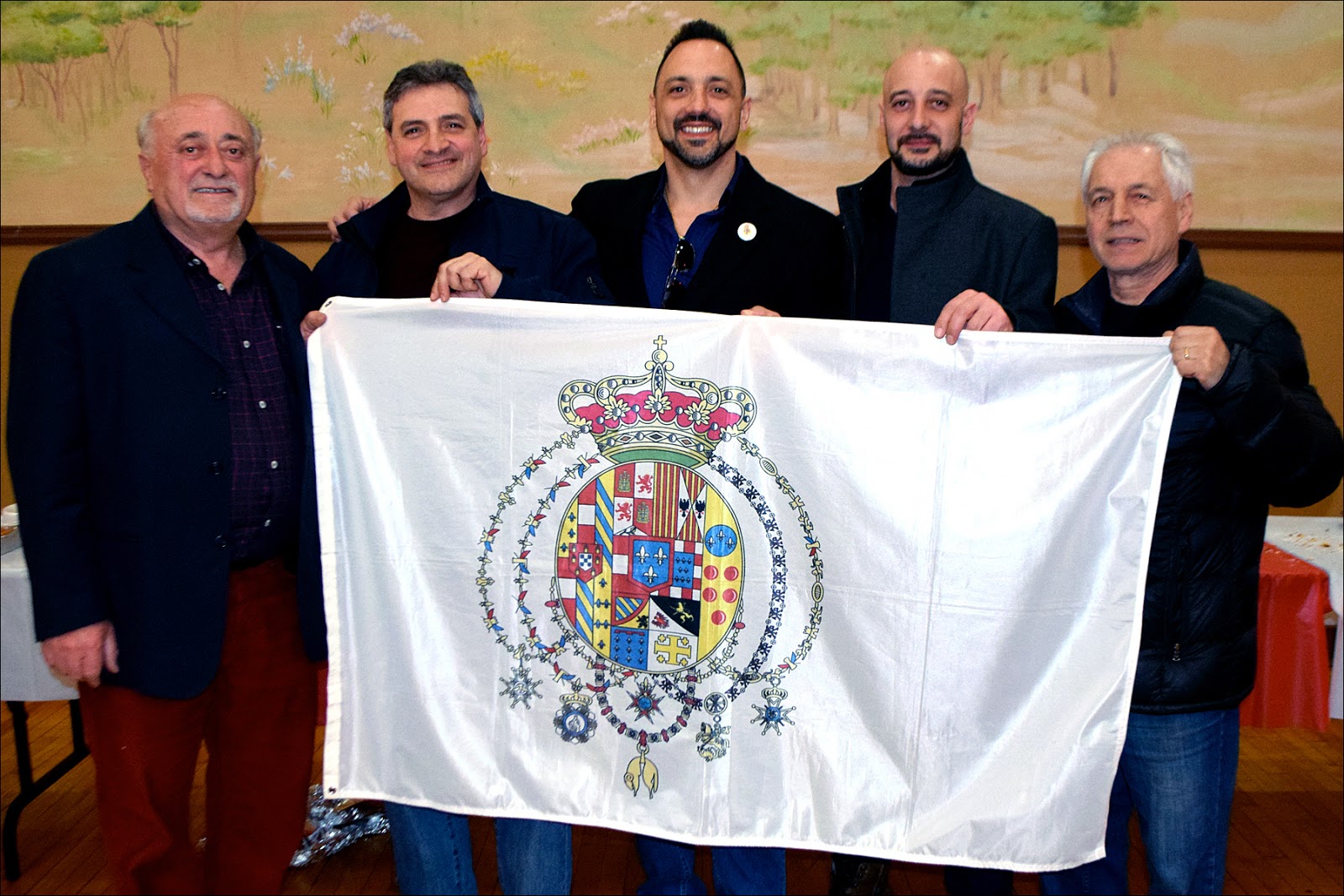
Converging from far and wide, members of the Sacred Military Constantinian Order of St. George; the Monte San Giacomo Society of Hoboken, New Jersey; the Associazione Culturale Pugliese Figli Maria SS. Addolorata of Bensonhurst, Brooklyn; the Congregazione Maria SS. del Sacro Monte of Jersey City, New Jersey; Club Sassiness d'America of Oyster Bay, New York; the San Cono Society of Williamsburg, Brooklyn; and the St. Rocco Society of Potenza in New York City; among others, partook in this year’s festivities.
During the introductions and greetings, our friend Dolores Alfieri, Director of Italian American Affairs for Gov. Andrew Cuomo presented Cav. O’Boyle with a proclamation for his unwavering service to the Italian American community. A well-deserved honor, we are very happy for Pat.
As to be expected at a pizza chiena celebration, many people brought their own homemade versions of the traditional southern Italian Easter delicacy. However, for the sake of variety, several contributors made additional holiday dishes, including frittata di maccheroni, pastiera Napoletana and, my personal favorite, rafaiul cu sanguinaccio, a fried ravioli-shaped pastry stuffed with a rich chocolate and pig’s blood pudding.
Dolores Alfieri, Director of Italian American Affairs for Gov. Andrew Cuomo presents a proclamation to Cav. Patrick O’Boyle
Set on several large folding tables, the fare was served family style beneath the society’s beautiful statue of the Madonna della Neve and, courtesy of the Constantinian Order of St. George, the flag of the Kingdom of the Two Sicilies. 
Before digging in, Rt. Rev. Economos Romanos V. Russo led us in prayer and blessed the bread, cheese and meat.
After the benediction, it took little coaxing to get partygoers to start eating; and eat we did. 
With so many dishes to choose from, it was impossible (for me, at least) to try them all, although we did our best. Among others, I had a taste of Nancy Speranza’s frittata di maccheroni, which is part of my family’s Pasquetta tradition, and Rossella Rago and Nonna Romana’s (of Cooking With Nonna fame) pizza chiena. 
Needless to say, everything I sampled was delicious, but once again I thought Elena’s rafaiul cu sanguinaccio was the standout dish, it was by far my favorite. Perhaps this is because, unlike the the other items offered, I rarely get to have it.
Guests help themselves to a wide range of southern Italian delicacies
Following dinner, partygoers mingled and worked off their meal by dancing the night away to traditional tarantella music spun by DJ Marilena Giovanna. As an added surprise, comedian Marcantonio Pezzano kept us in stitches with his characteristic brand of bawdy humor. Angela Rago took the mike from Marco and kept the laughter going.
Many thanks to President Vinnie Raymond and all the members of the Our Lady of the Snow Society for your remarkable warmth and hospitality. As always, you were magnificent hosts. Thank you to all the people who cooked and contributed to the party. It was a great joy to break bread and celebrate our culture together. Special thanks to Elena and Patrick for organizing the fête. Your hard work and dedication to our community is an inspiration.
(L) Pizza chiena, recipe from Napoli. (R) Calzone rustica, recipe from Teggiano 
(L) Pizza chiena, recipe from Calitri. (R) Pizza chiena, recipe from Caggiano
Pizza chiena, recipe from Monte San Giacomo
(Above and below) Rafaiul cu sanguinaccio, recipe from Sassano
Amaro Lucano and some Paulaner beer for the Feast of San Francesco di Paola
Pizza chiena, recipe from Mola di Bari 
Casatiello, recipe from Sassano
Our dear friends Marcantonio Pezzano, Cav. Rt. Rev. Economos Romanos V. Russo and Cav. Vincent Gangone
(Above and below) Partygoers danced the night away
(Above and below) A good time was had by all
The Knights of the Sacred Military Constantinian Order of St. George
with the flag of the Kingdom of the Two Sicilies
Our friends from the Monte San Giacomo Society and the
San Rocco Society of Potenza show their Due Sicilie pride
 
For more information visit the I love Pizza Gain a.k.a. Pizza Chiena group on Facebook

April 5, 2018

Happy Birthday Princess Camilla di Borbone!

HRH was born in Rome, Italy on April 5, 1971 
Photo courtesy of Real Casa di Borbone
Happy Birthday Princess Camilla di Borbone — Two Sicilies, Duchess of Castro and Dame Grand Cross of Justice of the Sacred Military Constantinian Order of Saint George! May God almighty bless you with a life full of joy and happiness. And may you always find favor in His eyes. Peace be upon you. Auguri!

April 3, 2018

Photo of the Week: Statue of Emperor Augustus on Mount Solaro, Capri

Statue of Emperor Augustus on Mount Solaro, Capri
Photo by New York Scugnizzo

April 2, 2018

Pasquetta — Little Easter 2018

A most excellent brew
In commemoration of the risen Christ's meeting (and subsequent dinner) with his disciples on the road to Emmaus, a small town outside Jerusalem, southern Italians celebrate Pasquetta, or Little Easter. Traditionally, family and friends would pack a lunch and take a short trip to the shore or countryside in remembrance of Christ’s journey. Because Easter Monday is not a national holiday here in the States and people have to work, its not always easy to organize a group outing. Nonetheless, I still try to keep the tradition whenever possible, even if it is by myself. 
Evviva San Francesco!
This year, because the Feast of San Francesco di Paola falls on the same day, I included a bottle of Paulaner bier from Munich to my cornucopia of Easter leftovers. Reputedly, the monks who started brewing the beer in 1634 were members of the Order of Minim founded by St. Francis and named it in his honor. Paulaner, it seems, is a corruption of Paola, the town in Calabria where St. Francis was born.
Instead of going to a park or museum, I spent the early part of my day meditating and reflecting on my many blessings at the Shrine Church of St. Bernadette (8201 13th Ave,) in Dyker Heights, Brooklyn, where they have a beautiful statue of San Francesco and tranquil church grounds. Though the inclement weather nixed my plans for a picnic and a beer, the opportunity to join Fr. Kamil Bober and parishioners in praying the first Monday Novena to Our Lady of the Miraculous Medal after Mass more than made up for it.
Luckily, later on I will be attending the 2nd Annual Sagra Della Pizza Chiena with the Our Lady of the Snow Society (410 Graham Ave.) in Williamsburg, Brooklyn, so I will be able to enjoy a drink and a toast to the patron saint of the Kingdom of the Two Sicilies with some friends.
Buona Pasquetta, Ave Maria and Evviva San Francesco!
Each year on the Feast, the LaRocca family offers flowers to San Francesco
The Shrine Church of St. Bernadette in Dyker Heights, Brooklyn
Snow covered Crucifix and statue of the Sacred Heart
St. Bernadette's Grotto of Our Lady of Lourdes

Feast of the Madonna dell’Arco

Madonna dell'Arco, ora pro nobis
The Monday after Easter, or Pasquetta, is the Feast of the Madonna dell’Arco, one of the so-called "Seven Sisters of Campania,” an appellation given to the region's major Marian devotions under different titles. Patroness of Sant’Anastasia, Napoli, the miraculous image, which got its name from its proximity to an ancient Roman arch, draws devotees called fujenti (those who come) from towns and villages throughout Campania. In celebration I’m posting a prayer to the Madonna dell’Arco.

Prayer to the Madonna dell’Arco

O Virgin of the Arch, who by means of this holy image painted on the plaster of a modest wall on the public street, worked many great marvels and portents to arouse the amazement of the peoples, showing them to have a particular benevolence towards this place, I beg you to obtain for me from your divine Son Jesus the love and obedience to His holy and divine will for all my life. Ave Maria.

April 1, 2018

New Book — Sicilian Splendors: Discovering the Secret Places That Speak to the Heart

New title that may be of interest to our readers. Available at Amazon.com

• Sicilian Splendors: Discovering the Secret Places That Speak to the Heart by John Keahey

Publisher: Thomas Dunne Books
Publication Date: November 13, 2018
Paperback: $28.99
Language: English
Pages: 304

Read description

Click here to see more books