|
Silver Sculpture of the Madonna dell’Assunta in the Reale Cappella del Tesoro di San Gennaro, Cathedral of the Assumption of Mary (Cattedrale di Santa Maria Assunta), commonly known as the Cathedral of St. Januarius (Cattedrale di San Gennaro), Napoli, Campania. Photo courtesy of Patrick O’Boyle
|
August 13, 2017
Photo of the Week: Silver Sculpture of the Madonna dell’Assunta, Reale Cappella del Tesoro di San Gennaro

August 12, 2017
Getting Ready for the Big Day
 |
Evviva San Rocco!
Photo by New York Scugnizzo
|
In an effort to expand the fête, organizers have added a San Rocco Triduum to this year’s festivities. Devotees will gather at the church Thursday, August 17th through Saturday, August 19th (7pm–8pm) for three days of prayer to our glorious patron.
The Feast will be celebrated on Sunday, August 20th at the Shrine Church of the Most Precious Blood of Jesus (113 Baxter Street) in Manhattan’s historic Little Italy. Mass will be celebrated at 12pm, followed by the procession with statue and first class relic of San Rocco. Danny Vecchiano and the Giglio Band will accompany the procession through the streets of Little Italy and Chinatown. Religious goods and raffles will be available for purchase outside the church and, as always, after the procession, partygoers will dance the night away and enjoy some delicious southern Italian fare provided by Peppino’s from Bay Ridge, Brooklyn.
We look forward to seeing you there. Viva San Rocco!
August 11, 2017
The Search for our Ancestry (XXXIX)

By Angelo Coniglio
When I started writing columns about genealogy, there were two possible sources for original Italian and Sicilian records: the actual repositories of the records in the old country; or, the photocopies of many of those records made by the Mormon church. These photocopies were made by hundreds of Mormon volunteers in the late 1990’s. They were microfilmed, generally, at provincial archives for civil records of birth, marriage and death; and at diocesan centers for sacramental records of baptisms, marriages and deaths. In both the civil and church instances, for privacy reasons, records after about 1910 were not filmed. Also, in some cases, local authorities, for their own reasons, did not authorize filming. The records that were filmed are now viewable on microfilm at Mormon FamilySearch Center (FSCs) around the world. The microfilms can be rented at www.familysearch.org by on-line payment, after which they are sent to the patron’s desired FSC. Local FSCs can be found by going to http://bit.ly/LocateFSCs
 But now, several on-line sources for viewing these records have developed, and I’ll present their features, advantages, and disadvantages. It should be understood that the on-line sources, for the most part, are representations of the above-mentioned microfilms: new images of the records, not necessarily images of records from additional years. Recognizing that, let’s review the types of records.
Civil records were instituted in the separate city-states of the Apennine Peninsula in about 1805; and in the Kingdom of Sicily, which extended from Naples and Abruzzo south to Messina and Palermo, in 1820. These records include: Atto di Nascita (Record of Birth), early 1800’s through 1910; Atto della Solenne Promessa di Celebrare il Matrimonio (Record of the Solemn Promise to Celebrate Marriage, or the ‘Marriage Contract’), early 1800’s through 1865; Atto di Matrimonio (Record of Marriage), 1866 through 1910, and Atto di Morte (Record of Death), early 1800’s through 1910. Civil records may also include Riveli (Censuses) which list real property and goods but not much genealogical information; Cittadinanze (Citizenships) which show changes of address; Pubblicazion or Notificazioni (Marriage Banns); and Allegati (Attachments) which accompany marriage records and may contain birth and/or death records of the betrothed and their parents. All these types of civil records are usually kept chronologically, usually with an index of the year’s records immediately following each year. When searching a microfilm, the index at the end of a year will give the record number of a particular birth, marriage or death, so the image of the record itself may be accessed. The records are in “Napoleonic format”, in the Italian language, and were quite consistent from town to town in the Kingdom of the Two Sicilies, while those of the northern city-states were more variable. On-line records, where they exist, have the same format as the microfilms.
Church records are more prone to differences between dioceses, and even between parishes in the same town, but are still rather consistent. The range of church records can be much greater than for civil records, with some as early as the 1300’s through 1910, but they have significantly less detail. They are in Latin, with the exception of some later records in Italian. Church records include: Battesimi (Baptisms); Cresime (Confirmations); Matrimoni (Marriages); and Morte (Deaths). Most civil records were on pre-printed forms, but except for later records, church records were completely handwritten, often using Latin abbreviations. Rather than yearly, church indexes covered several years, usually placed before the first year included in the index. Individual records often were not numbered; rather, the pages were numbered.
So where are these on-line records and how do we find them? They are on three main venues: www.Ancestry.com; www.familysearch.com; and the Italian ‘Portale Antenati’ (Ancestors Portal) www.antenati.san.beniculturali.it/. My upcoming columns will review each of these sources in detail.
Coniglio is the author of the book The Lady of the Wheel, inspired by his Sicilian research. Order the paperback or the Kindle version at http://bit.ly/SicilianStory Coniglio’s web page at http://bit.ly/AFCGen has helpul hints on genealogic research. If you have genealogy questions, or would like him to lecture to your club or group, e-mail him at genealogytips@aol.com
August 10, 2017
A Look at the 21st Annual Festa di San Donato in Williamsburg, Brooklyn
 |
Viva San Donato!
Photos by New York Scugnizzo
|
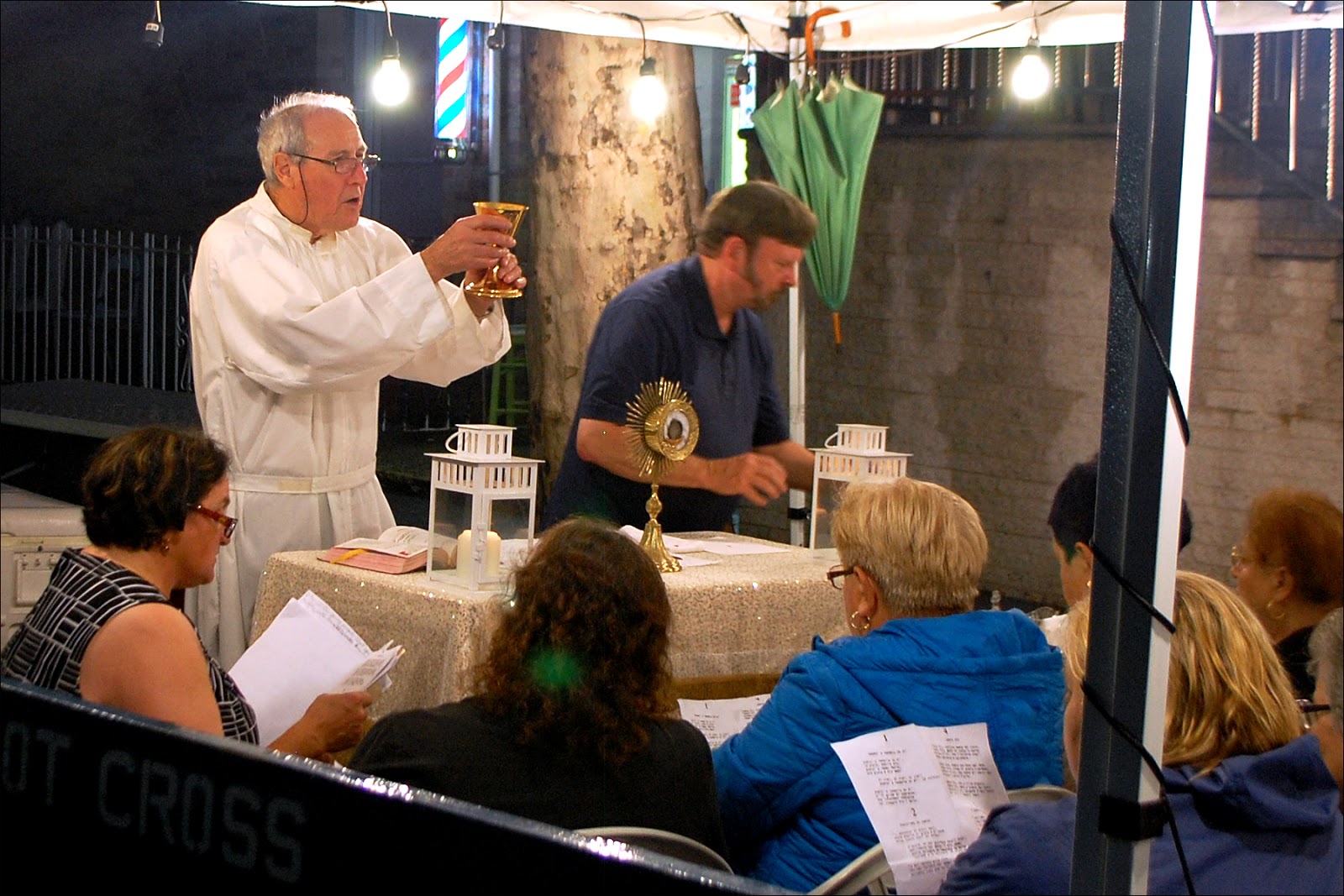
Monday’s rain was no match for the devotion to San Donato di Arezzo, as some two-dozen steadfast devotees braved the inclement weather to pray the Rosary and celebrate Mass in honor of our beloved patron outside the Mazza residence (158 Conselyea Street) in Williamsburg, Brooklyn.
 Squeezing under the tents and umbrellas, Mass was celebrated in English and Italian by Fr. Barozzi, who was dutifully assisted by Franca Mazza and James Glynn. The service concluded with the singing of a hymn to San Donato and veneration of the first class relic.
Fortunately, by the time Mass ended the rain had dissipated and attendees were able to enjoy a little fellowship, coffee and some lite fare, courtesy of the Mazza family.
 |
| A close-up of San Donato's relic |
 |
| (L) The statue of San Donato in front of the Mazza residence. (R) The reliquary is placed on the altar |
 |
| Sacred art on display |
 |
| Franca Mazza served as lector |
 |
| (Above & below) Mass was celebrated with Father Barozzi in Italian and English |
 |
| The congregation sang hymns in Italian |
 |
| After Mass, devotees venerate the relic of San Donato |
 |
| Afterward, we were treated to some delicious refreshments |
August 9, 2017
Evviva Maria! A Look at the 129th Annual Feast of Our Lady of the Snow in Williamsburg, Brooklyn
 |
Evviva Maria!
Photos by New York Scugnizzo
|
Scenes from Saturday’s Feast Day Mass and procession for Our Lady of the Snow, patroness of Sanza, Salerno, in Williamsburg, Brooklyn.
 |
| A shrine to the Blessed Mother is erected inside the Our Lady of the Snow Society Clubhouse (410 Graham Avenue) |
 |
| The festivities kicked off with the American and Italian anthems |
 |
| The society's standards and Our Lady of the Snow statue is presented to the expectant crowd |
 |
| (Above & below) Participants salute Old Glory during the National Anthem |
 |
| The Our Lady of the Snow Ladies Auxiliary display heart-felt devotion |
 |
| Members of the San Sabino Society show their support |
 |
| Devotees shower the statue with rose petals |
 |
| After the rose petal shower, young girls release a bouquet of balloons |
 |
| (L) Members of the Ladies Auxiliary carry the Blessed Mother to San Sabino. The ritual is a reenactment of the centuries-old tradition that takes place in Sanza. (R) The color guard lead the way |
 |
| (Above & below) The procession wends its way through the neighborhood |

 |
| We stopped for a moment of silence by the Society of St. Mary of the Snow Square on the corner of Herbert Street and Graham Avenue. Pilgrims briefly pay homage to San Donato outside the Mazza residence (158 Conselyea Street) |
 |
| (Above and below) A good time was had by all |
 |
| Always great to see young ones participating in our time-honored traditions |
 |
| Family and friends enjoy the festive holiday |
 |
| Cavalieri Vincent Gangone and John Napoli of the Sacred Military Constantinian Order of St. George visit the shrine set up outside the San Sabino Clubhouse |
 |
| San Sabino Martire and the Madonna della Neve |
 |
| The beautiful altar and the society's original statue of the Madonna della Neve inside St. Francis of Paola Church (219 Conselyea Street) |
 |
| After Mass, Cavs Gangone and Napoli join Frank Viola and HE Cav. John Viola, Delegate of the Sacred Military Constantinian Order of St. George |
 |
| Afterward, I had the great privilege of joining the very generous and hospitable Viola clan at La Locanda Restaurant (432 Graham Ave.) for a celebratory meal |
 |
| We enjoyed a delicious repast, replete with southern Italian delicacies... |
 |
| ...including one of my all-time favorites, cavatelli pomodoro |
 |
| Back at the clubhouse, the statue is returned to the shrine and revelers mingle and enjoy the festivities |
August 8, 2017
Around the Web - Italian American Podcast Episode 46: The Hidden History of Southern Italy’s Glory, Part 2

Listen to Episode 46: The Hidden History of Southern Italy’s Glory, Part 2
Also see:
• Around the Web - Italian American Podcast Episode 45: The Hidden History of Southern Italy’s Glory, Part 1
August 7, 2017
Celebrating the Feast of the Transfiguration of Our Lord Jesus Christ in Windsor Terrace, Brooklyn
 |
| Bishop James Massa |
Sunday evening I joined some eighty pilgrims at beautiful Holy Name of Jesus Church (245 Prospect Park West) in Windsor Terrace, Brooklyn for Solemn High Traditional Latin Mass for the Feast of the Transfiguration of Our Lord Jesus Christ.
Mass was sung by Celebrant and homilist the Most Reverend Bishop James Massa. Fr. Joseph Zwosta was the Deacon and Fr. Tomasz Szczepanczyk was the Subdeacon. The sacred ministers were dutifully assisted by Eddy Toribio (MC), Chris Carvajal, Brian Hilley, Lorenzo Tinio, Robert Jurman, John Leicmon, James Pierre and Matthew Wise.
The motets and musical setting of the Mass were composed by organist and choir director David Adam Smith. They were gloriously chanted by Ryland Angel (tenor), Art Bryan Manabat (tenor), Phillip Cheah (bass), and Peter Walker (bass).
Thank you Rev. Lawrence D. Ryan, Pastor and members of the Holy Name congregation for your continued warmth and hospitality. Special thanks to Cindy Brolsma and organizers for your hard work and dedication. Once again, it was a great joy to celebrate our faith together.
The next Latin Mass at Holy Name of Jesus Church will be celebrated on Friday, September 15, 2017 at 7:00pm for the Feast of the Seven Sorrows of the Blessed Virgin Mary.
August 6, 2017
Feast of the Transfiguration of Our Lord
 |
| Santissimo Salvatore, have mercy on us |
A prayer for the Transfiguration of Our Lord
At the Transfiguration, Father, You showed Jesus in glory, a glimpse of what His disciples would see in His risen life. Bless us in our humanity, with an awareness of Your presence, leading us to share in Your divine life even in our daily struggle. Help us to deepen our knowledge of the Law and the Prophets, channels of Your grace throughout history, and signposts for our journey. Amen.
Photo of the Week: Bronze Head of Young Boy (Testa di Ragazzo) by Vincenzo Gemito
 |
| Bronze head of young boy (Testa di ragazzo) by Vincenzo Gemito at the Museo Civico in the Maschio Angioino, Napoli. Photo by New York Scugnizzo |
August 4, 2017
The Presepio of Mercy Installation at Most Precious Blood Church Comes to a Close
 |
| Pulcinella |
While talk of selling the presepio had been ongoing for nearly a year, I was beginning to think it would never happen and was admittedly surprised to see the crèche denuded of its myriad figures inspired by Caravaggio’s extraordinary, The Seven Acts of Mercy (circa 1607), and Rembrandt van Rijn’s, The Return of the Prodigal Son (circa 1669).
Officially unveiled on the Feast of the Immaculate Conception on Tuesday, December 8, 2015, the Nativity of Mercy was commissioned by Monsignor Donald Sakano in conjunction with Pope Francis’ Year of Mercy. It was crafted by the world-renowned La Scarabottola workshop in Naples and was installed by Raffaele and Emmanuelle Scuotto.
 |
| The desolate scenery |
Illumination aside, the biggest complaint I heard about the presepio was the removal of the rear pews to accommodate the artwork's massive base. Considering the church’s scanty attendance, the diminished seating would not normally be a problem, but it did (unintentionally) adversely affect the San Gennaro and San Rocco Feasts, which always fill the pews.
 |
| The front of the presepio |
We shall see.
Either way Most Precious Blood Church continues to be a bastion of southern Italian faith and culture, of which the Nativity of Peace was a shining example. We avidly support the church's endeavors, especially its collaboration with the Italian feasts and Traditional Latin Mass, and encourage our readers to do the same.
The 128th Annual Feast of San Rocco will be celebrated on Sunday, August 20th at Noon, and the 91st Annual Feast of San Gennaro will be celebrated from September 14th thru 24th.
 |
| The back of the presepio Photos by New York Scugnizzo |
New Music: Responde Mihi - Liturgical Music in Baroque Naples

• Responde Mihi - Liturgical Music in Baroque Naples by Cappella Neapolitana, Antonio Florio
Label: Glossa
Release Date: July 7, 2017
Audio CD: $9.49
Number of Discs: 1
Available at Amazon.com
Read description
August 3, 2017
A Look at the 14th Annual Feast of Our Lady of Mount Carmel in Bergen Beach, Brooklyn
 |
Evviva Maria!
Photos by New York Scugnizzo
|
Scenes from Sunday's celebration of the Patroness of Marina di Gioiosa Ionica, Reggio Calabria at St. Bernard of Clairvaux Church (2055 East 69th Street) in Bergen Beach, Brooklyn.
 |
| (Above & below) Before Mass, we greeted our dear friends from the Gioiosa Ionica Society |

 |
| (L) After Mass, the statue is carried out to the expectant crowd. (R) Dutiful altar servers are raring to go |
 |
| Devotees pin donations on to the statue of Our Lady |
 |
| Before the procession, members of the Gioiosa Ionica Society take a commemorative photo with the clergy |
 |
| Departing the bustling fairgrounds, the procession wends its way through the neighborhood |
 |
| The procession was presided over by Pastor Monsignor Joseph R. Grimaldi and the Most Reverend Bishop Raymond Chappetto |
 |
| These adorable little angels had the best seats in the house |
 |
| As always, there was a terrific turnout for the procession |
 |
| Danny Vecchiano and the Giglio Band |
 |
| Lighting candles, I made my usual intercessory prayers for the happy repose of the souls of my ancestors |
 |
| Back at the fairgrounds I enjoyed a 'little snack' |
Subscribe to:
Posts (Atom)