April 27, 2010

Cesare Lombroso’s Barbaric Legacy

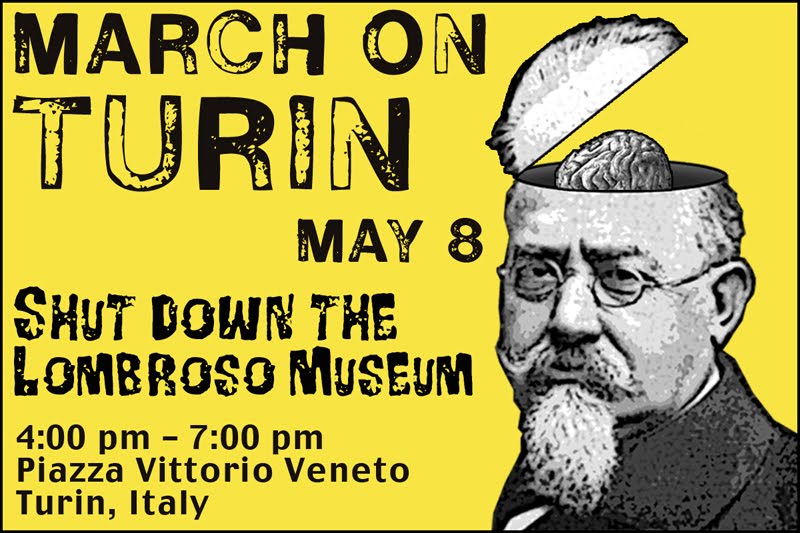
On Saturday May 8th, 2010 there will be a major demonstration at the newly renovated Cesare Lombroso Museum in Turin (Piedmont) to protest the political marginalization of Southern Italians and the desecration of the human remains contained therein. 

Cesare Lombroso (1835-1909) was the father of Italian Positivist Criminology, a school of thought advocating biological determinism (the belief that human behavior is innate and unalterable) as the cause of human criminality. He contended that the born criminal could be detected by certain physical characteristics, such as high cheekbones and upturned noses, among other “atavistic stigmata.” He “proved” his theories by taking skull measurements of “criminal” Southern Italians and comparing them with soldiers loyal to Piedmont.  His gruesome collection of decapitated heads harvested from Southern Italy is currently displayed at the Cesare Lombroso museum. 

It would be very easy to attack Lombroso based on modern and politically correct philosophical grounds, which tend to be violently opposed to anything resembling his theories. However, modern philosophy is often as politically motivated as it was in Lombroso’s day; so while is seems ironic, it is not surprising that many international human-rights groups are silent when the targets of discrimination are Southern Italians, and defending us doesn’t further their interests.

It would also be simple to discredit Lombroso’s ideas based on new scientific data, but it would also be unfair. The founders of many sciences were often grossly incorrect about some of their core theories, only to have others revise them and come up with viable alternatives. Modern science is finding abundant evidence of both positive and negative behavioral tendencies linked to certain genes, which can appear across many diverse populations. Such discoveries may be very different from Lombroso’s primitive conclusions, but are not completely incompatible with other aspects of his theories.

The problem with Lombroso, and his adherents, is one of motivation. Lombroso’s conclusions had less to do with science than providing a justification for his political agenda. Lombroso was a loyal supporter of Piedmont’s invasion and occupation of Southern Italy, and served as a doctor for the invading army. Many of the “brigands” that he studied were not “criminals” at all, but Bourbon soldiers who continued to fight against Piedmont after the Kingdom of the Two Sicilies fell. Some were interred in POW camps in the North, others were killed in the South, treated like hunting trophies, and had their heads removed for transport to Lombroso’s laboratory. One can argue that these Southern “brigands” were just as loyal as the Northern soldiers that Lombroso compared them to, and their only “crime” was being on the losing side of the war.
(L-R) Ghoul posing with his trophy; slain 'brigands' on display; 
violated corpse of Michelina De Cesare; severed heads in cages.

Lombroso’s ideas were not restricted to Southern Italians, but experimenting on Southerners was of special interest to him. He was Jewish himself, born Ezechia Marco Lombroso, and was appalled by anti-Semitism and very protective of his ethnic group, but like many persecuted groups or individuals, it doesn’t necessarily translate into tolerance or sympathy for others.

Cesare Lombroso’s politically motivated experiments continue to haunt us, both in the stereotype of the Southern Italian criminal and the disdainful treatment of the Southern people. A museum about Lombroso in itself might not be a bad thing, but the way it is done can have a powerful influence on the minds of its visitors. That the uncivilized display of Piedmont’s victims is permitted in today’s so-called enlightened and progressive society only underscores the hypocrisy and barbarism behind that society. Their remains should be returned to their true homeland, either for proper burial, or at least preservation in a dignified manner.

Silvano Montaldo, the director of the Cesare Lombroso Museum, claims that they are not promoting discrimination and go to great lengths to point out Lombroso's errors. I’m sure that at some level he believes that, but the disgraceful display of Southern Italian remains is very much in tune with the negative attitude toward Southerners that survives to this day. Can you envision the reaction of the British or Americans if the remains of their soldiers were treated with such disrespect? Would they remain silent on seeing the skulls of their Marines displayed as an inferior criminal type?

Submitted by Lucian

April 25, 2010

A legendary cop

Lt. Det. Joseph Petrosino

The following excerpt from 'Fortunate' Vallone taking a trip to Italy by Elizabeth Daley appeared in last week's edition of the Queens Chronicle, a local newspaper.
"Petrosino was investigating the Sicilian Mafia when he was killed in 1909. He was a highly regarded member of the police force during his time of service and ended up being good friends with Theodore Roosevelt, among other accomplishments."

Irked by this obviously dismissive handling of Detective Lt. Petrosino's many real accomplishments, Southern Italian nationalist Nicholas J. Narducci sent the Queens Chronicle the following letter, which was printed in their April 22nd edition.


Dear Editor:

In regards to your article concerning Peter Vallone Jr.'s upcoming trip to Italy (“‘Fortunate’ Vallone taking a trip to Italy,” April 15, Western Queens edition): You actually rate having been friends with Teddy Roosevelt an “accomplishment?”

NYPD Det. Lt. Giuseppe “Joe” Petrosino had far more real accomplishments under his belt.  All of which, I might add, were omitted from your article. Allow me, please, to enlighten your readers.

He created the first police bomb squad in this country’s history.

After being promoted to lieutenant, he was put in charge of the NYPD’s elite Italian Squad to deal with the twin problems of the Cosa Nostra and the Black Hand in this city’s Italian-American community. He was so effective in this capacity that crime in New York’s Italian-American neighborhoods dropped an incredible 50 percent!  The Italian Squad (later called the Italian Legion) became the prototype for later organized crime task forces throughout the country.

He pioneered witness-protection and intelligence-gathering programs to aid law enforcement officials in their war on organized crime.  His group set up a vast network of both paid and unpaid informants. 

He rescued legendary Neapolitan tenor Enrico Caruso from the clutches of the Black Hand, who had been demanding monies from him in exchange for his life.

He uncovered convincing evidence that anarchists in upstate New York were plotting to murder President William McKinley.  He passed this information along to the Secret Service.  Then-Vice President Theodore Roosevelt vouched for Petrosino’s skills as a police investigator.  Tragically, McKinley ignored the warnings and was shot in Buffalo by Leon Czolgosz on Sept. 6, 1901, dying eight days later.

According to Petrosino, his greatest accomplishment was rescuing one Angelo Carboni from certain execution in the electric chair for murder by finding the real culprit and bringing him to justice.

As I stated earlier, it was these that were his real accomplishments, not merely being a drinking buddy of “Old Rough Rider.”

In all fairness to you, however, nowadays it’s not what you do but who you know that determines your status in society.  Just ask people like Paris Hilton and Kim Kardashian.

Nicholas J. Narducci 
Whitestone 

April 21, 2010

Francesco de Mura

Two door panels with
Faith, Hope and putti 
attributed to Francesco de Mura,
Museo Civico di Castel Nuovo
Photo by New York Scugnizzo
By Giovanni di Napoli

In recent years I've made it a personal goal to pay homage to some of my favorite Southern Italian artists on their birthdays by viewing their works in person. Somehow, this tradition makes me feel connected to the artists; their greatness is a source of inspiration and pride. It's a simple gesture on my part and I find it to be a very rewarding. 

Luckily for me I have easy access to a few of their works, thanks to the proximity of the Metropolitan Museum of Art. Unfortunately, due to the museum's vast collection and limited space (which is mind boggling considering the massive size of the place), I was unable to view Francesco De Mura's preparatory sketch for The Assumption of the Virgin because it was out of circulation. A very helpful gentleman at the information desk told me that the museum rotates their collection, but sometimes it takes as long as three years before some works are put back on public display. He did, however, give me a phone number to request a special viewing of the drawings and prints in storage, but they need at least two weeks advanced notice.
Needless to say, it's impossible to stay disappointed for very long at the MET. The institution is home to one of the world's greatest art collections and I was not about to waste an opportunity to take some of it in. I made my way to the European Painting galleries on the second floor and leisurely wondered through its hallowed halls. Gazing in awe, I found myself surrounded by the esteemed works of some of Europe's most celebrated artists: Diego Velázquez, Rembrandt van Rijn, El Greco, Caravaggio, Anthony van Dyck, Nicolas Poussin, Jusepe de Ribera, et al.

Of course, some of the Titans of the South were represented as well. I made my usual pilgrimage to the R.H. Macy Gallery (room 10) and the Stephen C. Clark Gallery (room 30) to view the masterpieces of Luca Giordano, Mattia Preti, Francesco Solimena, Salvator Rosa, Corrado Giaquinto, Gaspare Traversi and Massimo Stanzione. It was almost like having a religious experience; I dreamed of being back in the land of my fathers again.

Although I didn't get to see De Mura's work, my visit to the MET was as pleasurable as ever. It was an ideal way to celebrate our culture and heritage. When I get the chance I'll make a special appointment to view De Mura's work, along with a few others that I would like to see (e.g. Salvator Rosa's Fall of the Giants), but for now I will be content to simply honor his memory.

Detail, Allegory of Faith
Francesco De Mura was born in Naples on April 21, 1696. His parents, Giuseppe di Muro and Anna Linguito, were wool merchants in the parish of Santa Maria della Scala. The boy showed an early propensity for drawing. According to the biographer Bernardo De Dominici (1683-1759), de Mura was beaten by his schoolmaster for sketching images of the saints. At the age of ten, on the advice of an artist friend, de Mura's father sent his son to study in the workshop of Domenico Viola, thus beginning the boy's formal training.

The young virtuoso was treated with great kindness by Viola, who had been a pupil of the great Mattia Preti. Sadly, in just over a year into de Mura's apprenticeship, Viola died. By 1708 he entered the studio of Francesco Solimena, Naples' most admired artist at the time. De Mura soon made an impression. As claimed by De Dominici, "It was a marvel to see" a boy of twelve skillfully copying the works of Solimena and his pupils (e.g. Giustino Lombardo). Master and protégé would form a life-long friendship.
In 1713 De Mura painted his first public work, a Crucified Christ with the Virgin and St. John, for the Chiesa di San Girolamo delle Monache. Soon followed were notable bozzetti depicting the Madonna delle Grazie and St. Anthony of Padua for the Pio Monte della Misericordia and the Immaculate Conception for the Sisters of Crocelle di Mannesi. These, and other, early works clearly show a late baroque style and the influence of Preti and Solimena.

As his reputation grew De Mura was no longer dependent on Solimena's atelier. By the 1720's he began receiving major commissions throughout Naples, including two paintings for the chapel at San Nicola alla Carità. In 1727 he painted a cycle for the sacristy of the Chiesa dell'Annunziata in Airola and five paintings for the Duomo in Capua. That same year he married Anna d'Ebreu. De Mura would then go on and produce ten paintings of the Virtues for the Chiesa di Santa Maria Donnarómita.

In 1731 De Mura was commissioned to decorate the chapel at Montecassino. He so impressed the Benedictine fathers with his work they employed him for almost ten years at the hilltop abbey. During this prolific period he produced over thirty paintings and frescoes. Sadly, these and other irreplaceable items were destroyed during the allied advance through Italy in 1943. Existing photographs show the influence of Luca Giordano.

Detail, Allegory of Hope
The next few years would be some of the artist's most noteworthy. King Carlo di Borbone employed De Mura to decorate the Palazzo Reale at Naples. The Glory of the Princes, homage to the marriage of the King to Maria Amalia of Saxony in 1738 is considered the most important of these works.

In 1739 De Mura completed The Young Christ among the Doctors in the Temple for the Certosa di San Martino. According to De Dominici the work was "one of the most beautiful painted by our Francesco, for the perfect composition as well as for the beauty, and nobility of color which, with its sweet harmony, makes one miraculous accord of all."

The Neapolitan's services were in great demand and in 1741 he left Naples for Turin where he participated (along with Corrado Giaquinto and other notable southern Italian artists) in Charles Emmanuel III of Savoy's grand project to aggrandize his capital. During his short stay in Piedmont De Mura painted several royal portraits (including the King's) and six ceilings portraying classical themes in the Royal Palace. He also received several commissions, including nine paintings depicting the heroics of the ancients, which would be sent back north from Naples. These, and later works, showed the influence acquired through contact with his fellow countryman Giaquinto during this period.

De Mura returned to his homeland in 1743 and continued to receive commissions from wealthy patrons and institutions, among these were the Chiesa di Santa Chiara, the Chiesa di Annunziata in Capua and the SS Severino e Sossio. In 1751 he repainted the Adoration of the Magi in the apse in the Nunziatella a Pizzofalcone that he originally created almost two decades earlier. He became a member of the newly founded Accademia di Belle Arti in 1752 and was appointed president in 1766. He would retire his post from the prestigious Academy four years later but continue teaching at his own studio. Among his disciples were Pietro Bardellino, Jacopo Cestaro, Giacinto Diano, Michele Foschini, Domenico Mondo and Alfonso di Spigna.

The venerable De Mura continued producing many works for the churches and patrons across Southern Italy until his death in 1782.


* * *
The following source proved invaluable to this post: 
A Taste for Angels: Neapolitan Painting in North America 1650-1750, Yale University Art Gallery, 1987.
* * *
Francesco de Mura in the news:
On June 26, 2010 their will be an unveiling in Airola, Benevento, of the restored painting, l'Addolorata ed il Cristo Deposto, by Francesco de Mura. The restoration was generously funded by the Associazione Culturale Italiana di New York.

April 19, 2010

Corrado Giaquinto

The Penitent Magdalen, Corrado Giaquinto
Photos by New York Scugnizzo
By Giovanni di Napoli

When I first viewed The Penitent Magdalen by Corrado Giaquinto at the Metropolitan Museum of Art, I was surprised to see that it was classified as Italian. I wondered about that, because many of the "Italian" paintings are classified by region. At first I thought it might be an oversight, or possibly a slight against the artist's birthplace in Puglia. Uncomfortable with my own wild speculation I decided to investigate. I found that the regional labels had more to do with particular artistic styles than the origin of the artists themselves, although in many cases they were identical. Corrado Giaquinto was a special case. He was known to adopt the style of the various locations where he painted, making classification difficult, and his work even more interesting.

Corrado Giaquinto was born in Molfetta, Puglia, in 1703. At sixteen he travelled to Naples and studied under the tutelage of Nicola Maria Rossi, a pupil of Francesco Solimena. Eventually, he would receive art instruction from the Neapolitan master himself. After several years of apprenticeship in Solimena's studio Giaquinto would seek his fortunes elsewhere. Unfortunately, only one work by the artist from this period is known to exist, a copy of one of Solimena's paintings.

Examples of the various regional classifications
Giaquinto arrived in Rome in 1723. He lodged at the workshop of Sebastiano Conca along with Neapolitan artist Giovanni Pandozzi. He spent his time studying contemporary Roman painting and sketching sculptures, oftentimes Michelangelo's famed Pietà. In addition to some altarpieces, Giaquinto was commissioned to paint the cupolas of San Nicola dei Lorenesi and the Basilica di San Lorenzo in Damaso.

On the move again, the Southerner visited Turin in 1733 where court architect Filippo Juvarra (a native of Messina, Sicily) gathered together a collection of artists to aggrandize the capital of Charles Emmanuel III of Savoy. Along with fellow Neapolitans Conca, Francesco de Mura and Sicilian Mariano Rossi (among others), Giaquinto painted decorations for the Royal Palace and villas of Cardinal Maurizo di Savoia and Queen Maria Cristina.

Giaquinto returned briefly to Rome in 1735 and again in 1738. He painted altarpieces and the vault of the Chiesa di San Giovanni Calibta. However, a series of paintings, commissioned by Pope Benedict XIV, for the Basilica di Santa Croce in Gerusalemme is considered his crowning achievement in the Eternal City. In 1740 he was admitted into the prestigious Accademia di San Luca and by 1752 he was the institution's chamberlain.
The Lamentation by Corrado Giaquinto
Giaquinto's fame was such that he received commissions from patrons back in Naples. Perhaps the most notable of these were his immense, Translation from Pozzuoli to Naples of the Relics of SS Eutyhes and Acutius for Giuseppe Spinelli, the archbishop of Naples. The painting (which was the first in the southern capital to move towards the barocchetto) was highly influential on Neapolitan artists at the time.

In 1753 Giaquinto reached the pinnacle of his career when Ferdinand VI summoned him to Madrid. He succeeded Jacopo Amigoni as primer pintor de cámara and was appointed director general of the Academia de Bellas Artes and head of the Real Fábrica de Tapices y Alfombras de Santa Bárbera. As court painter he had a profound influence on Spanish artists, most notably Antonio González-Velázquez and Francisco Bayeu. Even today, Spain is one of the few places that still revere the artist.

After the abdication of Ferdinand VI and the succession of Carlo di Borbone in 1759 Giaquinto began to lose prominence. Queen consort Maria Amalia of Saxony preferred the Neoclassicism of Anton Raffael Mengs (their court painter from Naples) to the barocchetto of Giaquinto. In 1762 Giaquinto was granted permission to leave the King's service and returned to the Kingdom of the Two Sicilies. He received commissions for the new baroque Cattedrale di Santa Maria Assunta as well as for the Chiesa di San Domenico in his hometown of Molfetta. His last substantial project was to paint the sacristy in San Luigi di Palazzo in Naples.

On April 19, 1766 Corrado Giaquinto died at the age of sixty-three.
Medea Rejuvenating Aeson by Corrado Giaquinto
(Photo added 1/26/13)
Corrado Giaquinto was very popular in his day; he became very wealthy and influential (especially in Spain and Italy) and has been compared to Neapolitan giants like Luca Giordano and Francesco Solimena. However, like many Southern Italian artists his reputation has waned over time as taste in art changed (among other factors). Thankfully, of late there has been a growth of scholarly interest in the history of Southern Italy; hopefully, this interest will continue to expand, especially into the arts. Anyone viewing the works of Corrado Giaquinto can plainly see they've been unjustly neglected and ignored.

It has always been the expressed purpose of this blog to recognize the achievements and contributions to world civilization by Southern Italians and to give these "forgotten" Titans their due. Well known across Europe before the Risorgimento, and celebrated in Spain today, Corrado Giaquinto is certainly one of these figures.

The following source proved invaluable to this post:
A Taste for Angels: Neapolitan Painting in North America 1650-1750, Yale University Art Gallery, 1987.

April 15, 2010

Arturo DiModica exhibit at the IAM

Photos courtesy of New York Scugnizzo
Recently, I visited New York City's Italian American Museum to view Arturo DiModica's latest sculpture, "Resurrection," and thought I would share a few photos with you.  The striking work depicts a bronze angel lifting a stainless steal Christ figure atop outstretched hands.  
I was pleasantly surprised to learn that a miniature version of DiModica's stainless steal "Horse Sculpture" was also on display.  
If you haven't seen these works yet I suggest you hurry because the exhibit ends on April 30, 2010.

After our visit to the museum we got some gelato and relaxed in nearby Petrosino Square located at Kenmare, Lafayette Sts. and Cleveland Place.

April 14, 2010

One Tin Soldier: The Frank Serpico Story

Frank Serpico
By Niccolò Graffio
“When vice prevails, and impious men bear sway,The post of honor is a private station.”– Joseph Addison: Cato, IV, 1713
Francesco Vincent “Frank” Serpico was born on April 14th, 1936 in Brooklyn, New York.  His father, Vincenzo Serpico, was born in the town of Marigliano, in the province of Naples, in the region of Campania, Italy.  His mother, Maria Giovanna, was born in Ohio but returned with her family when she was young to Italy where she later met and married Vincenzo.

Frank Serpico’s childhood was an innocuous one.  At the age of 18 he joined the U.S. Army and was shipped off to Korea, where he remained stationed for two years.  Returning home, he enrolled in Brooklyn College, CUNY, while working part-time as a private investigator and youth counselor.

He joined the New York City Police Department in 1959 at the age of 23, being sworn in as a probationary patrolman on September 11th of the same year.  On March 5th, 1960 he was commissioned a patrolman for the NYPD.  His first assignment was in the 81st precinct (in the north-central area of Brooklyn).  He would hold the job of patrolman for 12 years.  He then worked for two years in the Bureau of Criminal Investigation (BCI), doing “exciting” police work such as filing fingerprints.

He was later assigned to work in the plainclothes division.  It was here he first encountered the widespread corruption he would soon learn was characteristic of the NYPD.  Serpico’s own strong moral fiber hindered his “career” as a plainclothesman, since he consistently refused to have any part in the corruption that was rampant in the department.  His attempts to expose those who did on several occasions nearly cost him his life!  
He first began reporting on the corruption in the NYPD in 1967.  However, corrupt officials high in the police hierarchy, plus the Byzantine bureaucracy, stymied his efforts.  In spite of the fact a fellow principled officer named David Durk eventually came forward to help him in his efforts, Frank soon began to believe (probably correctly) that his fellow partners learned of his secret meetings with police investigators.  Fearing for his safety, he decided to come forward into the spotlight on April 25th, 1970 by contributing to a front page article in the New York Times on rampant corruption in the police department.

That piece, plus the ensuing political fallout, forced then-Mayor John V. Lindsay (a cafone if ever there was one!) to appoint a five-member commission to investigate the article’s allegations.  The commission, headed by the redoubtable Whitman Knapp (and named after him), began its investigations of corruption in the NYPD in June, 1970.  Public hearings, however, didn’t begin until October 18th of the following year.

The publicity surrounding the investigations of the Knapp Commission would transform Police Detective Frank Serpico into a minor celebrity, but at an almost deadly cost.  As one might imagine, he was hardly a welcome sight in any precinct after violating the tacit “blue wall of silence”.

On February 3rd, 1971 at 10:42 PM during a narcotics stakeout in Brooklyn, Serpico was shot at point blank range in the face just below the eye.  In spite of the fact three other cops were at the scene, no one called in a “10-13” (officer down).  None of them came to his aid even though he called for help.  This later made Serpico believe he had been led there to be murdered.

An elderly Latino gentleman, upon hearing gunshots, called emergency services and then remained with Serpico, helping to keep him alive, until help arrived.  While in the hospital he was harassed by the police department with hourly bed checks.  Ultimately, though, he survived, and testified before the Knapp Commission.  In spite of the highly questionable circumstances surrounding Frank Serpico’s shooting, none of the other three officers were ever brought up on charges and two of them were even awarded medals!

In addition to hearing testimonies from Frank Serpico and David Durk, the commission members also heard from former Police Commissioner Howard R. Leary, corrupt policemen and victims of police shakedowns.  The investigations of the commission were far-reaching.  Numerous criminal indictments were handed down against corrupt police officials.  Reforms were instituted for the NYPD including: holding commanders accountable for the actions of their subordinates, putting offices of the Internal Affairs Division in all precincts as well as putting informants in all precincts.

Serpico retired from the NYPD on June 15, 1972, one month after receiving the department’s highest award: the Medal of Honor.  He relocated to Switzerland in order to heal from his wounds and ended up staying there for the next 10 years.  During that time he traveled extensively, lecturing on corruption and police brutality.  He eventually returned to the United States and currently resides in upstate New York.

His minor celebrity was transformed into a nationwide status with the release of the movie Serpico in 1973 starring fellow Southerner Al Pacino.  The movie is considered one of Pacino’s best roles and it helped to propel Frank Serpico into icon status as an incorruptible cop.  He still speaks out against corruption and brutality in law enforcement, as well as the weakening in civil liberties that has become characteristic of this country in recent decades.
Frank Serpico's firearms on exhibit at the Italian American Museum 
Photo courtesy of New York Scugnizzo
The media in this country has always been too quick to paint our people as capable of little besides racketeering and murder.  Movies such as The Godfather Trilogy, The Valachi Papers; TV series such as The Sopranos and books such as The Don is Dead are quick reminders of this fact.  Movies such as Serpico are the exception, not the rule, in how we are portrayed.  Since the overwhelming majority of Americans get their worldview through this media prism, is it surprising we are so stereotyped by our fellow citizens?

It is bad enough to hear these stereotypes uttered by others, but to this writer, it is especially disheartening to hear them from the mouths of our own people.  Such is the power of the media to mold and to destroy.  Oswald Spengler was right!

Our people’s detractors (especially those of Northern European descent) might well ask themselves why in this country’s long history the first police officer to step forward to unmask the culture of corruption that existed in the NYPD was a Southern Italian!  

According to Peter Maas, author of the book Serpico, Frank Serpico was the first policeman in U.S. history to step forward and speak out against police corruption!  The existences of men like Serpico, plus men like Giuseppe Petrosino, James Vincenzo Capone (aka Richard “Two-gun” Hart) et al clearly shows a much more balanced portrayal of us as a people is in order by the media.  That will not come about until we unite as an ethnos and demand it!  If other people can do it there is no reason other than our own apathy to stop us from doing it as well.

Do we demand the media moguls show our fellow Americans our best as well as our worst, or do we content ourselves with sitting in front of the “boob tube” and watch nothing but racist drivel like Jersey Shore?  As always, the choice is ours.

Further reading:
Maas, Peter; Serpico, Frank (2005). Serpico: The Classic Story of the Cop Who Couldn't Be Bought. New York: Perennial

March 30, 2010

Freedom Won and Lost: The Sicilian Vespers

The Sicilian Vespers (1846) by Francesco Hayez
By Niccolò Graffio

“Freedom cannot be granted. It must be taken.”
– Max Stirner: The Ego and His Own, 1845.

Americans in general today certainly take for granted the freedoms they still possess. This is not an unfair or inaccurate statement to make. How many Americans, for example, take the time out of their busy schedules watching television, surfing the Net, playing video games, “hanging out” in bars/clubs or just gaining weight to engage in such innocuous activities as educating themselves on the latest bills before their legislators? How many of them go further and contact their legislators to offer them their opinions on these bills? How many even bother to just vote on Election Day? You get the point, I’m sure. Every day things go on among our elected officials that will ultimately affect our daily lives, positively or negatively, and most seem content to remain blissfully detached from these proceedings.

One thing I’ve noticed Americans do like to do, politically speaking, is complain. Americans complain a lot! They complain at the workplace; they complain at the barber shop/hair salon; they complain at barbeques. They’ll complain anywhere they can find an ear to bend. Everyone likes to complain about politics, it seems; few are willing to do anything about it.

It wasn’t always this way. If one takes the time to read books on American history, one will realize that decades ago a greater percentage of Americans became actively involved in politics than now. One can’t help but notice those times in history when Americans were most involved in politics were lean times, economically speaking, like the Great Depression. Affluence appears to breed indolence.

In other parts of the world today, we see something different. In Greece, for example, the government is teetering on the verge of insolvency. During the bull market earlier in this decade corrupt local officials took advantage of the economic boon to throw long-established principles of accounting out the window and spent more than they were taking in, foolishly believing they could “rob Peter to pay Paul”. Now that they are stuck along with most everyone else in the midst of a severe global recession, the Greeks are finding to their dismay the rest of their neighbors in the EU consider their government bonds toxic.

As a result, officials in Athens have been forced to invoke drastic austerity measures to prevent (or at least forestall) an impending implosion of the Greek economy. This has touched a raw nerve among many in the Greek populace, who feel (probably correctly) they are being made the scapegoat for the corruption and incompetence of government officials. Many have taken to the streets in protest. The potential for violence is there! Certainly an enraged electorate is something no elected official in Greece is looking forward to on Election Day.

As a result of our historic national prosperity, Americans, especially when comparing themselves to foreigners, tend to view themselves as superior. That somehow our national greatness is inherent and has always existed. Nothing could be further from the truth! Throughout much of this country’s history the bulk of its citizenry have struggled to earn a living. Furthermore, the relative isolation of this country (to the land-hungry empires of Europe) was in large part responsible for keeping it safe from foreign domination.

America, in fact, began as a “political experiment”; a republic born of compromise between rival factions. Had it not also been for its alliances with Spain and France, there is no doubt in this writer’s mind the vast armies of Britannia would have quickly ground it down into the dirt, and men like George Washington, Thomas Jefferson and Benjamin Franklin would have, in all probability, found themselves facing a rope!

American history, then, is the story of a political experiment that succeeded. The following is the story of one that failed.

The Kingdom of Sicily was founded in 1130 by Roger II, Count of Sicily, a man of Norman and Italian extractions. His reign as king lasted from 1130-1154 and in its early stages was characterized mainly by suppression of rebellions, fending off foreign invasions and contending with a belligerent Pope, who initially refused to recognize Roger’s title as suzerain of the newly-formed kingdom.

Having finally secured his new kingdom, Roger built up an armada and went about conquering surrounding territories, creating a fledgling empire with its center at Palermo. His expeditions eventually brought him into conflict with the Byzantine Empire to the east, and though his fleets raised hell throughout the imperial dominions, they failed to capture Constantinople, the capital. Roger died in 1154.
Roger established a short-lived dynasty that ended in 1189 with the death of his grandson William II, nicknamed “the Good”. The throne was seized by Tancred of Lecce, an illegitimate son of Roger III, Duke of Apulia, the eldest son of King Roger II of Sicily. After seizing the throne, Tancred had William’s widow, Queen Consort Joan of England (sister of King Richard the Lionheart) imprisoned.

When Richard arrived in Sicily with his army on his way to battle the Muslims in the Holy Land, he demanded Tancred free his sister and return her dowry. When Tancred refused Richard attacked his dominions, eventually securing her release. When Richard left for the Holy Land in 1191, Tancred found himself facing the armies of Holy Roman Emperor Henry VI and his wife Constance, who was a daughter of King Roger II of Sicily by his third wife Beatrice of Rethel, and his rightful heir.
The Sicilian Vespers (1822) by Francesco Hayez
Though an epidemic caused Henry to temporarily withdraw his armies to the north, and Constance for a time was taken hostage by Tancred, his death in 1194 along with the premature death of his young son (and co-ruler) Roger III effectively ended his attempt at establishing a dynasty. When Henry returned later that same year, Tancred’s other son William III was taken prisoner to Germany and Henry had himself proclaimed King of Sicily, ending Norman rule in Sicily.

The accession of Henry and Constance to the throne of Sicily saw the establishment of the Hohenstaufen dynasty. Their son Frederick II was crowned King of Sicily (as King Frederick I) at the age of three in 1197, with his mother Constance relinquishing her title as Queens to remain as regent. He would go on to become King of Germany and Burgundy as well as Holy Roman Emperor.

Frederick was a renowned patron of the arts and sciences, though he was a notorious religious skeptic at a time when much of Europe was in thrall to the Roman Catholic Church. In 1224 he founded the University of Naples. At the time of his death in 1250 he was the preeminent monarch in Europe. However, within four years of his death, his son Conrad IV, heir to the thrones of Sicily and the Holy Roman Empire, would himself be dead and Hohenstaufen rule would begin to crumble in Sicily. By February 26th, 1266, with the death of King Manfred at the Battle of Benevento, the island would be in the hands of Charles I (also known as Charles of Anjou).

Charles was an energetic, ambitious ruler who was determined to be master of all Italy and the eastern Mediterranean. Unlike the Norman and Hohenstaufen rulers before him, Charles made Naples his capital. Sicily was to be his springboard for an eventual invasion of Byzantine lands to the east.

To finance his military campaigns, Charles heavily taxed his subjects and debased the currency. This all but ruined trade on Sicily. He also brought in French nobles loyal to himself and put them in various positions of authority. Though historians paint Charles as a tough but fair ruler, more often than not he was anywhere but on Sicily, leaving his French nobles to run affairs. The Sicilians chafed under their rule, which was characterized as cruel, oppressive and rapacious. Circumstances were rife for rebellion!

While all this was going on, external forces were conspiring against Charles’ ambitions as well. Emperor Michael VII Palaeologus, restorer and ruler of the Byzantine Empire, attempted to reconcile the Orthodox Church of his domains with the Catholic Church centered in Rome. The purpose of which was to drive a wedge between the Pope and the rulers of the Latin states now occupying formerly Byzantine-held lands. Michael also intrigued with Pedro III, King of Aragon.

When Charles of Anjou defeated Manfred, title to his kingdom passed to his daughter Constance, who was wife of Pedro. Pedro now had claim to the Kingdom of Sicily. Through the machinations of Giovanni da Procida, a Campanian physician and diplomat, Pedro was able to further stir up discontent amongst native Sicilian nobles to Angevin rule. Procida then travelled to Constantinople to seek the aid of Emperor Michael, who refused to enter into intrigues with Pedro unless it had the blessings of the Pope. Giovanni da Procida was able to secure the consent of Pope Nicholas III, who feared Charles’ growing power in Southern Italy.

What happened next is subject to debate among historical scholars to this day. That Pedro and Michael conspired to end Charles’ rule of Sicily there can be no doubt. How much their intrigues contributed to the rebellion there against Angevin rule remains an open question. The events surrounding the rebellion itself are also far from certain. The opinion of many historians (and this writer) is the insurrection occurred parallel to the intrigues of Pedro and Michael, who simply took advantage of a good thing.

According to one version the inhabitants of the city of Palermo were holding Easter Monday festivities just outside the town when French soldiers arrived to check for weapons, which Sicilians were forbidden to possess. The Frenchmen took the occasion to molest their women, which triggered a murderous riot that mushroomed into a full-blown insurrection!

Another version has it that a group of drunken French soldiers “crashed” a Sicilian wedding, harassing and vexing those in attendance before committing an outrage against the bride! Pandemonium predictably followed suit.
The Sicilian Vespers (1865) by Michele Rapisardi
A popular version of events, one advanced by the late British historian Steven Runciman, has it that during the Easter Monday festivities a group of drunken French soldiers attempted to mingle with the locals. The Sicilians coldly kept their distance from the Frenchmen. One of their group, a sergeant named Drouet, spied a comely young Sicilian lady and forcibly pulled her out of the crowd. His attempts at l’amour accomplished nothing but to incite the fury of her husband who was standing nearby. Pulling out a dagger, he rushed the overbearing Drouet and stabbed him to death! When his comrades attempted to come to his aid, they were quickly surrounded by a larger group of Sicilians who fell upon them with daggers and swords, dispatching them all.

At that moment the bells of the Vespers began to ring in Palermo. The Sicilians, realizing nothing but the most hideous and brutal reprisals awaited them, decided to “go for broke”. Raising their weapons, they shouted in the Sicilian language: “Moranu li Franchiski!” (“Death to the French!”). Racing through the streets of Palermo, they struck down every Frenchman they came across, while simultaneously exhorting their fellow townsmen to do the same. Since the French by this time were universally hated, it was not a hard thing to do. No one was spared: men, women and children. By the next morning every Frenchman in the city of Palermo was dead. It should be noted many modern historians think the magnitude of the slaughter was probably an exaggeration.

Whatever the truth, the insurrection quickly spread over the whole island. Most French officials were killed, though those who had ruled wisely were spared and allowed to depart in peace. Example: William Porcelet, the Vice-Justiciar of Western Sicily, had won the love of the Sicilians for his fairness and benevolent rule. The rebels escorted him and his family with honors to Palermo, allowing them to board a ship bound for Provence. Likewise the town of Sperlinga, at the heart of Sicily, allowed the French garrison there to retire safely to Messina.

By May the whole island was in rebel hands. Each major town proclaimed itself a commune answerable only to Papal authority. Charles of Anjou’s fleet which he had amassed just outside Messina in preparation for an invasion of Constantinople was put to the torch.

Significantly, the rebels decided on establishing a rudimentary version of a federal republic. They appealed to the Pope for protection. Unfortunately, by this time Nicholas III was dead and Martin IV, a lackey of Charles of Anjou, occupied the Papal throne. No aid of any kind would be forthcoming.

With Charles amassing a fleet in preparation for a punitive expedition to Sicily, and no one else to turn to for aid, the Sicilians reluctantly petitioned Pedro III for help. Conveniently sitting at the head of a large fleet near Tunis just 200 miles from Sicily, Pedro sailed for the island. Marching up the coast, he arrived in Palermo on September 2, 1282. Needless to say, the Sicilians weren’t exactly enthusiastic about replacing one foreign king with another. However, since Pope Martin IV had reasserted Charles’ right to the island, and Pedro promised to honor the islanders’ ancient privileges, they agreed to recognize him as their suzerain. One September 4th, 1282, Pedro III was crowned King Pietro I of Sicily by a mandate of the Sicilian people.

Charles would spend the rest of his reign as King of Naples trying to reestablish his control over the island of Sicily, and would fail every time. He would exhaust his forces in the endeavor, thereby sparing the ailing Byzantine Empire from almost certain destruction. The Sicilian Vespers triggered a war in the central and western Mediterranean regions that lasted until 1302, when the rulers of the kingdoms of Naples and Aragon signed the Peace of Caltabellotta, the last of a series of treaties that basically maintained the status quo. Charles II (son of Charles I) was recognized as King of Naples, and the island kingdom of Sicily, now known as the Kingdom of Trinacria, passed to Federico III, third son of Pedro III of Aragon. A house divided, the Kingdom of Sicily would remain under foreign domination.

As mentioned earlier in this article, America’s only reason for existence was the aid extended to it by the French and Spanish, as well as its isolation relative to Europe. Sicily, sadly, is located at the center of the Mediterranean, historically making it a coveted spot for empire-builders. One is left to wonder how different the history of that region might have been had the Sicilians, like the Americans long after them, found a benefactor for their fledgling republic.

Further reading:
Steven Runciman: The Sicilian Vespers; Cambridge Univ. Press, 1995.