September 21, 2020

Hiking Staten Island’s Verdant Greenways

Bronze church bells on display in church plaza
Photos by New York Scugnizzo
Looking to clear our minds and prepare for the upcoming week brimming with patronal Feast days (i.e. San Gennaro & Our Lady of La Salette on Saturday, Santa Candida & Sant’Eustachio on Sunday, San Matteo on Monday, San Maurizio on Tuesday, Padre Pio on Wednesday, et cetera), a few of us went hiking Friday morning in southern Staten Island’s vast and verdant open space reserve. 
(L) The facade of the Old Church of St. Joachim and St. Ann.
(R) Bronze statue of Fr. John Drumgoole by sculptor Robert Cushing

A picture-perfect day for a ramble, our little jaunt began at the the Old Church of St. Joachim and St. Anne in Pleasant Plains. Now closed, the church once served the destitute street children housed at the Mission of the Immaculate Virgin, commonly known as Mount Loreto, founded by Fr. John Drumgoole in 1871. Almost completely destroyed in a fire in 1973, all that remained was the facade. Rebuilt in 1976, the new building was incorporated into the original church exterior.

Bronze statues of Sant'Anna and San Gioacchino above the entranceway

From the churchyard, we traversed the open space reserve and nature preserve of the Mount Loreto Unique Area. Spotting all sorts of flora and fauna (e.g. ducks, swans, and large snapping turtles), we covered a lot of contrasting terrain, including tidal and freshwater wetlands, vernal ponds, and a lengthy shoreline of ocean-facing bluffs.

An ephemeral pool teeming with animal life

To our surprise, we stumbled across the outdoor shrine of the Immaculate Virgin, a large stone niche that once housed a statue of Our Lady. Now used as a “spontaneous shrine” memorializing the dearly departed, the space is covered with a sundry collection of statuary, prayer cards and other religious articles. The ideal spot to take a breather, we prayed the Holy Rosary for the poor and forgotten Souls of Purgatory before continuing on our way.

Non-native red-ear sliders sunning themselves on a log
Hard to tell from this photo, but this snapping turtle was almost three feet long

Trudging all the way up Heyerdahl Hill to the remote ruins of Heyerdahl House, one of the highest points on the eastern coast, we caught site of several white-tail deer. Used to keep watch during the Revolutionary war (1775-1783), the scenic hilltop's winding paths once crawled with British soldiers.  

We sauntered through the grasslands
Old St. Joachim and St. Ann slowly disappears behind us

Local lore claims the woods are haunted by the ghost of a young girl on a pale horse. It is said, when a skirmish broke out between the Redcoats and Revolutionaries, she galloped off into the forest never to be seen again. Thankfully, we didn't spot any equestrian phantoms.

The Eastern Showy Aster (Eurybia Spectabilis)
The New Jersey coastline can be seen in the distance

Overlooking heavily wooded Bucks Hollow, we sat quietly for awhile on the abandoned stones and took in all the sites and sounds this peaceful summit had to offer. Considering urban sprawl, it was hard to believe we were still in the dystopic environs of New York City. Thank God for small mercies.


~ Giovanni di Napoli, September 20th, Feasts of Santa Candida Martire and Sant’Eustachio and Companions

Discovering the Shrine of the Immaculate Virgin

(L) The niche is used as a spontaneous shrine
(R) One of several Infant of Prague statues on the altar

(Above & below) The shrine is covered with religious articles

(L-R) Sant'Antonio da Padova and Our Lady stand outside the niche
(L-R) The Gretta Moultan Gate and a wooded trail
(Above & below) The further we delved into the forest,
the more overgrown and eldritch the foliage became
 

One of several white-tail hinds we saw on our excursion
What's left of M. Heyerdahl's stone house. One of the most isolated
parts of the city, the closest building is two miles from here.

Photo of the Week: Silver Bust of San Matteo at the Basilica Cattedrale SS. Matteo e Gregorio in Salerno

Photo by Andrew Giordano

September 14, 2020

Photo of the Week: Crucifix at the Chiesa di Sant’Agostino in Salerno

Side chapel with 15th-century Gothic Crucifix between 17th-century
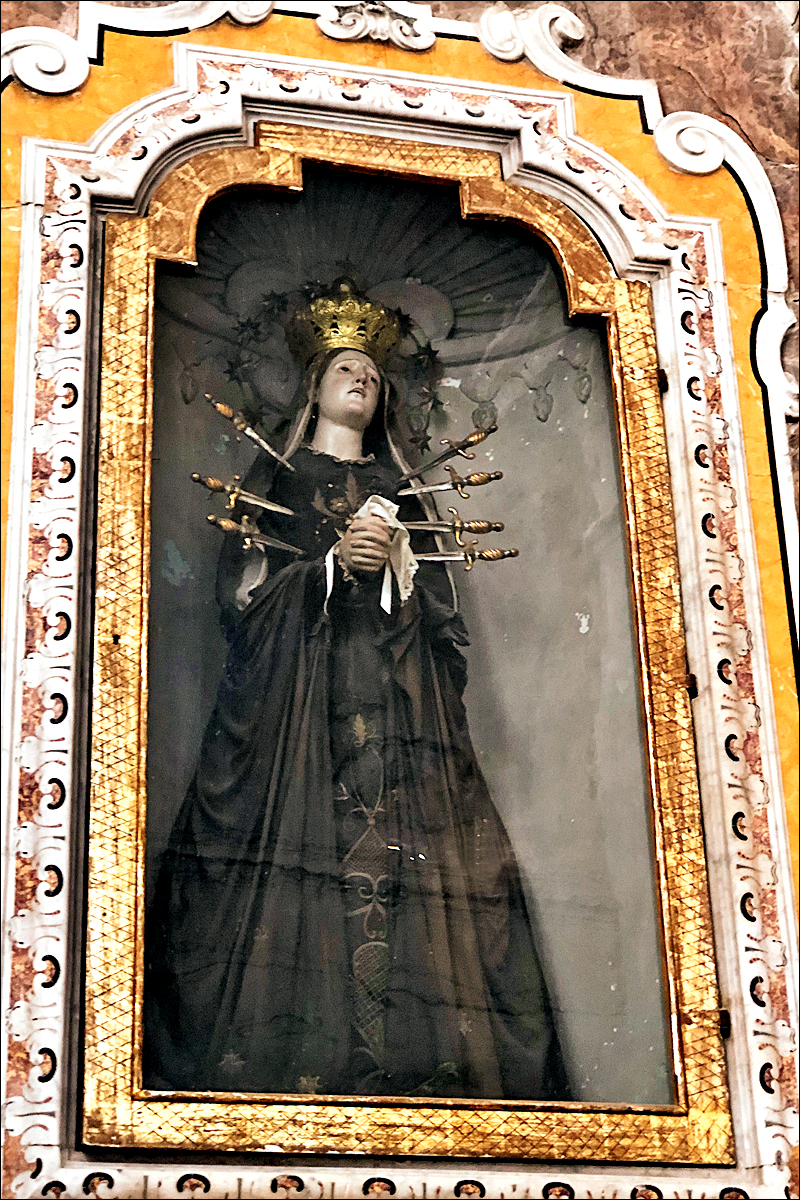
Baroque statues of the Madonna Addolorata and San Giovanni
Evangelista at the Chiesa di Sant'Agostino in Salerno.
Photo by Andrew Giordano

September 11, 2020

Celebrating the Nativity of the Blessed Virgin Mary at Amunì, in Bay Ridge, Brooklyn

The Fratelli della Santa Fede with Chef Dardanello (second from right)
After a month of fasting and prayers of reparation for the sacrilege committed against Our Lady during the Mass for the Feast of the Assumption at the Cathedral di Santa Maria Assunta in Napoli, members and friends of the Fratelli della Santa Fede (Brothers of the Holy Faith) broke our fast Tuesday evening with a celebratory dinner for the Nativity of the Blessed Virgin Mary at Amunì in Bay Ridge, Brooklyn. 

Table shrine with reliquary prayer cards for Sant'Anna, Santa Patrizia di Napoli and Blessed Emperor Karl of Austria; a green scapular; pocket statuette of the Infant of Prague; tin reliquary of San Gennaro; and statuettes of San Gennaro and Notre-Dame-de-Sous-Terre (Our Lady of the Underground)

Located at 7217 3rd Avenue, I discovered the quaint Sicilian eatery purely by accident on the day we started our fast. Looking for a change of scenery, I took a different route during my nightly passeggiata and spotted the A-frame sign in front of the restaurant advertising its Sicilian Specialties. Since I had already eaten dinner I didn’t order anything, but I was curious to see what they offered and grabbed a menu to go. 

Crostini smothered with fresh ricotta and sliced figs,
topped with crushed pistachios

Liking what I saw, I returned the next day for some takeout and met the very personable chef and owner, Vincent Dardanello. Surprised I haven’t heard of the place sooner, I learned that they only just opened in December 2019 and had barely three months before having to shutdown due to COVID-19.


Abstaining from meat and eating just one meal a day, I ordered the panelle special with a side of carciofi fritti, fried artichoke hearts tossed with caciocavallo cheese and parsley. The panelle, served on a toasted roll with fresh ricotta, caciocavallo and topped with lemon zest, was crispy and tasty. The portions were more than enough to hold me over for the day.

Zucchini blossoms stuffed with fresh ricotta and mozzarella

Since then, Amunì has become my go-to restaurant whenever I’m not in the mood to cook or just looking to get out. Admittedly, this has become more frequent because the food has been consistently delicious. Steadily working my way through the menu I’ve since enjoyed the caponata, meatless arancinette, insalata di finocchio, and the milinciani fritti, a breaded eggplant sandwich with roasted peppers and mozzarella.


Having been raving about the place for weeks, my friends were all on board when I suggested we hold our celebration there.

Arancini

Seated in the cozy and serene backyard dining area, our party settled in and erected a little table-top shrine devoted to the Blessed Mother. Saying grace and our group’s ever-growing Litany of patron saints, we made a toast with the first of several bottles of Nero d’Avila, a deep ruby red, medium-bodied wine from Sicily (Molino a Vento).
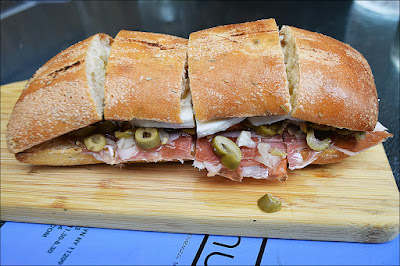
Muffuletta

Chef Dardanello started us off right and whetted our appetite with a couple of antipasti specials. First we had crispy crostini smothered with fresh ricotta and sliced figs, topped with crushed pistachios, then some fried zucchini blossoms stuffed with fresh ricotta and mozzarella. 


These delicacies were soon followed with traditional arancini, deep fried rice balls stuffed with ground beef, peas and mozzarella, and sfincione, a Sicilian style pizza with tomato, seasoned bread crumbs and anchovy. Two classic Sicilian dishes, they are a must try. 

Insalata di finocchio

Next up was the muffuletta, a popular sandwich that originated with Sicilian immigrants in New Orleans. With our friend Tony joining us from The Big Easy, we couldn’t wait to hear what he thought of Brooklyn’s take on this N’awlins classic. Layered with prosciutto, mortadella, salami, fresh mozzarella, and chopped olive salad, the sandwich is a work of art. 


Pressing Tony for his thoughts, we were happy to hear his standards were met. According to him, the only major difference was the choice of cheese. Instead of mozzarella, down South they use sharp provolone.

Sfincione

For our entree Chef Dardanello prepared for us a pair of perfectly cooked (sanguinoso) New York Strip Steaks with caramelized onions on the side. Knowing we were breaking our fast and looking to eat meat again he made the tender and juicy beef special just for us. This was perfectly paired with a refreshing insalata di finocchio, fennel, arugula and oranges tossed with fresh squeezed lemon juice and extra virgin olive oil.

New York Strip Steak with caramelized onions

For dessert we finished up with some fresh figs and affogato, vanilla gelato with a shot of hot espresso, topped with whipped cream and cocoa. Dinner, of course, isn't complete without caffé, so we capped off our grand repast with some demitasse.


Sated and enjoying the cool night breeze, we decided to walk off our meal with a leisurely stroll through the neighborhood. I’m happy to say there was a semblance of a nightlife in the area. Locals were milling around and the outdoor tables were filled. Hopefully this means the hysteria is starting to subside and people are attempting to get back to their regular lives. 

Affogato

If you’re looking for una vera esperienza Siciliana (a true Sicilian experience) in Brooklyn without breaking the bank, I highly recommend Amunì. The authentic fare, first-rate service, and relaxed ambiance makes for a terrific night out. Buon appetito!


~ Giovanni di Napoli, September 10th, Feast of San Nicola da Tolentino


Amunì ★★★★★

Una Vera Esperienza Siciliana

7217 3rd Avenue

Brooklyn, New York 11209

718-833-7833 | vincent@amunibrooklyn.com

September 10, 2020

Feast of San Nicola da Tolentino

San Nicola da Tolentino, ora pro nobis
September 10th is the Feast of San Nicola da Tolentino (St. Nicholas of Tolentino), Augustinian Friar and Mystic. Patron of the Poor and Forgotten Souls in Purgatory, he is also the principal protector of San Valentino in Abruzzo Citeriore (PE), Arsita (TE), Montoro (AV), Albi (CZ) and San Nicola Arcella (CS), among the others. In celebration, we're posting a prayer to St. Nicholas of Tolentino. The accompanying photo is my makeshift shrine to San Nicola da Tolentino. Evviva San Nicola da Tolentino!

Prayer to Saint Nicholas of Tolentino

O God, source of strength and courage, you gave your beloved preacher, Saint Nicholas of Tolentino, the conviction of faith to the very end. Grace us with the ability to translate your teaching into action, remain patient amid hardship, serve the poor and those who suffer, and live as your true and faithful servants. Saint Nicholas of Tolentino, pray for us.

New Music — Domenico Scarlatti: Complete Keyboard Sonatas Vol. 25

New music that may be of interest to our readers.

Domenico Scarlatti: Complete Keyboard Sonatas Vol. 25 performed by Pascal Pascaleff

Label: Naxos
Release Date: August 18, 2020
Audio CD: $11.99
Number of Discs: 1

Available at Amazon.com

Read description

September 9, 2020

New Book — The History of Molise and Abruzzo Italy

New title that may be of interest to our readers. Available at Amazon.com

The History of Molise and Abruzzo Italy by Giuseppe Ferrone

Publisher: Giuseppe Ferrone
Publication Date: August 28, 2020
Paperback: $19.99
Language: English
Pages: 396

Read description

Click here to see more books

Listing does not imply any endorsement

September 7, 2020

Photo of the Week: Madonna Addolorata at the Basilica Cattedrale SS. Matteo e Gregorio in Salerno

Photo by Andrew Giordano

Meridiunalata XXII: Hilaire Belloc’s “Tarantella” Translated into Neapolitan

Hilaire Belloc
In this installment of Meridiunalata / Southernade, Cav. Charles Sant'Elia translates into Neapolitan Tarantella by the great Franco-British writer Hilaire Belloc (1870-1953). While we normally translate vernacular (Neapolitan, Sicilian, et al.) works into English, we have on two occasions published poems from English into Neapolitan (see The Raven by Edgar Allan Poe and Notes on Coming Home by He Zhizhang). As with the two previous authors, we believe this may be the first time this was attempted with Belloc's work.
Tarantella
By Hilaire Belloc
Do you remember an Inn,
Miranda?
Do you remember an Inn?
And the tedding and the spreading
Of the straw for a bedding,
And the fleas that tease in the High Pyrenees,
And the wine that tasted of tar?
And the cheers and the jeers of the young muleteers
(Under the vine of the dark verandah)?
Do you remember an Inn, Miranda,
Do you remember an Inn?
And the cheers and the jeers of the young muleteers
Who hadn’t got a penny,
And who weren’t paying any,
And the hammer at the doors and the din?
And the hip! Hop! Hap!
Of the clap
Of the hands to the twirl and the swirl
Of the girl gone chancing,
Glancing,
Dancing,
Backing and advancing,
Snapping of the clapper to the spin
Out and in–
And the ting, tong, tang of the guitar!
Do you remember an Inn,
Miranda?
Do you remember an Inn?
     Never more;
     Miranda,
     Never more.
     Only the high peaks hoar:
     And Aragon a torrent at the door.
     No sound
     In the walls of the halls where falls
     The tread
     Of the feet of the dead to the ground,
     No sound:
     But the boom
     Of the far waterfall like doom.

Tarantella
Hilaire Belloc (tradotta da Cav. Charles Sant’Elia)
T’arrecuorde ‘e na Taverna,
Miranda?
T’arrecuorde ‘e na Taverna?
E ‘o sténnere e ‘o spánnere
D’’a paglia pe nu lietto,
E ‘e púllece ca cufféjano ncopp’’e Pirinèje Aute,
‘O vino ca sapeva ‘e pece?
E ll’allucche e ‘e sische d’’e giùvene vaticare
(Sott’a prévola d’’a loggia scura)?
T’arrecuorde ‘e na Taverna, Miranda,
T’arrecuorde ‘e na Taverna?
E ll’allucche e ‘e sische d’’e giùvene vaticare
Ca nun tenévano nu turnese,
E ca nun pavávano niente,
E stu martellà ‘e’ porte e ‘a barbuglia?
E chillo hip! Hop! Hap!
D’’o sbattimiento
D’’e mmane a ‘o girà e a ll’avutà
D’’a guagliona juta arrisicanno,
Smiccejanno,
Abballanno,
Jenno annanze e arreto,
Schiocche ‘e mmane a ‘o girà
Dinto e fora–
E ‘o tingo tongo tango d’’a chitarra!
T’arrecuorde ‘e na Taverna,
Miranda?
T’arrecuorde ‘e na Taverna?
     Maje cchiù;
     Miranda,
     Maje cchiù.
     Sulo ‘a mascata d’’e cimme:
     E Aragona nu dellúvio ‘a’ porta.
     Nisciuno suono
     Int’’e mura d’’e sale addò cade
     ‘O scarpesà
     D’’e piede d’’e muorte nterra,
     Nisciuno suono:
     Ca ‘o tuono
     D’’a malasciorta comm’a na cascata luntana.

September 5, 2020

Compra Sud — Amunì

Let's support those who keep our traditions and folkways alive

Amunì 

Una Vera Esperienza Siciliana
7217 3rd Avenue
Brooklyn, New York 11209
718-833-7833

amunibrooklyn.com

* Our recommendations will be unsolicited, and only from our personal experience. No second hand suggestions will be made.

New Book: The Invention of Sicily

Forthcoming title that may be of interest to our readers. Available at Amazon.com

The Invention of Sicily by Jamie Mackay

Publisher: Verso
Publication Date: July 13, 2021
Hardcover: NA
Language: English
Pages: 336

Read description

Click here to see more books

Listing does not imply any endorsement

September 3, 2020

Feast of St. Pius X, Pope of the Eucharist and “Hammer of the Modernists”

St. Pius X, ora pro nobis
The true friends of the people are neither revolutionaries nor innovators, but traditionalists. ~ St. Pius X (1)
September 3rd is the Feast of St. Pius X (1835-1914), Pope and Confessor. Born Giuseppe Melchiorre Sarto in Riese, when the Veneto was part of the Austrian Empire, he rose to the Pontifical Throne on August 4, 1903. A staunch conservative, Pius X tirelessly waged war against the evils of the Revolution and defended the Church against the heresy of modernism. On this front, in 1907 he issued the decree, Lamentabili Sane Exitu, a syllabus condemning modernist errors, and Pascendi Dominici Gregis, a prophetic encyclical on the nefarious doctrines and tactics used by the numerous "enemies of the Cross of Christ." Three years later, in his edict Sacrorum Antistitun, His Holiness required all Catholic clergy and educators to take an oath against modernism.

During his papacy, Pius X regularly visited the sick in hospitals, supported European immigrants in the Americas, and helped relieve the victims of earthquakes in Calabria and the eruption of Mt. Vesuvius in Campania. A highly prolific writer and liturgical reformer, he made great efforts to improve priestly formation and promulgate reverence for the Eucharist. Encouraging frequent reception of Holy Communion, Pius X also lowered the age requirement for children receiving First Communion to the age of reason. Thus he is the patron saint of First Communicants.

In celebration, I’m posting a prayer to St. Pius X. Links to the works cited are provided below and clearly they are still relevant today. The photo of the relic was taken at the 2019 Feast of St. Pius X at Holy Name of Jesus Church (245 Prospect Park West) in Windsor Terrace, Brooklyn. Evviva San Pio X!

Prayer to St. Pius X

Glorious Pope of the Eucharist, Saint Pius X, you sought "to restore all things in Christ." Obtain for me a true love of Jesus so that I may live only for Him. Help me to acquire a lively fervor and a sincere will to strive for sanctity of life, and that I may avail myself of the riches of the Holy Eucharist in sacrifice and sacrament. By your love for Mary, mother and queen of all, inflame my heart with tender devotion to her.

Blessed model of the priesthood, obtain for us holy, dedicated priests, and increase vocations to the religious life. Dispel confusion and hatred and anxiety, and incline our hearts to peace and concord. so that all nations will place themselves under the sweet reign of Christ. Amen.

Saint Pius X, pray for me.


(1) Excerpt from the Encyclical Notre Charge Apostolique, Acta Apostolicae Sedis, Typis Polyglottis Vaticanis, 1910, vol.18, p.803. 
Source: traditioninaction.org.

Additional reading
:
The Apostolic Constitution “Lamentabili Sane Exitu” 
Source: fisheaters.com
The Encyclical “Pascendi Dominici Gregis” 
Source: fisheaters.com
The Motu Proprio “Sacrorum Antistitum” 
Source: fisheaters.com
September 2, 2020

Feast of the Holy Martyrs of September

Holy Martyrs of September, orate pro nobis
September 2nd is the Feast of the Holy Martyrs of September, victims of the French Revolution. On September 2nd and 3rd in 1792 a group of 191 faithful Catholics were killed at the Carmes Prison (formally a Carmelite monastery) in Paris for refusing to take an oath to the Republic’s Civil Constitution of the Clergy, a heretical law that denied Papal authority and placed the clergy under the dominion of the state. Choosing death over apostasy, the imprisoned priests, monks and nuns were mercilessly massacred by a mob of bloodthirsty Jacobins and members of the vigilance committees. The martyrs were beatified by Pope Pius XI in 1926.

In celebration, I’m posting a prayer to the Holy Martyrs of September.

Prayer to the Holy Martyrs of September


Grant a joyful outcome to our prayers, O Lord, so that we, who each year devoutly honor the day of the passion of the holy Martyrs of September, may also imitate the constancy of their faith. Through our Lord Jesus Christ, your Son, who lives and reigns with you in the unity of the Holy Spirit, one God, for ever and ever. Amen.

September 1, 2020

Feast of Sant’Egidio Abate

Sant'Edidio, ora pro nobis
September 1st is the Feast of Sant’Egidio (St. Giles), Hermit and Abbot. One of the Fourteen Holy Helpers, he is the patron saint of outcasts, lepers, beggars, cripples, the handicapped and nursing mothers. He is also the patron of Latronico, a small hilltop town in Basilicata, and Altavilla Silentina in Provincia di Salerno. 

According to tradition, Sant’Egidio travelled to Gaul from Athens in the middle of the seventh century. Of royal stock, he voluntarily relinquished his titles and wealth and chose the solitary life of a hermit in the forests of Septimania, an ancient territory in southern France. His reputation for holiness and miracles attracted many unwanted followers, which caused the recluse to withdraw deeper and deeper into the remote wilderness. Settling in a cave near the banks of the River Gard, his only companion was a hind, who provided him with milk. 

During a stag hunt, the Visigoth King Wamba (672-680) and his men spotted the deer and in pursuit let lose an arrow. While trying to comfort and protect the frightened doe, Sant’Egidio was accidentally wounded in the leg (alternate versions say it was his hand). Remorseful, the King had his doctors try and help nurse the holy man back to health and offered him great wealth and land. At first Sant’Egidio refused all assistance, but eventually he acquiesced because he could no longer elude his many admirers.

Uninterested in personal gain, Sant’Egidio proposed building an abby with the treasure and the King agreed. Originally dedicated to St. Peter and St. Paul, the Benedictine monastery was rededicated in the ninth century in honor of the Holy Abbot. Home to the Saint's miraculous relics, the Abbey de Saint-Gilles is still a popular pilgrim destination today.

In celebration, I’m posting a prayer to St. Giles. The accompanying photo of Saint Giles with Christ Triumphant over Satan and the Mission of the Apostles (ca. 1408) by Miguel Alcañiz comes courtesy of the Metropolitan Museum of Art in New York City. Evviva 
Sant’Egidio!

Prayer to St. Giles

My Lord and my God! I offer up to You my petition in union with the bitter passion and death of Jesus Christ, Your Son, together with the merits of His Immaculate and Blessed Mother, Mary ever Virgin, and of all the Saints, particularly with those of the Holy Helper, St. Giles, in whose honor I make this prayer. Look down upon me, merciful Lord! Grant me Your Grace and Your Love, and graciously hear my prayer. Amen.

August 31, 2020

Photo of the Week: La Statua del Nilo in Naples

The Statue of the Nile in Naples, nicknamed Cuòrpo' e Napule,
or "the body of Naples." Photo by Andrew Giordano

August 30, 2020

Feast of the Holy Martyrs of Salerno (San Fortunato, San Gaio, and Sant'Ante)

Holy Martyrs of Salerno, orate pro nobis
August 30th is the Feast of the Holy Martyrs of Salerno, San Fortunato, San Gaio (Gaius), and Sant’Ante. Little is actually known about the Saints, except that they were beheaded for their faith during the persecutions of Emperor Diocletian (303-310). Originally interred in a small chapel marking the spot of their execution near the mouth of the Irno river, the Salernitani were induced to move the Saints’ relics to safety behind the city’s walls to protect them from saracen raids in the first half of the tenth century. Enshrined inside the now demolished Chiesa di San Giovanni Battista, they were translated again in 1081 to the Romanesque Duomo di Salerno and placed in a chapel dedicated to the Holy Martyrs.

In celebration, I’m posting a prayer to the Martyrs of Salerno in Italian. The accompanying photos, courtesy of Andrew Giordano, were taken at the Basilica Cattedrale SS. Matteo e Gregorio in Salerno 
during the 2019 Feast of San Matteo. The silver busts of the Holy Martyrs were made in 1680 by the great Neapolitan polymath, Giovan Domenico Vinaccia (1625-1695). Evviva San Fortunato, San Gaio, and Sant’Ante!

Preghiera a SS. Martiri Fortunato, Gaio e Ante

O nostri gloriosi Protettori, SS. Fortunato, Gaio e Ante, che pur di non abbandonare la fede nel Cristo, appresa dal presbitero salernitano S.Felice, preferiste insieme con lui affrontare il martirio, otteneteci dal Signore che la fede in Lui rifulga nella nostra vita pubblica e privata. Intercedete a che noi felici di essere stati chiamati alla fede, la rendiamo evidente in noi con l'obbedienza a quanto il Vangelo c'insegna. Pater, Ave, e Gloria

O santi nostri Patroni, illuminate le nostre menti! Fate che il vostro eroico esempio insegni a noi la coerenza nella nostra vita. Aiutateci ad essere cristiani con le opere, senza farci allettare dalle lusinghe del mondo. Che possiamo vivere, seguendo Gesù nell'amore del Padre e nell'essere d'esempio al nostro prossimo! Pater, Ave, e Gloria

O nostri celesti Patroni, che prima del martirio esortaste tutti ad abbandonare le dottrine false e bugiarde, pregate l'Altissimo, affinché un giorno, come voi foste nostri concittadini su questa terra, così noi possiamo divenire vostri concittadini nel cielo. Pater, Ave, e Gloria

Feast of Santa Rosa da Lima

Santa Rosa da Lima, ora pro nobis
Without the burden of afflictions it is impossible to reach the height of grace. The gift of grace increases as the struggles increase. ~ St. Rose of Lima
August 30th is the feast of Santa Rosa da Lima (born Isabel Flores de Oliva), Virgin and Mystic. The first saint of the Americas, Santa Rosa da Lima is the patron saint of embroiderers, florists and gardeners. She is also invoked against vanity, by those who are derided for their piety, and for the resolution of family quarrels. In celebration, I’m posting a prayer to St. Rose of Lima. Pictured is St. Rose of Lima with the Child Jesus by Luca Giordano. Evviva Santa Rosa da Lima!

Prayer to St. Rose of Lima

Loving God, Saint Rose was a mystic and visionary who received invisible stigmata, and yet she often suffered from the feeling that You were distant. Despite how lonely this felt, she persisted in believing that You were indeed with her all the time, and she continually prayed to grow stronger in her ability to trust You. I ask her to intercede for me when my feelings tell me You are not near, and to pray most powerfully for all those I know who are right now experiencing loneliness because they are unaware of how close You are to them. Open our hearts to the reality of Your intimacy. Saint Rose, pray for us. Amen.

August 28, 2020

Feast of Sant’Agostino di Ippona

Sant'Agostino di Ippona, ora pro nobis
Adésto supplicatiónibus nostris, omnípotens Deus: et, quibus fidúciam sperándæ pietátis indúlges, intercedénte beáto Augustíno, Confessóre tuo atque Pontifice, consuétæ misericórdiæ tribune benignus efféctum. Per Dóminum.
August 28th is the Feast of Sant’Agostino di Ippona (St. Augustine of Hippo), Bishop monk, mystic, wonderworker, and Doctor of the Church. A Romanized Berber from the Province of Numidia, he received a Christian education from his mother, Santa Monica. Converting from a life of sin, St. Augustine became one of the great theologians of the Church. Thus he is the patron saint of theologians and printers.

In celebration, I’m posting a prayer to St. Augustine in Latin and English. Pictured is my makeshift shrine. Evviva Sant'Agostino di Ippona!
Prayer to St. Augustine
Give ear to our prayers, O almighty God, and, by the intercession of blessed Augustine, Thy confessor and bishop, graciously grant the effect of Thine accustomed mercy to those in whom Thou dost encourage a strong trust in the kindness which is their hope. Through our Lord.

August 27, 2020

Feast of San Baccolo di Sorrento

San Baccolo di Sorrento, ora pro nobis
August 27th is the Feast of San Baccolo di Sorrento (St. Baculus), Bishop and Confessor. Though shrouded in mystery, we know San Baccolo was a seventh century Sorrentine nobleman who renounced his family’s wealth and privilege to devote his life to God. One of the many co-patrons of Naples, the great Saint is also the patron of Sorrento. Originally buried in a city wall for protection, the Bishop's relics were later interred beneath the altar in the Chiesa Santi Felice e Baccolo in Sorrento.

In celebration, I’m posting a prayer to St. Baculus. The accompanying photo of a copy of Luca Giordano's The Patron Saints of Naples Adoring Christ on the Cross hangs above the Padre Pio confessional at the National Centre for Padre Pio in Barto, Pennsylvania. St. Baculus is the shadowy figure standing behind the kneeling Santa Candida the Elder. Evviva San Baccolo Vescovo!

Prayer to St. Baculus

Grant, we beseech Thee, almighty God, that the examples of St. Baculus of Sorrento may effectually move us to reform our lives; that while we celebrate his festival, we may also imitate his actions. Through our Lord Jesus Christ. Amen.

Look upon our Weakness, almighty God, and since the burden of our own deeds weighs heavily upon us, may the glorious intercession of St. Baculus protect us. Through our Lord Jesus Christ. Amen.

August 25, 2020

Novena to Pope St. Pius X

San Pio X, ora pro nobis
Prayer by Fr. Lawrence Lovasik to be recited for nine consecutive days, August 25th — September 2nd, in preparation for the Feast on September 3rd.
Glorious Pontiff, Saint Pius the X, devoted servant of Our Lord and loving child of Mary, I invoke you as a saint in Heaven. I give myself to you that you may always be my father, my protector and my guide in the way of holiness and salvation. Aid me in observing the duties of my state in life. Obtain for me great purity of heart and a fervent love of the interior life after your own example. 
Pope of the Blessed Sacrament, teach me to love Holy Mass and Holy Communion as the source of all grace and holiness and to receive this Sacrament as often as I can. Gentle father of the poor, help me to imitate your charity toward my fellowmen in word and deed. Consoler of the suffering, help me to bear my daily cross patiently and with perfect resignation to the will of God. Loving Shepherd of the flock of Christ obtain for me the grace of being a true child of Holy Mother Church. 
Saint Pius the X beloved Holy Father, I humbly implore your powerful intercession in obtaining from the Divine Heart of Jesus all the graces necessary for my spiritual and temporal welfare. I recommend to you in particular this favor… (mention your request) 
Great Pontiff, whom Holy Mother Church has raised to the honor of our altars and urged me to invoke and imitate as a Saint, I have great confidence in your prayers. I earnestly trust that if it is God’s Holy Will, my petition will be granted through your intercession for me at the throne of God. 
St. Pius the X pray for me and for those I love. I beg of you, by your love for Jesus and Mary, do not abandon us in our needs. May we experience the peace and joy of your holy death. Amen 
Our Father, Hail Mary and Glory be, 3 x each
* The accompanying photo was taken in the sacristy of the Shrine Church of the Holy Innocents (128 West 37th St.) in New York City.

Feast of St. Louis IX, King of France

St. Louis IX, ora pro nobis
August 25th is the Feast of St. Louis IX, King of France. Reigning from 1226 to 1270, St. Louis valiantly led two crusades to recover the Holy Land from the Mohammedans. A pious and munificent ruler, King Louis built hospitals, orphanages and libraries, as well as schools, churches and cathedrals throughout his kingdom. In addition to being a great patron of the arts, he was renowned for his many charitable works, including the feeding of the poor daily in his palace and washing their feet every Saturday. Sadly, he died of pestilence during the siege of Tunis, precipitately ending the Eighth Crusade. In celebration, I’m posting a prayer to St. Louis IX. I’m withholding the location of the statue to prevent vandalism and violence by the unhinged mob who have targeted the great saint (and others) during the iconoclastic tantrums allowed to run roughshod by cowardly and corrupt leaders across these United States since 2020. Vive le roi!

Prayer to St. Louis IX, King of France

O God, Who didst exalt blessed Louis Thy Confessor from an earthly realm to the glory of Thy Heavenly kingdom: grant, we pray Thee, that by his merits and intercession we may be made heirs of the King of Kings, Thy Son our Lord Jesus Christ, Who liveth and reigneth for ever and ever. Amen

August 24, 2020

Feast of Santa Giovanna Antida Thouret

Santa Giovanna Antida
Thouret, ora pro nobis
August 24th is the Feast of Santa Giovanna Antida Thouret (Saint Jeanne-Antide Thouret), Virgin, Nun and Foundress of the Sisters of Charity.

Born on November 27, 1765 in Sancey-le-Long, France, Santa Giovanna Antida was drawn to an austere religious life and entered the Vincentian Daughters of Charity at the age of 22.

When the sisters were banned during the anti-religious repression of the French Revolution, she refused to renounce her vows and was severely beaten by the authorities.

Forced into exile, Santa Giovanna Antida and a handful of religious fled to Switzerland, but due to anti-Catholic intolerance they moved on to the Kingdom of Prussia.

When the persecution subsided, she returned to France in 1797 and founded a school for poor girls. Soon after, with the support of Napoleon’s mother, Letizia Ramolino, she founded the Sisters of Charity in Besançon.

Despite papal recognition, the Archbishop of Besançon refused to approve the order, so in 1810 Santa Giovanna Antida and seven sisters moved south to the Kingdom of Naples and continued their charitable and apostolic works, caring for the sick, poor and infirm at the Hospital of the Incurable.

She died in Naples on August 24, 1826 and is interred at the Chiesa di Santa Maria Regina Coeli.

In celebration, I’m posting a prayer in Italian to Saint Jeanne-Antide Thouret. The accompanying photo was taken at the Reale Cappella del Tesoro di San Gennaro inside the Duomo di Napoli. Evviva Santa Giovanna Antida Thouret!

Prayer to Saint Jeanne-Antide Thouret

O Santissima Trinità, che regni in cielo, noi ti ringraziamo dei doni e delle grazie che hai concesse alla gloriosa Madre Santa Giovanna Antida, e ti preghiamo, per sua intercessione, di concederci la grazia che ti domandiamo. Concedici ancora di imitate le virtu di questa tua Serva fedele, la quale visse amando Te e beneficando il prossimo, e di fare nostra la preghiera che Ella ti indirizzava nei pericoli e nelle avversità della travagliata sua vita; Signore, tu vedi tutto, tu puoi tutto; io spero nella tua bonità e nella tua potenza; i tuoi voleri si compiano su di me per la mia santificazione. Amen.