June 14, 2018

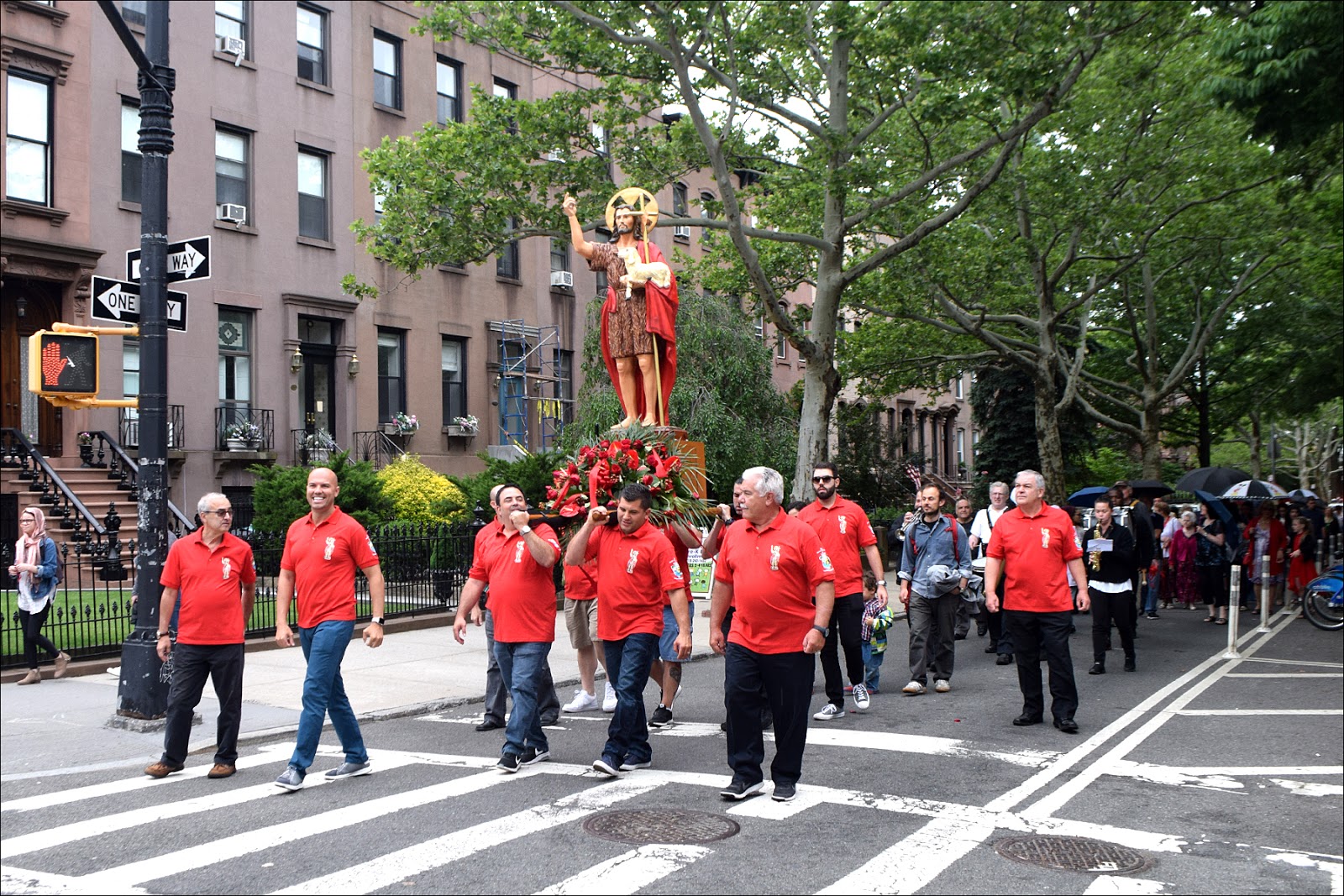
Evviva San Giovanni! A Look at the 3rd Annual Feast of St. John in Carroll Gardens, Brooklyn

St. Stephen's sanctuary is adorned with flowers and streamers for Sunday's Feast of San Giovanni Battista, patron saint of Pozzallo, Sicily 
Arriving early, I made my usual intercessory prayers to the saints
for the happy repose of the souls of my ancestors.
(L-R) La Madonna dell'Arco, Santa Rita and Santa Rosalia
After Mass, the Pozzallesi, who are celebrating their society's 99th Anniversary, carry their beloved patron out of the church
Members of the Society of the Citizens of Pozzallo United take a commemorative photo outside Sacred Hearts — St. Stephen Church (125 Summit St.) 
The color guard proudly led the way
The crucifer and acolytes follow suit 
Celebrant Fr. Salvatore, visiting from Pozzallo, Sicily, was accompanied by Pastor Msr. Guy Massie and dutiful servers
(Above & below) The procession saunters through the neighborhood
The procession comes to a close at the society clubhouse,
located on Citizens of Pozzallo Way, aka Henry St.
 The statue was rested in front of the clubhouse 
Inside, we were treated to an amazing buffet dinner
(Above & below) The clubhouse is decorated with an array of Pozzallese and Sicilian armorial bearings and other heraldic devices 
(Above & below) Partygoers enjoy a festive block party outside the clubhouse 
Revelers trip the light fantastic to musical stylings of Charlie Romo
Photos by New York Scugnizzo

June 13, 2018

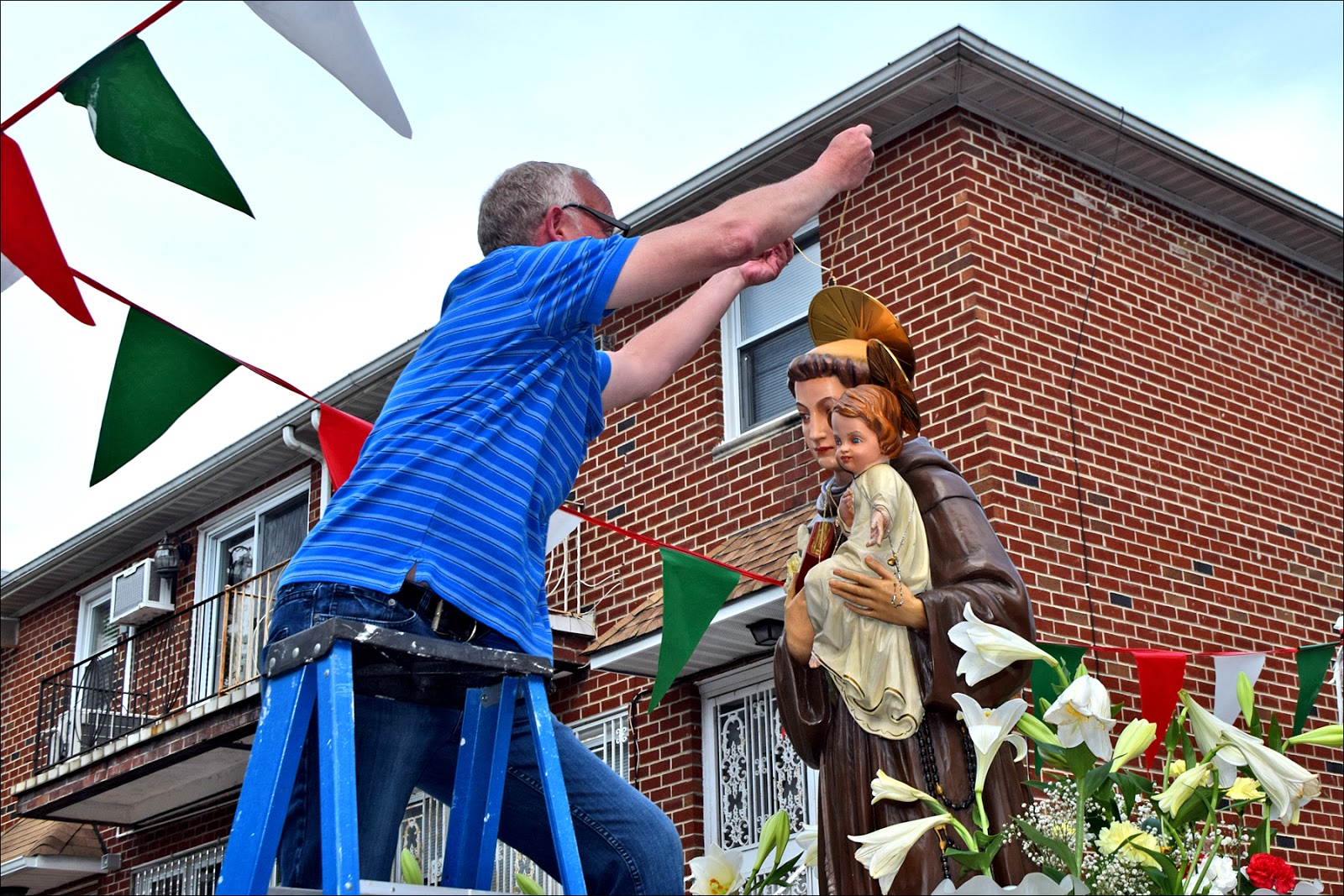
Viva Sant’Antonio! A Look at the 2018 Feast of St. Anthony of Padua in Bath Beach, Brooklyn

Saturday, June 9th: Sant'Antonio stands outside the Grumo Appula Society Clubhouse (8729 20th Ave.) in Bath Beach, Brooklyn 
(Above & below) Stephen LaRocca offers a new gold chain to Sant'Antonio 
"Viva Sant'Antonio!" 
Devotees pin donations on to the ribbons
The color guard lead the procession through the neighborhood
(Above & below) Along the way, volunteers distribute loaves of blessed bread
The procession saunters down Benson Avenue 
Bells toll for Saint Anthony at Saint Finbar Church (138 Bay 20th St.)
(Above & below) The kids happily take part in the tradition 
(Above & below) In the final stretch,
devotees carried the statue back to the clubhouse 
Before Mass, members pose for a commemorative photo
Photos by New York Scugnizzo

June 11, 2018

Photo of the Week: Monument to Torquato Tasso

Statue of the 16th-century poet from Sorrento, best know for his epic poem Gerusalemme liberata (Jerusalem Delivered), Piazza Tasso, Sorrento, Campania  Photo by New York Scugnizzo

June 10, 2018

The Search for our Ancestry (XLVIII)

Translation Hints
By Angelo Coniglio                                                    
Beginning researchers often assume that all Sicilian and Italian records repose with ‘the church’, and ask how churches can be contacted for the records.  But there were and are two separate sets of records generally available: 1) church, or canonical, sacramental records; and 2) civil records of life events.  Perhaps it’s obvious that church records are kept in churches and parish or diocesan archives, but civil records are not. Rather, they are permanently stored in the towns of origin, with duplicates at provincial centers. Church records, some available as early as the 1300’s, record the administration of sacraments: battesime (baptisms), cresime (chrismation or confirmation), matrimoni (marriages), and morti (extreme unction). Civil records, instituted in the early 1800’s, by order of or inspired by Napoleon’s ‘civil code’, give dates and details of nati (births), pubblicazioni or notificazioni (marriage banns of proposed marriages), matrimoni (marriages), cittadinanzi (changes of address), and morti (deaths).
Marriage records show perhaps the greatest differences between church and civil records and their transformation over the decades, as well as insight to church/state politics and their effect on the public. Before the early 1800’s, there were no civil records, since the church held both spiritual and worldly authority. Early church marriage records were written in Latin, as were all records of sacraments. The records were kept in sequential church registers. Each clerk had his own methods, but usually there was an index covering ten to twenty years, before each set of records. These indices would generally be roughly alphabetical by the first letter of the groom’s surname.  But sometimes they were alphabetical by the first letter of the groom’s given name, and you must remember the Latin forms of the names: Aloysius for Luigi, Joseph for Giuseppe, Hieronymus for Giralomo, Philillipus for Filippo, etc.
No marriage ‘certificates’ or ‘licenses’ were given to the participants. Church marriage records gave the date of the marriage and reported the dates of three consecutive feast-day masses at which the proposed marriage had been publicized. Then the title and name of the officiating priest was given, followed by the name of the groom, his father, his mother and whether they were living or dead at the time of the record. Next, the same information for the bride. If either betrothed was previously widowed, that was noted. Normally, the town of the marriage was not specifically mentioned, but rendered as ‘here’ or ‘this land’, unless one of the principals was from another town, which would be listed. The record gave the names of one or two witnesses to the sacrament and stated that the couple pledged their troth and were joined in marriage before the holy church. Although some men might be called ‘Magister’ (Master) or ‘Dominus’ (Don), no ages, occupations, or detailed residences were noted.
When civil record-keeping was started in the early 1800’s, a record that was instituted then, and remained in use until after 1860, was the Atto Della Solenne Promessa di Celebrare il Matrimonio (Record of the Solemn Promise to Celebrate Matrimony), or what we would call a ‘Civil Marriage Contract’.  Though some call this a ‘marriage record’ it is not. These documents, in Italian, are ‘split’ records, where facts about the participants are listed on the left. On the right is a notation that the actual marriage, as reported by the pastor, took place in church on a given date. The date of the ‘Promise’ may be a day or two before the marriage date. The contract was filed in the permanent civil registry of the town (the Anagrafe). The marriage record, as before, was kept by the church and was the official, binding document.
The four-page civil marriage promise used from about 1820 – 1860 has much more detail than the church marriage record. It gives the date of the contract and of the marriage; the name, age, occupation, birthplace and residence of the groom; his parents’ names and status (living or dead); and the same information for the bride. Often the ages of the parents, if living, were also given. In addition to the names of two witnesses to the contract, the record lists all the documents in the Allegati, or ‘attachments’ to the civil matrimonial file, typically: the birth record of the groom and the bride; the death records of parents of the betrothed; death records of any previous spouses of the bride or groom; and copies of the marriage banns. Those records are held in a separate file, but sometimes the list gives actual dates of births, deaths, etc. and names of the principals. The signatures of any attendees at the contract registration who knew how to write (a relatively rare occurrence) are at the bottom of the marriage promise.
Then came the creation of a nation that did not exist before 1860: The Kingdom of Italy, which unified former northern city-states and duchies. It subsumed Sicilian lands and their records, from Abruzzo and Napoli south to Messina and Palermo, while breaking the hold of the church over the administration of law. Church holdings were taken over by the state, and church marriages were no longer recognized as ‘legitimate’. In 1875, this led to new Atti di Matrimonio (Civil Records of Marriage) with no mention of the church, and the requirement that whether they were married in church or not, a couple had to be wed in a civil ceremony for the marriage and any children resulting from it to be legitimate.
Coniglio is the author of the book The Lady of the Wheel, inspired by his Sicilian research. Order the paperback or the Kindle version at http://bit.ly/SicilianStory Coniglio’s web page at http://bit.ly/AFCGen has helpul hints on genealogic research. If you have genealogy questions, or would like him to lecture to your club or group, e-mail him at genealogytips@aol.com

June 9, 2018

Feast of the Madonna Avvocata

Madonna Avvocata, ora pro nobis
The Monday following Pentecost is the Feast of the Madonna Avvocata (Our Lady of the Advocate), one of the so-called "Seven Sisters of Campania,” an appellation given to the region's major Marian devotions under different titles. According to tradition, in 1485 a shepherd named Gabriele Cinnamo was drawn to a cave on top of Mount Falerzio in the Capo d’Orso area of Maiori on the Amalfi Coast. An apparition of the Blessed Mother appeared to Gabriele and instructed him to build a shrine at the location. Gabriele abandoned his life as a shepherd and devoted himself to Our Lady and her request. Over the centuries his modest chapel grew into the magnificent Santuario di Maria Santissima Avvocata, which has become a popular destination for pilgrims and the source of many miracles. In celebration I’m posting a Hail Holy Queen. Evviva Madonna Avvocata!
Hail Holy Queen 
Hail, holy Queen, Mother of mercy: Hail, our life, our sweetness and our hope. To you do we cry, poor banished children of Eve. To you do we send up our sighs, mourning and weeping in this veil of tears. Turn then, most gracious advocate, your eyes of mercy toward us; and after this our exile show unto us the blessed fruit of your womb, Jesus. O clement, O loving, o sweet Virgin Mary.

Celebrating Traditional Latin Mass for the Novena of the Sacred Heart of Jesus in Bay Ridge, Brooklyn

Brooklyn's Visitation Monastery
Photos by New York Scugnizzo
Tuesday evening my friends and I attended a beautiful Sung Mass at Visitation Monastery (8902 Ridge Blvd.) in Bay Ridge, Brooklyn for the Novena of the Sacred Heart of Jesus. Since first offering the Traditional Mass a few months back, attendance at the chapel has been growing steadily, with nearly a hundred faithful filling the pews.
St. Jane Frances de Chantal
Arriving early, we found a seat beneath the stained glass window of St. Jane Frances de Chantal, founder of the Order of the Visitation of Holy Mary. Sitting in quiet prayer, we conducted our Holy Hour of Reparation, which included the Act of Consecration to the Sacred Heart by St. Margaret Mary Alacoque, meditating on the Stations of the Cross, and Eucharistic Adoration.
The Most Holy Sacrifice of the Mass was sung by Celebrant and Homilist Fr. Stephen Saffron, who spoke at length about the devotion to the Sacred Heart and the significance of the Extraordinary Form of the Roman Rite. He was dutifully assisted by several young servers and members of the Schola Cantorum from the Church of the Holy Innocents in Midtown Manhattan.
After Mass, we prayed the novena and Litany of the Sacred Heart of Jesus.
Newly assigned to pastoral service at St. Josaphat Church in Bayside, Queens, we wish Fr. Saffron all the best and much success in his endeavors. It goes without saying, he will be sorely missed at St. Anselm’s in Brooklyn. Knowing how difficult it will be to commute, we pray he will be able to continue the monthly Tridentine Masses at the monastery.
Thank you to the sisters of the Order of the Visitation of Holy Mary for organizing the Mass and warmly welcoming us inside your beautiful chapel and monastery grounds. As always, it was a great joy to celebrate our faith together.

June 6, 2018

A Look at the 2018 Festa di San Calogero in Bensonhurst, Brooklyn

Viva San Calò! The procession kicked off Sunday morning outside the Societá San Calogero di Torretta clubhouse (7520 20th Ave.)
Young boys carry the society banner
(Above & below) The procession wends its way through the neighborhood
We sauntered down bustling 18th Avenue
A good time was had by all
Approaching St. Dominic’s RC Church (2001 Bay Ridge Parkway)
Nearly 200 devotees gathered at the church for Mass
(L) Under renovation, Mass was celebrated in Italian in the church gymnasium
(R) The statue of San Calogero was displayed on the stage behind the altar
According to legend, the deer sent by God to help support the elderly hermit was slain by a huntsman named Siero. Mournful of his mistake, Siero became a disciple of the saint and assisted him until his death 
After Mass, members of the society took a commemorative photo
From the church, the procession makes its way back to the clubhouse
(Above & below) Revelers enjoyed a terrific barbecue with all the fixins
Photos by New York Scugnizzo